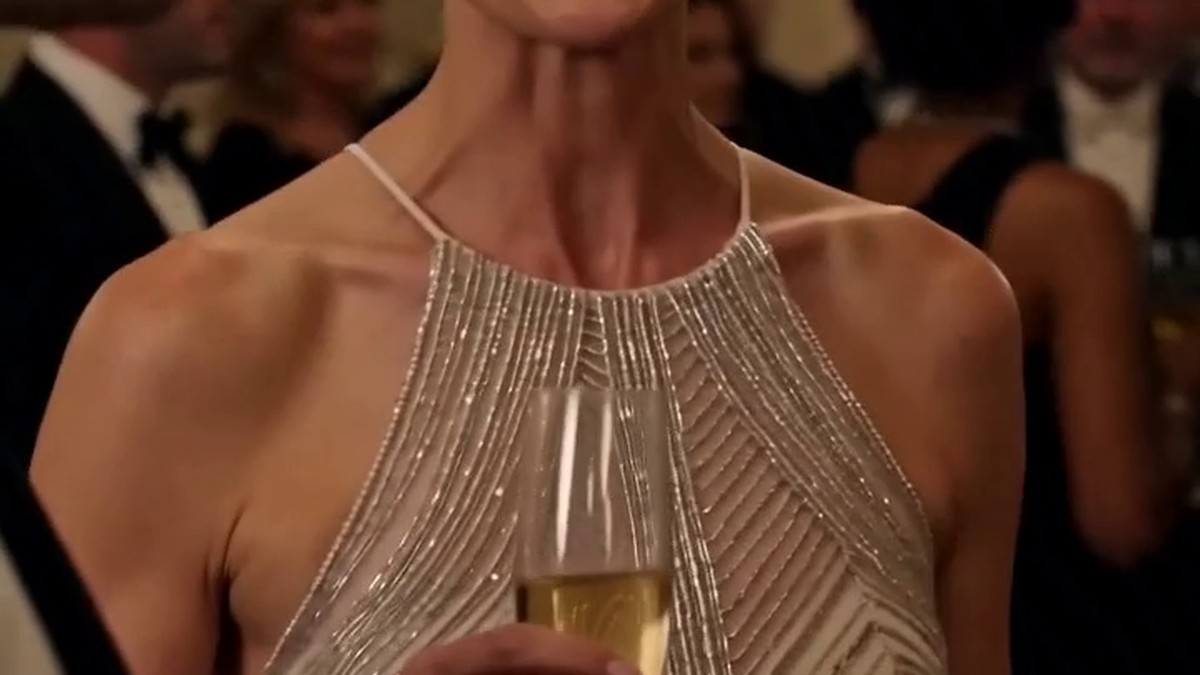
“Eight months,” Clara said. “This agency. I had no idea it was your foundation’s gala until I walked through that door tonight.”
“Eight months in this city and you never once—”
“I tried for two years.” Her voice split open on the last word. “I called. I wrote letters. Every single one came back unopened. Every number I had went dead.”
Marcus’s jaw locked. “I never received anything.”
“Somebody did,” Clara said. She wasn’t looking at him anymore. She was looking past him — toward the head table, toward the candlelight and the crystal and the careful architecture of a life built to keep her out. “Somebody worked very hard to make sure you didn’t.”
Behind them, Vanessa’s voice cut through — high and brittle and just slightly too fast.
“This is absurd. I have never intercepted anything—”
“The moving boxes,” Clara said. She turned to face her directly. First time all night. “Your assistant signed for them two years ago. How do you explain that?”
The colour drained from Vanessa’s face like something had been pulled from beneath it.
Marcus turned toward his wife. Slowly. The way a man moves when the answer is already sitting in his chest and all he needs is to hear it spoken aloud so it becomes real.
“Vanessa,” he said. Quiet. Just her name — but loaded like a question that had been waiting years to be asked.
“How did you know about the moving boxes?”
The silence that followed was the kind that has weight.
Vanessa’s mouth opened. Closed. Her fingers found the stem of her champagne flute and gripped it until her knuckles went white — a woman reaching for anything solid.
“I don’t know what she’s been telling you—”
“I haven’t told him anything yet,” Clara said. “You just confirmed it.”
The ballroom hummed around them. Silverware against china. A string quartet sawing through something Viennese. Two hundred guests in black tie, completely unaware that the entire architecture of a marriage was cracking down the middle ten feet from the dessert station.
Marcus didn’t move. He stood with his hands at his sides and his face very still, the way Clara remembered he used to go still when something hit him too hard to absorb all at once. She’d always thought it looked like grief in rehearsal.
“Tell me,” he said. Not to Clara. To Vanessa.
“Marcus, this woman walked in off the street tonight and you’re just going to—”
“Tell me.”
It came out quiet, and that was worse than shouting.
Vanessa set down the champagne flute. She straightened her shoulders. Something shifted in her expression — the performance of composure so practised it had almost become real.
“I protected you,” she said. “That’s what I did. I protected this family.”
“From what?” Marcus said. “From her?”
“From a distraction. From someone who was going to pull you backward when you finally had a chance to move forward.” Her voice found its footing now, climbing toward something like conviction. “You were rebuilding. After everything — after the collapse, the lawsuits, the years it took to get back to something solid — you were finally building something real. I was not going to let some ghost from your past walk back in and—”
“She’s not a ghost,” Marcus said. “She’s my daughter.”
The word landed in the room like a stone dropped into still water.
Vanessa’s composure didn’t shatter. It didn’t collapse dramatically. It just — thinned. Like ice losing its opacity, turning clear and fragile before the break.
“You knew,” Clara said. She hadn’t meant to say it out loud. It came from somewhere lower than thought.
“I knew,” Marcus confirmed. His eyes stayed on Vanessa. “I’ve known since last year. The investigator I hired found the returned letters. Found the signed receipt on the moving boxes. Found everything.” A pause that stretched like wire pulled taut. “I’ve been waiting for her to tell me herself.”
Vanessa made a sound that was almost a laugh. “An investigator.”
“You taught me to protect what matters,” he said. “I learned from the best.”
“Marcus—”
“How many?” Clara heard herself ask. Her voice came from very far away. “How many letters?”
Nobody answered. She already knew. Forty-one. She’d written forty-one letters over two years. She remembered the exact number because she’d counted them the night she finally stopped — sat on the floor of her apartment with the box of unsent drafts and the returned originals and counted them like a penance.
Forty-one letters. And his wife had held every single one.
The string quartet shifted into something slower. The candles breathed.
“You have to understand,” Vanessa said — but she was looking at Marcus now, not Clara, and the word *you* was doing a lot of work. “She’d already been gone for years. You’d grieved it. You’d moved past it. I watched you do it. I was there—”
“You were there because you made sure there was nowhere else for me to look,” Marcus said.
“That’s not—”
“The phone numbers?” Clara asked.
A beat. Then: “The service plans were in my name.”
Clara nodded slowly. She felt strange. Not the rage she’d carried for two years — this was something different. Something almost quiet, which frightened her more.
“I want to ask you something,” she said to Vanessa. She was surprised by how level her own voice was. “Did you ever read them?”
Vanessa blinked. “What?”
“The letters. Did you ever read them, or did you just — file them away somewhere and never think about it?”
Something moved across Vanessa’s face. Complicated and fast, like weather.
“I read the first one,” she said, finally. Quietly.
“Then you knew what you were burying.”
No answer. Which was its own answer.
Marcus turned to look at Clara. Fully — the way he’d been careful not to all night, as though direct eye contact were a current he wasn’t sure he could take.
She let herself look back. It had been eleven years. He was older — the way all of us get older, a slow accumulation of weather — but the line of his jaw was the same. The way he held his shoulders. The particular stillness.
She thought about the twenty-three-year-old woman who had written him the first letter. The one who had believed, genuinely, that if she could just get the words right — if she could just find the right combination of honest and careful and brave — the silence would break. That the silence was a mistake rather than a wall.
It had been a wall. Just built by different hands than she’d thought.
“I’m not here to burn anything down,” Clara said. She looked at both of them — at Marcus, at Vanessa, at the careful glittering world they’d constructed. “I want you to know that. I didn’t come here tonight to do that.”
“You came to work an event,” Marcus said. Something in his voice had shifted. Softer. “You had no idea.”
“No idea,” she confirmed. “But I’m here now.”
He nodded. Once. Slow.
“So am I.”
—
The gala ended at midnight.
Clara stood outside on the stone steps, the city spreading below her in its ordinary blazing way — indifferent and magnificent and completely unaware that her life had just rearranged itself. She’d retrieved her coat from the cloakroom and signed out with the agency coordinator and done all the normal procedural things a person does when the event is over and it’s time to go home.
She heard the door open behind her.
“Clara.”
She turned. Marcus stood at the top of the steps, his jacket still buttoned, the pocket square still perfect. But something in his bearing had changed — some fundamental tension released, like a cable cut.
“I have the letters,” he said. “The investigator recovered copies. I’ve had them for eight months.”
Eight months. The same amount of time she’d been working events in this city.
“Did you read them?” she asked.
“Every one. Several times.” A pause. “You write the way you used to talk. Like everything matters.”
She didn’t know what to do with that. She put it somewhere careful.
“What happens now?” she asked.
He came down two steps. Stopped. The city roared softly beneath them, traffic and wind and all that ordinary sound.
“I don’t know,” he said. “I think we figure it out slowly. Carefully.” His eyes stayed on her face. “If you want to.”
Clara breathed in the cold night air. She thought about forty-one letters. She thought about two years of silence and eight months of a city neither of them had known they were sharing. She thought about all the time that gets taken from you and cannot be recovered — only accounted for, only carried, only eventually set down.
“Slowly,” she said. “And carefully.”
He nodded.
Below them, taxis moved through yellow light. Somewhere distant a horn sounded and dissolved. The night held them both in it — not resolved exactly, not finished, but open in a way that things had not been open for a very long time.
She pulled her coat tighter.
He stayed where he was.
Neither of them left.