Every pew filled. Every breath held. The guests waited for the priest to speak the words that would bind Daniel and Valeria together — forever.
Everything was exactly as it should be.
Until the heavy doors at the back of the church swung open.
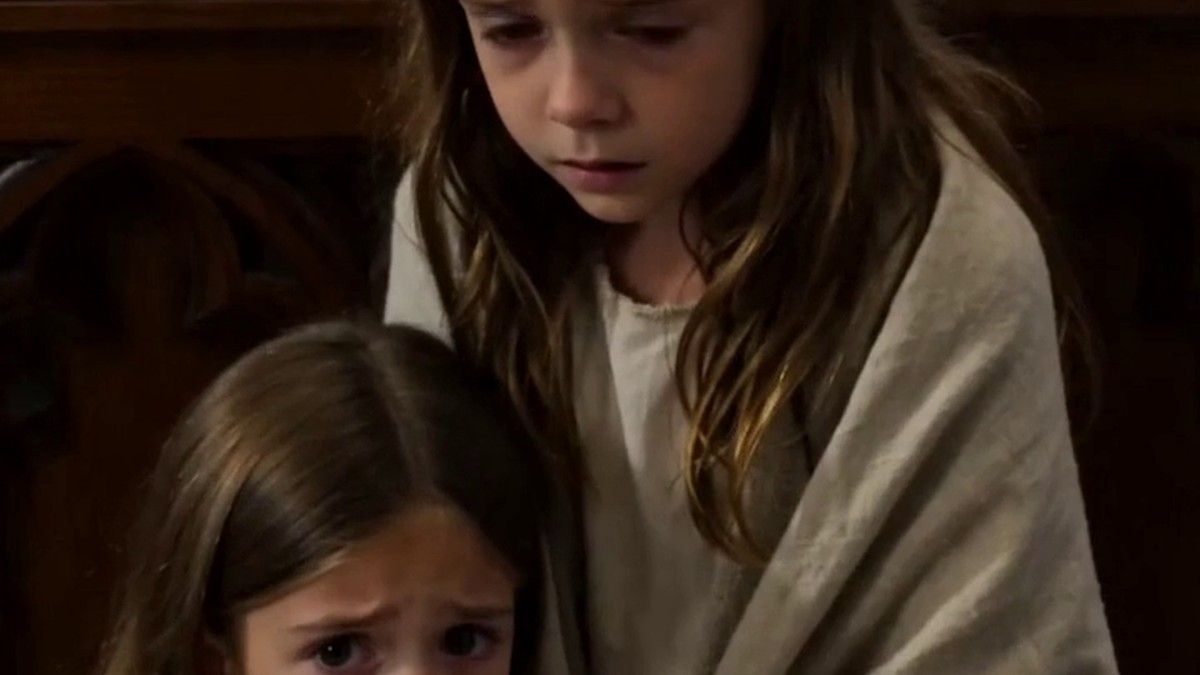
Two little girls walked in, hand in hand. Their clothes were worn thin. Their hair tangled. Their faces streaked with dried tears.
A ripple of whispers spread through the crowd.
Valeria’s eyes narrowed.
She stepped down from the altar — fast, sharp, her heels striking the stone floor.
— Who let these disgusting little strays in here? Get them out. Right now.
The girls pulled each other close, trembling.
And then something happened that no one saw coming.
The ring slipped from Daniel’s fingers.
It hit the floor with a small, cold sound.
His eyes went glassy. His throat worked.
He took one step toward them. Then another.
When he finally spoke, his voice was barely there.
— …Sofía.
The older girl raised her head slowly.
The moment she saw his face, she broke apart.
— Daddy…
The entire church went silent. Not quiet — *silent.* The kind that presses down on your chest.
Valeria felt the blood drain from her face.
— What… what did she just say?
Daniel crossed the aisle in four steps and pulled both girls into his arms. He held them like a man who’d been drowning for years and had just found the surface.
He couldn’t stop crying.
— I never stopped looking for you. Never.
The younger girl buried her face in his jacket.
— We looked for you too, Daddy. For so long.
Valeria stumbled back.
— This has to be some kind of joke.
Daniel looked at her over his daughters’ heads. His eyes were red. His voice was steady.
— They’re not a joke. They’re my daughters.
The whispers turned into something louder now. Shock. Confusion. Someone gasped.
Valeria’s hands were shaking.
— You told me you didn’t have children.
Daniel closed his eyes for a moment.
— Five years ago there was a fire. They disappeared. Everyone told me they were gone. I never believed it. I never stopped searching.
The doors opened again.
A social worker walked in alongside two police officers. She stepped forward and addressed the room.
— The girls were found several days ago at a shelter. For years they were separated after being victimized by a child trafficking network. A DNA match led us to their father.
Daniel pressed his daughters closer.
He couldn’t speak. He just held them.
Valeria stood alone near the altar, watching.
Slowly, in the quiet of that moment, she understood.
The man she was about to marry was no longer standing at an altar. He wasn’t thinking about vows or rings or forever. He was looking at the two small faces he had spent five years mourning.
Daniel took Sofía’s hand in his. He looked up at the priest.
— I’m sorry. I can’t get married today.
Then he turned to the crowd — all of them, every face staring back at him.
— The most important day of my life was never going to be a wedding.
He looked down at his girls.
— It’s this one.
For the first time since they’d walked through those doors, both girls smiled.
The three of them walked out together — down the aisle, through the open doors, into the light.
And the guests rose to their feet. The applause started slowly, then filled every corner of that church, echoing off the stone walls and the vaulted ceiling.
Because that day, the real miracle didn’t happen at the altar.
It happened the moment a father put his arms around the two people he loved most in the world — and refused to let go.
The applause was still echoing when Valeria’s composure finally shattered.
She stood at the altar alone, bouquet hanging from one hand, veil slightly askew. The guests were on their feet — but not for her. They were clapping for him. For those two ragged girls. For a reunion she hadn’t been invited to.
Something hot and ugly moved through her chest.
She walked down the aisle fast, her heels cracking against the stone, and pushed through the church doors into the white September light.
Daniel was there — kneeling on the steps, both girls wrapped in his arms, the social worker standing to the side with her hand pressed to her mouth.
— Daniel.
Her voice came out harder than she intended.
He looked up.
— Daniel, we need to talk. Right now.
He didn’t stand. He stayed exactly where he was, one arm around each daughter, his eyes meeting hers with an expression she hadn’t seen on his face before. Not anger. Not guilt.
Just clarity.
— We will. Later.
— *Later?*
— Valeria.
Her name in his mouth — quiet, measured, like a door being gently closed.
— These are my children. Nothing comes before them. Not today. Not ever.
The younger girl — she couldn’t have been more than seven — peeked out from behind Daniel’s arm and looked at Valeria with wide, wary eyes. The kind of eyes that had seen too much and learned not to trust too fast.
Valeria opened her mouth. Closed it.
She turned and walked back inside.
—
The guests were already filtering out when she found her mother near the second pew, gathering their things.
— Mamá.
Her mother looked at her carefully.
— Come. Let’s go home.
— He humiliated me.
Her mother was quiet for a moment.
— He found his daughters, Valeria.
— He *lied* to me. He told me he had no children. Five years I was with this man —
— He lost them in a fire. He thought they were dead.
— He should have told me. He should have *said something* —
— And then what? Her mother’s voice was soft but direct. *You would have stayed?*
The question landed in a place Valeria hadn’t expected.
She thought about it.
She thought about the way her face had gone hard the moment those girls walked through the doors. *Disgusting little strays.* The words had come out so quickly. So naturally.
She thought about Daniel’s face when he’d heard his daughter say *Daddy.*
She thought about the fact that in the five years they had been together, whenever Daniel got quiet and distant — whenever he stared out a window for too long — she had always assumed he was thinking about work. She had never asked. She hadn’t wanted to know.
She sat down in the empty pew.
Her bouquet dropped to the floor.
She didn’t pick it up.
—
Outside, the detective assigned to the case — a broad-shouldered woman named Reyes — had pulled Daniel aside while the girls sat on the church steps with cups of water and a kind officer named Marco who was letting them pet his police dog.
— We need to go over everything when you’re ready, — Reyes said. — What we know about the network is significant. Three cities. Dozens of children. Your daughters — Sofía and the younger one, Ana — they were moved twice in three years. We only got the DNA match last week.
Daniel’s jaw was tight.
— Who had them?
— We’re still building the case. I can’t give you names yet. But I can tell you this — Reyes met his eyes — the people responsible are in custody. All of them. This is over.
He looked back at his daughters.
Sofía had one hand on the police dog. Her face was still pale, still guarded — the face of a child who had learned to expect the worst. But there was something else in it now. Something fragile and new.
She was watching her father.
Making sure he was still there.
Still real.
Daniel excused himself from Reyes and walked back to the steps. He sat down between his daughters. Sofía leaned into him immediately, like a plant leaning toward light. Ana climbed straight into his lap, shoes and all, and tucked her head under his chin.
— Are we going home now? — Ana asked.
He pressed a kiss to the top of her head.
— We’re going home.
— Do you have a dog?
He laughed — the kind of laugh that’s made of tears as much as anything else.
— Not yet.
— Can we get one?
— Yes.
— Can *I* name it?
— You can name it whatever you want.
Ana considered this with the gravity of a scientist conducting her most important experiment.
— Potato, — she announced.
Sofía looked up at her sister, then at her father, and the corner of her mouth moved — small and slow — into something that was almost a smile.
It was the first real smile she’d managed all day.
Daniel held both of them and didn’t let go.
—
Three weeks later, Daniel sat across from Valeria in a quiet café near her apartment.
She had called. He had come.
She looked different — not only in the way people look after being publicly left at the altar, though that too, but in a deeper way. Something behind her eyes had shifted.
— I said something unforgivable to your daughters the moment I saw them, — she said. She didn’t look away. — They were frightened and alone and I called them strays. They were *children.*
Daniel wrapped his hands around his coffee cup.
— Yes.
— I’ve thought about that every single day since.
He said nothing.
— I’m not asking for anything, — she said quickly. — I know it’s over. I know I can’t — — she stopped. Pressed her lips together. Started again. — I just needed you to know that I heard myself say it. And I didn’t recognize the person it came from. And I need to understand why those words came so easily.
Silence stretched between them.
Then Daniel said:
— They don’t know your name. They don’t know you existed. As far as they’re concerned, that day at the church was just the day they found me.
Valeria nodded.
— That’s as it should be.
He stood. Left money on the table for both coffees.
At the door, he paused.
— I should have told you about the fire. I kept it locked up because I couldn’t — — his voice caught briefly — — I couldn’t say it out loud without it feeling like giving up. That was a failure. Mine.
Valeria looked at him across the small café. Looked at him the way you look at something you’re seeing clearly for the very first time, when it’s already too late to do anything about it.
— Goodbye, Daniel.
— Goodbye.
He walked out into the street.
Into the October morning.
Into the rest of his life.
—
The apartment Daniel had kept for five years — the one where he’d poured two cups of coffee every morning for one person, where the second bedroom had stayed locked, where a single photograph of two little girls lived face-down in a desk drawer because he couldn’t look at it and couldn’t throw it away — that apartment smelled different now.
Like shampoo and cereal and the particular chaos of two children relearning how to take up space.
Sofía’s drawings were taped to the kitchen wall. Ana’s shoes were always in the wrong place. Someone had written *POTATO* in crayon on the inside of the bathroom cabinet, apparently in preparation.
Daniel stood in the doorway of their room some nights and just watched them sleep.
The nightmares came — for all three of them. Some nights Sofía woke up crying and he’d sit with her until it passed, her hand in his, neither of them needing to speak. Some nights he was the one who woke in the dark, heart slamming, absolutely certain that when he walked down the hall their beds would be empty again.
They never were.
Slowly, the certainty of that began to settle into his bones.
They were home.
*They were home.*
Six months after the wedding that never happened, a trial date was set. The network that had taken his daughters — that had taken *dozens* of children — began to come apart in a courtroom two cities away. Daniel testified. So, eventually, did Sofía, in a closed session with a child advocate at her side, her voice flat and precise as she described things no child should ever know.
She held his hand before she went in.
She held it after she came out.
— Done? — he asked.
— Done, — she said.
They got ice cream on the way home.
Ana dropped hers on the sidewalk within thirty seconds, stared at it lying there on the pavement, and looked up at her father with absolute devastation.
He bought her another one.
And another when she dropped that one too.
*Potato* the dog — a chaotic tan mutt from the shelter, too large for the apartment and too beloved to do anything about it — was waiting at the door when they got back. Tail going like a propeller. Nails scrabbling on the hardwood.
Ana threw herself at the dog.
Sofía leaned against Daniel’s arm.
— Dad?
— Yeah?
— I don’t think about it all the time anymore, — she said quietly. — The bad stuff. I thought I always would. But I don’t.
He looked down at her.
At the top of her head — the same dark hair she’d had at six years old, a little longer now, a little less tangled.
— Good. — And then, because he needed her to actually hear it: — That’s exactly how it’s supposed to go.
Sofía nodded.
Pushed off his arm.
Went to go fight her sister for control of the dog.
Daniel stood in the hallway of his apartment — *their* apartment — and listened to the noise of it. The shouting and the laughing and Potato’s ridiculous bark and the thud of small feet on the floor.
Five years of silence.
And now this.
He pressed one hand flat against the wall, just to feel something solid. Just to make sure he was standing in a real place, in a real life, that was actually and permanently his.
Outside, the city moved and breathed and went about its business, indifferent as cities always are.
But inside that apartment on a Tuesday evening in March, a father listened to his daughters argue over a dog named Potato.
And that was everything.
That was the whole world.