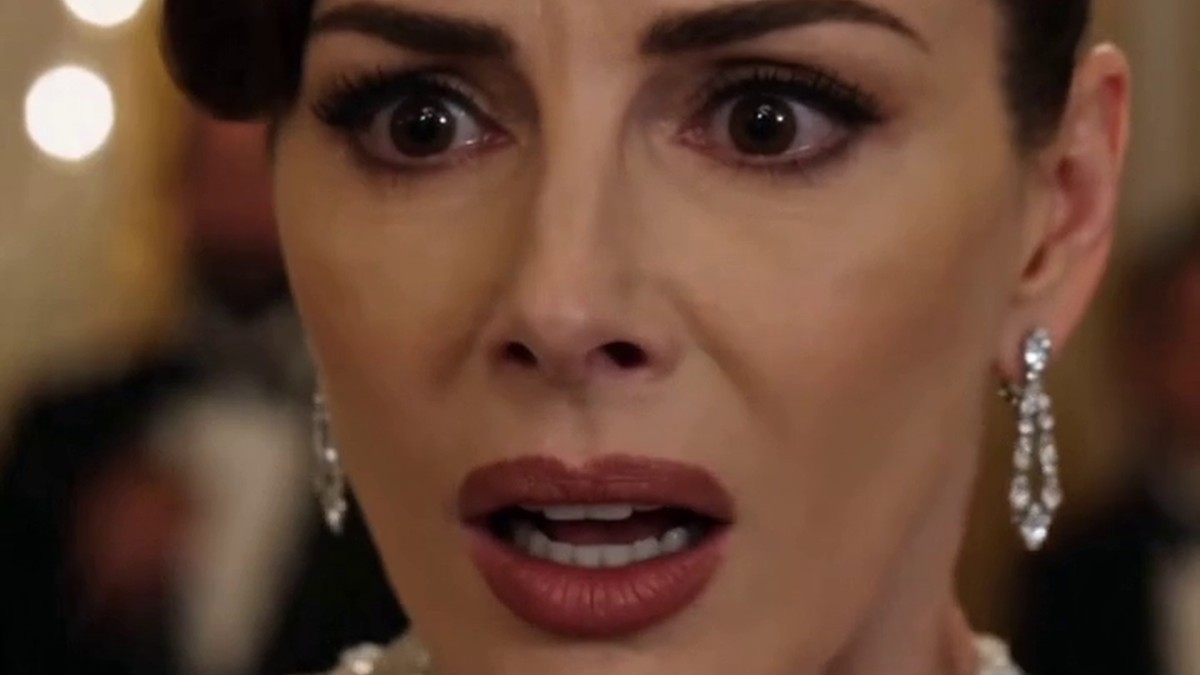
Lucia moved through it quietly.
Black uniform, steady hands, a smile that gave nothing away. She refilled glasses, cleared plates, stayed invisible. That was the job. She was good at it.
Then a woman in a silver dress slammed her palm against the table.
“You.” Her voice cut across the ambient noise. “Get over here. Now.”
Lucia crossed the floor without rushing.
“How can I help you, ma’am?”
The woman looked her up and down the way you’d inspect something you’d stepped in.
“Who authorized someone like you to serve my table?” She turned to no one in particular. “Have her removed.”
Heads began to turn. Conversations faltered.
Lucia said nothing.
That silence seemed to enrage the woman more than any response could have. She snatched a champagne flute from the nearest tray and flung it into a tower of crystal glasses arranged nearby. The whole structure came down in an explosion of shattering sound.
“Learn to apologize when you ruin someone’s evening!”
The ballroom went dead still.
Every eye in the room was on the young waitress. They were waiting — for the flinch, for the tears, for the collapse.
Lucia drew a slow breath.
Then she lifted her eyes.
“Do you… really not remember me?”
The woman’s brow tightened. “I have never seen your face in my life.”
Lucia reached up to her collar. A small silver locket hung there — old, worn smooth at the edges, the kind of thing that had been held ten thousand times. She opened it with one thumb.
Inside was a photograph. Faded. Creased.
The woman stepped back.
Something moved across her face — color draining, expression unraveling.
“That locket…”
“Yes,” Lucia said quietly. “The same one that disappeared twenty years ago.”
The woman’s hands began to shake.
“That’s… that’s not possible…”
Lucia didn’t look away.
“I remember everything.”
She remembered the fire. The smoke filling the hallway before the flames did. The screaming that seemed to come from inside the walls. She remembered being left behind while everyone ran — and she remembered who pulled the door shut.
Who left her on the other side of it.
Tears broke down the woman’s face now, streaking through the carefully applied perfection.
“I thought you were dead…”
Lucia closed the locket.
“I wasn’t.” Her voice was even. Quiet. Absolute. “I survived. And I never forgot.”
The guests watched in silence, understanding nothing and feeling everything.
Then, from the far end of the room, an older man stopped walking. He had just stepped through the entrance. He stared at the locket the way a man stares at something he buried.
He pressed a hand over his mouth.
“That’s my daughter’s.” His voice broke on the last word. “That’s my missing daughter’s locket.”
Lucia turned slowly toward him.
The space between them collapsed.
Both of them — eyes flooding, breath gone.
Across the room, the woman in silver was backing away, one step at a time, as if she could still outrun it. But she knew. She’d always known this moment existed somewhere in her future, waiting with infinite patience.
The past she had sealed away for two decades had just walked back through the door in a black uniform.
And this time, there was nowhere left to go.
Everyone was about to learn the truth.
The old man’s name was Harlan Voss.
Lucia knew it before he said a word. She had spent twenty years learning it — repeating it in the dark the way other children repeated prayers.
He crossed the ballroom with the stiff urgency of a man whose knees had forgotten how to run. The crowd parted for him. He was the kind of man crowds always parted for — broad shoulders still carrying the architecture of old money, white hair swept back with authority, a face that had been photographed at enough ribbon cuttings that strangers felt they already knew him.
He didn’t look like a man who had lost anything.
That was the first wound.
“Give me that,” he said, reaching for the locket.
Lucia closed her fingers around it.
“No.”
The word stopped him two feet away. He wasn’t used to the word. That was obvious.
His jaw worked. His eyes — pale gray, winter-morning gray — moved over her face the way you read a document you’re not sure you’re interpreting correctly.
“Where did you get it?” he said. His voice had dropped. The question was for her alone now, even though the room was so quiet you could hear the ice melting in the water glasses.
“From my mother,” Lucia said. “The night she died.”
The silence deepened.
Harlan Voss put one hand on the back of a chair. Not to pull it out. To hold himself up.
“That’s not possible.” The words came out hollow. Rehearsed. The words of a man who had said them to himself so many times they’d lost all meaning. “Elena died in the fire. They found — there were remains—”
“There were remains,” a voice said from across the room.
The woman in silver.
She hadn’t run far enough. She stood near the exit, one hand pressed flat against the wall, and when they looked at her she didn’t look away. Something in her had given up trying. You could see it in the way her shoulders had dropped, the way her chin had lifted — not with defiance, but with the exhausted posture of someone who had been waiting for the sentence to be read aloud.
“There were remains,” she said again, louder. “Because I made sure there were.”
The room inhaled.
Harlan Voss turned very slowly toward her.
“Margaux.”
She laughed once — a short, broken sound that had nothing to do with humor. “Don’t say my name like that. Like I owe you something.”
“You told me my daughter died.” His voice was barely controlled. “You were there. You told me you tried to get her out.”
“I was there,” Margaux said. “I did try. For about ten seconds.” She looked at Lucia. Really looked at her — for the first time, without contempt, without theater. Just looked. “You were so small,” she said softly, as if that explained anything. As if that explained everything.
Lucia felt something move through her chest. Not forgiveness. Something older than forgiveness. Something that had been waiting longer.
“Tell him,” Lucia said.
Margaux pulled in a breath.
“Tell him what you told me, right before you closed the door.”
—
It came out in pieces. Not the neat confession of someone who had rehearsed it, but the ragged, uneven unburdening of a woman who had carried weight so long she’d forgotten what it felt like to stand straight.
Margaux and Elena Voss had grown up together in the same wealthy neighborhood, same schools, same social orbit. Friends — the kind of friends made from proximity and boredom. When Elena married Harlan Voss and became something luminous and unreachable, Margaux had stayed in the penumbra. Always the second woman in the photograph. Always the name people forgot.
The night of the fire, Margaux had been at the Voss estate. She and Elena had argued — about money, about a business deal Margaux had needed Harlan to support, about the quiet, grinding resentment of a woman who had spent her best years watching someone else live the life she felt she deserved. Elena had threatened to tell Harlan everything. About the debts. About the scheme. About all of it.
The fire started in the library. An accident. Truly an accident — Lucia had verified this in court records years later, a toppled lamp, old curtains, a house built with too much wood and too little mercy.
But in the chaos, as smoke thickened the corridor and the screaming started, Margaux had found Elena’s daughter first. A small girl in a nightgown, separated from her nanny, clutching the silver locket her mother had given her that morning.
And Margaux had made a calculation.
It took less than three seconds.
She had led the girl to the east wing — away from the exits, not toward them — and told her to wait. *Mama is coming. Stay here and wait.* Then she had walked back through the smoke and let the door fall shut behind her.
Elena died in the fire.
With Elena gone, with the child gone, there was no witness. No threat.
There were remains. Margaux had made sure of that part, too — a whispered word to a coroner who owed her a favor, paperwork that closed the case before questions could root themselves.
Harlan Voss buried an empty casket.
Margaux inherited the business partnership by default, stepped into the grief-softened circle of Harlan’s trust, and built herself a life on the foundation of what she had done.
—
The child had survived because of a kitchen worker named Rosario, who had gone back into the building for no reason she could explain except that she heard something, a sound like a voice, maybe a child’s voice, maybe just wind, but she went back anyway, and she came out carrying a small girl in a white nightgown, unconscious from the smoke, a silver locket clutched in one fist.
The girl had no identification. No documentation. No memory for three days.
By the time she woke and said her name, the death certificate was already filed.
Rosario kept her. Because what else do you do with a child the world has decided is dead?
She named her Lucia, which means *light*, which was the word Rosario had thought of when she carried that unconscious child out of the burning dark.
Lucia grew up in small apartments and borrowed beds and restaurant kitchens. She grew up watching Rosario work herself to the bone and never complain. She grew up wearing the locket her first mother had clasped around her neck on what turned out to be their last morning, and she grew up memorizing the face in the photograph inside it — a young woman, laughing, blurry with motion, caught in a moment of pure unselfconscious joy.
She had spent twenty years learning who that woman was.
She had spent the last three getting herself hired at every high-end venue in the city until she found the people who needed finding.
Tonight had not been an accident.
—
When Margaux finished speaking, the ballroom was so quiet Lucia could hear her own heartbeat.
Harlan Voss had not moved. He stood with one hand still resting on the back of that chair, and he was looking at Lucia with an expression she had no category for — it wasn’t grief exactly, or relief exactly, or love exactly, though it contained pieces of all three. It was the face of a man seeing something he had told himself not to hope for so many times that hope had become a kind of wound.
“Elena.” His voice cracked. “Her eyes.”
Lucia looked back at him.
She had prepared for this moment in a hundred different ways over the years. She had imagined rage and she had imagined tears and she had imagined herself cold and composed and untouchable. She had not imagined this — the way his eyes moved over her face like he was memorizing it, like he was learning it, like he was twenty years late to the most important meeting of his life and he knew it.
“She talked about you,” Lucia said. “In the photograph. She’s laughing. I used to study it and try to figure out what you must have said to make her laugh like that.”
Harlan Voss sat down. He just — sat down, right there, without pulling the chair out properly, half-falling into it, one hand covering his mouth.
His shoulders shook.
Lucia had never seen a man like him cry. She suspected very few people had.
She crossed the distance between them and stood close enough that he could reach her, and after a moment he did — one large hand wrapping around her forearm, not grabbing, just holding, the way you hold something you thought you had lost forever and now don’t quite trust is real.
From somewhere behind her came the sound of movement.
Security had arrived. Two men in dark suits, followed by a woman with a hotel badge and a look of controlled alarm. Behind them, someone else — a man in a gray jacket who had been sitting near the entrance all evening and who now showed a badge he had been waiting to show.
Detective Raines.
Lucia had made a phone call before her shift began.
She had told him: *Come to the Imperial. Come before midnight. Bring the file.*
He had asked her what file.
She had said: *The Voss fire. 2004. You’ll know which one.*
—
Margaux did not run.
This was the thing Lucia would think about afterward — that Margaux didn’t run, didn’t fight, didn’t reach for her phone to call a lawyer or throw money at the problem the way people like her usually did. She stood near the wall where she had stopped, and she watched the detective approach, and something in her face had the quality of a woman finally putting down a very heavy suitcase.
“Margaux Delaine?” The detective’s voice was businesslike but not unkind.
“Yes.” She said it clearly.
“I need you to come with me.”
She straightened the hem of her silver dress. An absurd gesture — meticulous and human and somehow unbearably sad. She looked once more across the room at Lucia.
“You were supposed to stay in that room,” she said. Not an accusation. Something more like wonder. “I told you to wait.”
“I know,” Lucia said.
“But you didn’t.”
“No.” Lucia looked at her steadily. “I never did.”
Margaux nodded once, as if that was the answer she had always known was coming. Then she walked with the detective toward the door, through the crowd that moved aside in absolute silence, and disappeared into the bright corridor beyond.
—
The champagne had gone warm.
The chandeliers still burned overhead, indifferent and magnificent.
Slowly, carefully, the way the world always does after something real has happened inside it, the room began to breathe again. Conversations restarted in low murmurs. A waiter appeared with a dustpan for the broken crystal. The ambient noise of money and influence reassembled itself around the edges of the moment like water closing over a stone.
But at a table in the center of the room, Harlan Voss sat beside a young woman in a black uniform, both of them with their hands wrapped around cups of coffee someone had quietly brought, and neither of them spoke for a long time.
The locket lay on the table between them.
Open.
Elena’s blurry, laughing face looked up at the chandeliers.
“She was afraid of hotels,” Harlan said finally. “She said they smelled like other people’s loneliness.” He looked at the photograph. “She would have hated tonight. All these people performing for each other.” A pause. “She would have liked you.”
Lucia said nothing. She was still learning how to occupy this moment, how much of herself to let it be real.
“I have a house,” Harlan said. “It’s too big. It has been too big for twenty years.” He said it to the photograph, not to her. “No one is obligated to—I’m not trying to—” He stopped. Started again. “I’m trying to say that if you wanted to, there would be room.”
Lucia looked down at the locket.
She thought about Rosario’s apartment, the kitchen smell, the way Rosario used to say *buenos días, mija* in a voice rough with early mornings. She thought about twenty years of small rooms and borrowed beds and the particular loneliness of growing up knowing you belonged somewhere you had never been allowed to go.
She thought about how long she had been angry.
She was surprised to find, sitting here now in the wreckage of the evening she had planned so carefully, that the anger had weight to it — real, solid weight — but that she could set it down for a moment. Not let go of it. Just set it down.
“I’d want to bring a photograph of my mother,” she said. “The woman who raised me.”
Harlan Voss looked at her for a moment. “Of course.”
“She died four years ago. But I’d want her in the house.”
“Yes,” he said, and meant it.
Lucia picked up the locket and closed it, the small silver clasp clicking shut with the sound of a door closing gently on something that had been open too long.
Outside the tall windows, the city burned with its ordinary lights — all those lives going on, all those ordinary griefs and ordinary mercies moving through the dark. Somewhere in a precinct downtown, a woman in a silver dress was answering questions she should have answered two decades ago. Somewhere a cold case file was being pulled from a drawer.
And here, in the Imperial Hotel, under the suspended constellations of its chandeliers, a daughter sat beside a father who had buried an empty casket, and they drank bad coffee, and they were quiet together for the first time.
It wasn’t joy, exactly.
It was something harder and more permanent than joy.
It was the particular grace of a thing undone — of a door, finally, opened from the other side.