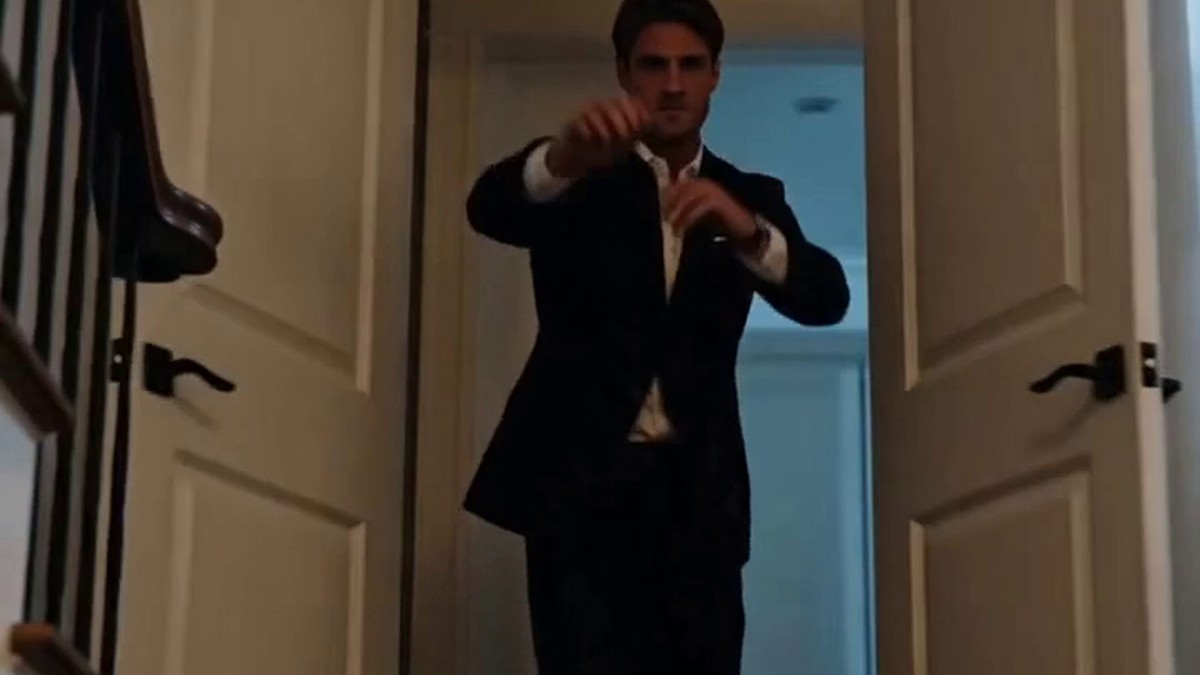
The deal was done. Signed, sealed — the kind of victory that comes only once in a career. He was thirty-something, sharp-eyed, built by ambition — and tonight, for the first time in years, he let himself feel it. Flowers tucked under one arm, a cake box in the other, he pushed open the front door of his villa and called out his wife’s name like a man who believed the world owed him nothing but good things from here on out.
He was wrong.
The hallway gave him not his wife — but his son. Four years old, drowsy, still wrapped in his pyjamas, blinking up at his father with the kind of pure, unguarded eyes that don’t yet know what secrets are for.
“Daddy,” the boy said, his voice soft with half-sleep. “Carlos is here. He’s upstairs.”
One name. Four letters. And just like that — the smile died.
Carlos wasn’t a friend. Carlos was a ghost his wife had sworn she’d buried. The flowers hit the floor. The cake hit the floor. The man took the stairs two at a time, each step fuelled by something hot and black rising from his chest, and when he reached the bedroom door he didn’t knock.
He never would again.
What waited on the other side of that door — no description could do it justice, and none is needed. His face went rigid, then volcanic. Veins pressed against skin. From somewhere across the darkened room came his wife’s fractured voice and Carlos’s desperate whisper — the kind of words men reach for when there are no words left that matter.
Then the lights went out.
The first thing he did was breathe.
Not because he was calm. Because his body demanded it — one raw, shuddering intake of air, like a man surfacing from black water. The darkness held. Nobody moved. The three of them existed in that bedroom like figures frozen mid-sentence in a nightmare nobody had the courage to finish.
Then he found the light switch.
He pressed it slowly. Deliberately. The way you press a detonator when you’ve already made peace with the explosion.
The room flooded yellow. His wife — Maya — sat against the headboard, sheet pulled to her collarbone, hair unravelled, eyes so wide and wet they looked like wounds. Carlos stood near the window, halfway dressed, one hand braced on the curtain rod as though the fabric could hold him up. He was older than the man remembered. Softer around the jaw. But the eyes were the same — calculating even now, even caught, already searching for the angle, the exit, the line that might thread them both out of this.
Carlos opened his mouth.
“Don’t.” The man’s voice came out quiet. That was the most frightening thing about it — how quiet. “Don’t say a single word.”
Carlos closed his mouth.
Maya made a sound — half his name, half just breath — and he turned to look at her. Really look. He’d loved this woman with the same ferocity he’d applied to every ambition in his life, which meant completely, which meant he’d left almost nothing for himself. Now he stood at the foot of the bed he’d paid for, in the house he’d built, holding the ruin of an evening he’d planned for weeks, and he studied her face the way a detective studies a crime scene — not for feeling, not yet, but for truth.
He found it. He’d already found it the moment he walked through the door.
“How long,” he said. Not a question. A measurement.
Maya flinched. “Please — Marcos, please, let me—”
“How long, Maya.”
The silence stretched like something alive. Carlos shifted his weight and Marcos’s eyes snapped to him — fast, sharp, the way a predator tracks movement — and something in that look made Carlos go very still.
“Eight months.” Maya’s voice broke on the second syllable. “It started in March.”
March. He’d been in Dubai in March. Closing the preliminary round of the very deal he’d come home tonight to celebrate. He thought about the phone calls he’d made from that hotel room, her voice warm and familiar on the other end, asking him how it was going, telling him she was proud. He thought about the flight home, the flowers, the boy asleep in his pyjamas with his devastating innocent eyes.
Something in his chest didn’t so much break as reorganise — rearranged into a shape he didn’t recognise yet but knew he’d be living inside of for a long time.
He turned to Carlos.
“You were in my home,” he said. “With my son in the next room.”
Carlos finally spoke. His voice had that oiled quality Marcos remembered — smooth, rehearsed, built for negotiation. “Marcos, I understand how this—”
“My son.” Marcos took one step toward him. Just one. “Four years old. Asleep down the hall. And you were here.”
Carlos had the intelligence, at least, to stop talking.
“Get out of my house.” Marcos said it the way he closed deals — with absolute finality, no inflection, no room for counter-offer. “Take your shoes. Take your shirt. Leave everything else. If I see you in this neighbourhood again — if I see you anywhere near my son — I will dismantle every professional relationship you have. I know your business partners. I know your investors. I know the deals you’ve bent rules on and the ones you’ve broken them on entirely.” He paused. “I have had a very good night, Carlos. Don’t make me spend the goodwill.”
The room held its breath.
Carlos looked at Maya once — a look that carried its own complicated story, one Marcos refused to read — and then he picked up his jacket from the chair, his shoes from the floor, and he walked out. Marcos didn’t move until he heard the front door close. Then the gate. Then the engine, receding down the quiet street.
Gone.
For a long moment there was nothing but the hum of the ceiling fan and Maya’s soft, fractured breathing.
Marcos walked to the window. Looked out at the garden he’d planted on a weekend three years ago when he’d been feeling uncharacteristically domestic. The roses were blooming — he hadn’t noticed until now. Strange timing for that.
“Marcos.” Her voice came from behind him, wrecked and careful. “Say something.”
“I don’t know what to say.” He wasn’t being evasive. He was being precise — the most honest thing he’d offered in the last ten minutes.
“I’m sorry.” She said it again. And again. The word fracturing further each time, losing its shape. “I know that doesn’t — I know it’s not enough, I know—”
“Stop.” He turned. “Not tonight.”
“You have to let me—”
“Maya.” He said her name and she went silent. “Our son is awake. He heard the door. He probably heard the voices.” He moved toward the hallway, hand on the doorframe, and paused without turning back. “Tonight we go to our son. We tuck him in. We tell him everything’s fine. Because for him — it has to be, tonight. Whatever this is—” He exhaled slowly through his nose. “Whatever we are now — he doesn’t carry it. Not yet. Tomorrow we talk. All of it. And then we decide.”
He heard her breath catch. The small, shattered sound of a woman who’d expected anger and received something she didn’t know how to hold.
He walked down the hallway.
—
His son was sitting at the top of the stairs, small feet dangling over the edge, clutching the ear of a stuffed rabbit worn thin by love. He looked up at his father with those clear, fathomless eyes — the eyes that had started all of this — and said, very seriously, “I heard the door.”
“Yeah, buddy.” Marcos sat down on the step beside him. The stair creaked under their combined weight. “Company left.”
“Was it Carlos?”
“It was.”
“Is he coming back?”
Marcos looked at his son — this small, perfect, catastrophically honest creature — and felt something move through him. Not the hot black thing from before. Something older and quieter and far more durable.
“No,” he said. “He’s not coming back.”
His son considered this with the gravity only four-year-olds can truly muster. Then he held out the rabbit — an offering, or maybe just a reflex of generosity — and Marcos took it gently, held it for a moment, handed it back.
“Okay,” the boy said, satisfied by some internal logic his father would never fully decode. “Can we have cake?”
Marcos looked down the stairs. The cake box lay on its side near the front door, flowers scattered around it like the aftermath of something. He descended, gathered them both — cake miraculously intact, flowers only slightly crushed — and carried them to the kitchen.
He cut three slices.
Maya appeared in the doorway sometime later, silent, eyes raw, wearing the grey cardigan she always reached for when she didn’t know what else to do with her hands. She looked at the table — the three plates, the three forks, his son already climbing into his chair with the focus of a man with priorities — and she looked at Marcos.
He didn’t smile. He wasn’t ready for that. Might not be ready for a long time, and they both understood it.
But he pulled out her chair.
She sat.
His son announced, with great authority, that this was the best cake he had ever eaten in his entire life, which was saying something, given the full four years of evidence he was working with.
Marcos watched him eat. Watched the small fierce joy of it — chocolate on his chin, feet swinging under the chair, completely inhabiting the moment the way children do before the world teaches them not to.
This, he thought. This is what was worth coming home for.
Not the deal. Not the victory. Not even the flowers.
This — right here, right now, in this kitchen, with the wreckage just outside the frame and the hardest conversation of his life still waiting for morning.
He picked up his fork.
He took a bite.
And outside, the night settled quiet over the garden, where the roses bloomed on, indifferent and extraordinary, asking nothing of anyone.