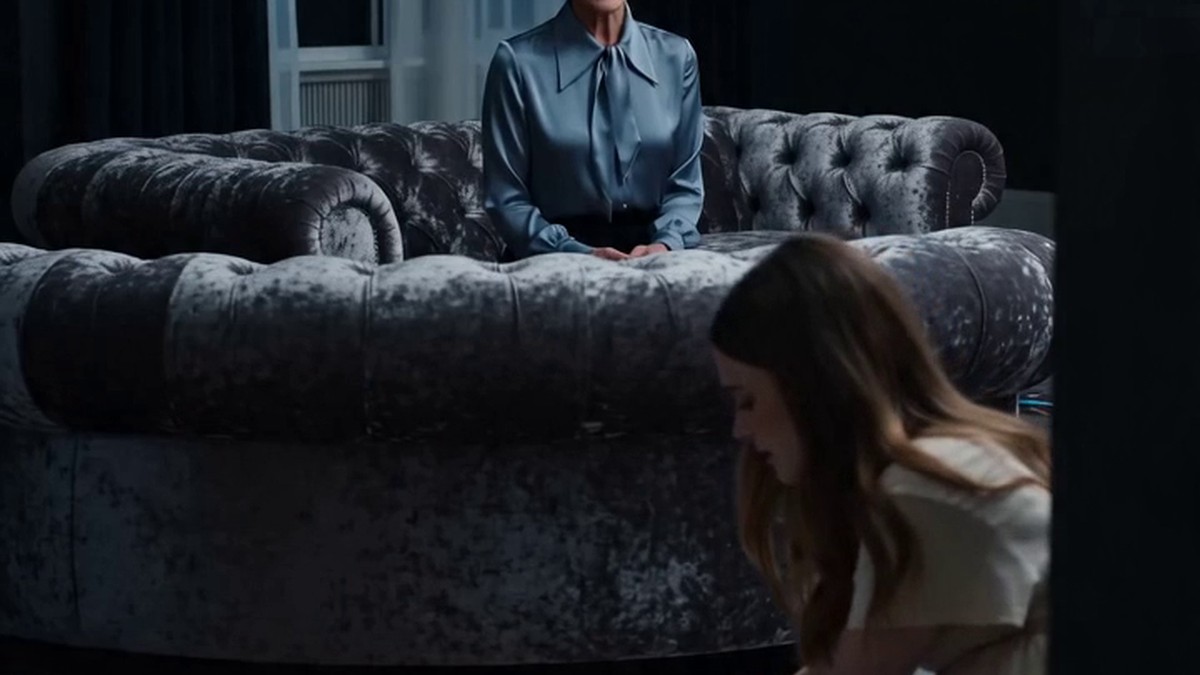
I’d slipped out of the office nearly two hours early — my birthday, my call — with a loose bunch of wildflowers dangling from one hand and a stupid, unsuspecting grin on my face. I was certain I was walking into something warm. Something celebratory. My boots had barely cleared the threshold when that certainty collapsed entirely.
White marble. Soapy water spreading across it in slow, defeated pools. Shards of cake. Blue frosting ground into the grout. Rose petals scattered like something had died.
And kneeling directly in the center of all of it — Hannah.
Twenty-six years old. Eight months along. Down on her hands and knees with her maternity blouse soaked gray to the skin, her spine curled protectively around her belly, her small hands trembling as she dragged a rag across the stone in absolute, airless silence. Tears dropped from her jaw onto the marble in a steady, wordless rhythm. Not one sound escaped her throat. Not one.
Across the room, my mother — Evelyn — sat on the velvet sofa with the posture of a woman who had never once doubted herself. Her back was ruler-straight. Her eyes were completely empty. She was watching Hannah scrub the floor the way a person watches something they consider settled business.
Then I saw it. Among the wreckage of white cake layers crushed flat beneath a designer heel, a few piped letters survived in blue icing, barely legible, heartbreaking in their specificity:
*Happy Birthday Daddy.*
The air left my chest like a door slamming shut.
The wildflowers sank slowly in my hand until the stems grazed my trouser leg.
From somewhere near the pantry wall came the sound of a woman breaking. One of our housemaids — steady, professional, someone I had never once seen rattled — was falling apart, her hand pressed over her mouth, losing the battle to stay quiet.
“She made it herself, Mr. Thomas.” Her voice came out in fragments, trembling with something that had crossed well past grief into fury. “The whole morning she was in here baking. Your mother walked in, took it straight out of her hands, and threw it on the floor.”
The room went so silent I could hear Hannah’s rag moving against the marble.
Nobody breathed.
My mother didn’t flinch. She simply uncrossed and recrossed her ankles, adjusted the clasp on her bracelet, and said, with the bored precision of a woman correcting a seating chart: “The girl needs to understand her place.”
That was the sentence.
That was the one that split the room open.
—
I’ve spent a long time being careful with Evelyn. Patient. Strategic. The way you’re careful around a fault line — you know the catastrophe is possible, you just keep hoping it never actually arrives. I’d negotiated. I’d deflected. I’d absorbed her comments about Hannah’s background, her loaded silences at dinner, the small humiliations she parcelled out so steadily that they almost looked like nothing. I’d told myself: she’ll come around. She’ll see what I see. Give it time.
Standing in that doorway, flowers in my fist, blue frosting pressed into the grout between my wife’s fingers — I finally understood that I had been extending a mercy that was quietly killing someone I loved.
I set the wildflowers down on the counter.
I set them down slowly, deliberately, the way you set something down when you’re making sure your hands stay steady for what comes next.
“Get up, Hannah.”
My voice came out lower and calmer than I expected. Hannah looked up at me, and for a second her whole face fractured — not relief, not yet, just the raw, startled expression of someone who’d been so alone in a room that a single voice broke something open. She started to push herself up. I crossed the kitchen in four steps and took both her hands in mine. They were freezing. Still shaking.
I helped her to her feet. I kept my hands around hers until I felt the trembling ease, just slightly. I looked at her face — the tear-tracked jaw, the set mouth, the particular stillness of a woman who has been storing something enormous in a very small space. I touched her cheek once, very briefly, with the back of two fingers.
Then I turned around.
—
Evelyn was watching me the way she always watched me when she expected to manage me — a careful, practised neutrality, the expression she’d worn through every disagreement we’d ever had. She was already composing herself for the conversation she expected. The measured objections. The legacy, the family name, the things a mother is allowed to say.
I pulled a chair from the kitchen table and placed it directly in front of the sofa. Not to the side. Not at a comfortable conversational angle. Directly in front, close enough that there was no distance to hide in.
I sat down.
I leaned forward, elbows on my knees, and I looked at her until she had nowhere else to look but back.
“You threw the birthday cake my pregnant wife spent her morning baking.”
Not a question. I wanted her to hear exactly what the sentence was.
A flicker crossed her face — something between irritation and the first, faint awareness that this conversation was not going to go the way the others had. “Thomas, I will not be spoken to—”
“You threw it on the floor.” I kept my voice level. “And then you made her get down on her hands and knees and clean it up. In her eighth month. While you sat and watched.”
“She needs to understand—”
“Stop.”
The word dropped like a weight. Evelyn actually stopped.
Behind me I heard Hannah’s breath — slow, controlled, a woman grounding herself.
“I’ve been patient with you,” I said. “I told myself you’d come around. I told myself you were adjusting. I told myself a lot of things because it was easier than having this conversation.” I paused. “I was wrong to do that. Because what I was actually doing was leaving her to absorb everything you chose not to say to my face.”
Evelyn’s jaw tightened. “I have only ever acted in the interest of this family.”
“No.” My voice didn’t rise. It got quieter. “You acted in the interest of what you think this family should look like. That is not the same thing. And Hannah — ” I let the name sit there deliberately, because I had noticed, I had always noticed, that my mother preferred to say *the girl* — “Hannah *is* my family. She is my wife. That is my child she is carrying. And the way you have treated her — the comments, the cold shoulders, what happened here today — that is finished. Right now. Today.”
Evelyn’s eyes went to Hannah. Something moved in them — not softness. Something harder than softness. A recalculation.
“You’re going to choose her over your own mother.”
“I’m not choosing anything,” I said. “I’m telling you that the behaviour stops. If you want to be part of this family — the actual family, the one that lives here, the one that’s about to get larger — then you will treat my wife with basic human decency. Not warmth, if that’s too much to ask. Just decency. She doesn’t need your approval. She never needed it. But she will not be humiliated in her own home.”
Silence.
The kitchen clock ticked. The soapy water had spread all the way to the baseboard and was beginning to dry at the edges, leaving faint white rings on the marble.
“And if I find that unacceptable?” Evelyn said, and her voice had gone very careful, very precise.
I held her gaze.
“Then I’ll arrange for the car to take you back to the city tonight. I will call you. I will visit. I will be a good son, because that’s what I intend to go on being. But this house is Hannah’s home. You are a guest in it. And a guest who hurts the people I love is a guest who doesn’t stay.”
Evelyn looked at me for a very long time. I watched something move behind her eyes — not defeat, exactly. More like a woman who has been negotiating so long she is genuinely surprised to have run out of room. Her chin rose slightly. The bracelet clasp clicked.
And then, slowly, with the particular controlled grace of a woman who will not give anything away any more than she absolutely has to, she turned her eyes to Hannah.
Hannah was standing near the counter, one hand resting on the edge of it, the other curved around her stomach. She looked back at Evelyn without flinching. She didn’t drop her gaze. She didn’t fill the silence with reassurance or apology or any of the softening gestures I had watched her reach for over two years of these exchanges.
She just stood there, steady, and waited.
Evelyn said nothing. But she held that look a long beat longer than she had to, and something in the line of her shoulders — almost invisible, almost nothing — shifted.
It wasn’t an apology. It wouldn’t be, not today, maybe not ever in any form I would recognise. But it was the end of something. I could feel the end of it in the room like a pressure change.
—
Our housekeeper — still composed, still precise, now drier-eyed — quietly gathered the last of the cake wreckage without being asked. She worked quickly and without comment, which was its own kind of grace.
Evelyn excused herself to the guest room not long after.
The kitchen slowly became just the kitchen again.
I found a clean towel and finished drying the last of the marble myself. Hannah stood beside me, not helping, just standing close. When I straightened up she was looking at the counter where the cake had been, and there was something on her face I couldn’t quite read — not quite grief, not quite relief. The complicated expression of a person who has been through a storm and is only now beginning to take inventory of what’s still standing.
“You didn’t have to come home early,” she said.
“I know.”
“You didn’t have to do any of that.”
“I did,” I said. “I should have done it sooner.”
She looked at me. Her eyes were dry now but still raw at the edges, reddened and tender in the way eyes get when they’ve worked hard.
“The cake,” she started, and then didn’t finish.
“I saw the letters,” I said.
Her mouth pressed together. Just for a second, the composure she’d been holding so tightly wavered — one visible tremor in the chin — and then she pulled it back. A woman who has been strong for too long learning, reluctantly, that she might not have to be.
I put my hand over hers on the counter.
“Next year,” I said, “you’ll make another one. And I’ll be here on time, and we will eat it in this kitchen, all three of us, and not one piece of it will end up on the floor.”
A small, cautious sound escaped her — almost a laugh, caught too late, turning into something more like a breath.
“You’re promising a lot,” she said quietly.
“I am,” I said. “I’m also the guy who showed up with wildflowers on a Tuesday. You knew what you were getting.”
The cautious sound came again, and this time it landed. Soft. Real.
She leaned her head against my shoulder, very carefully, the way she did now that her centre of gravity was no longer entirely her own. I felt the warmth of her through her still-damp blouse. The slow, settled weight of her.
Through the kitchen window the afternoon light had gone orange and slant, lying in long stripes across the marble floor. The rose petals were gone. The frosting was gone. The disaster, piece by piece, had been carried away.
What remained was ordinary and entirely enough: two people standing together in a kitchen at the end of a hard day, shoulder to shoulder, waiting on whatever came next.
The wildflowers were still on the counter, a little battered, stems crooked from where I’d let them dangle too long.
Hannah reached out and touched the edge of one petal — gently, the way she touched things she intended to keep.
She didn’t say anything.
She didn’t have to.