The words hit like a slap. His finger stabbed the air between them, voice carrying across the entire banquet hall — past the crystal chandeliers, past the silk-draped tables, past every stunned face that turned to look. And beside him, she stood there, his partner, wearing that smile like a weapon. Slow. Deliberate. Merciless.
“Old woman,” she said softly, almost tenderly, “your money belongs to us now.”
They were certain of it. Certain they’d finally ground her down to nothing.
Charlotte’s eyes went wide — just for a moment. Just long enough for them to enjoy it. Then she turned, and she walked out of that glittering room alone, her heels quiet against the marble, the laughter of the party swallowing the sound of her exit.
She didn’t cry.
That was the first thing they got wrong about her.
—
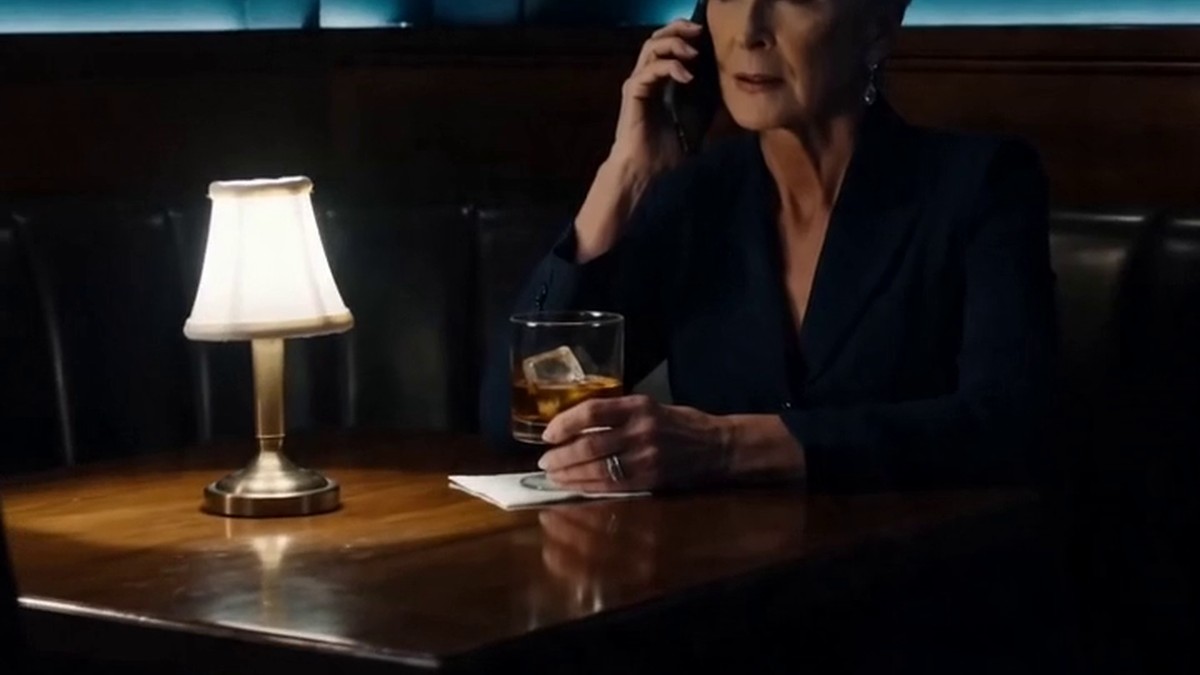
Hours later, a different woman sat in a corner booth of a dim, near-empty bar. The fragile grandmother they’d humiliated? Gone. In her place: a woman with a glass of aged whiskey in one hand and a phone pressed to her ear in the other. The low light caught something in her expression — not grief, not defeat.
Precision.
A slow smile pulled at the corners of her mouth. Cold. Certain. The kind of smile that belongs to someone who has already won and is simply waiting for the calendar to catch up.
She leaned close to the receiver.
“Want to watch them lose everything by tomorrow night?” she whispered.
She wasn’t starting over.
She was cashing in.
What she had built over fifty years was not a company.
It was a trap.
And tonight, two very stupid people had just stepped into it.
—
Charlotte set the phone down and let the silence settle around her like a coat. The bar smelled of old wood and spilled bourbon and the particular exhaustion of people who had nowhere better to be. She liked it. She had always liked rooms that didn’t pretend to be something they weren’t.
She took a slow pull of whiskey and let her mind run the sequence one more time. Not from anxiety. From pleasure.
His name was Derrick. Thirty-four years old, beautiful jaw, the kind of confidence that gets handed to certain men at birth and never properly taxed. He had come into her company eighteen months ago through a boutique consulting firm she’d specifically selected — the way a surgeon selects a scalpel. He was exactly what she needed him to be: ambitious, impatient, and absolutely convinced that older women with soft voices could be managed.
The woman beside him at the party — Sasha — was smarter. Charlotte gave her that. Sasha had done her homework, understood quarterly projections, asked the right questions in the right meetings. But Sasha had made one mistake. She had looked at Charlotte’s gray hair and her quiet hands and her habit of deferring in group settings and she had concluded: *diminished*.
That was the last error either of them would ever make in a boardroom.
—
The call she’d just finished was to a man named Paul Whitmore. Paul had been her attorney for twenty-seven years and her friend for thirty-one, and he had a voice like gravel and patience and a mind like a steel vault. When she’d whispered her question into the phone, he had laughed — not cruelly, but with the particular delight of a man who has been waiting a long time for a complicated machine to finally do the thing it was built to do.
“The documents are already filed,” he’d said. “Have been for six weeks.”
Six weeks. Since before the first whisper of the board vote. Since before Derrick had started cc’ing Sasha on emails that were never meant for Charlotte’s eyes. She had seen it all. She had let it run.
She had fed them rope by the yard.
—
The thing they didn’t know — the thing almost nobody knew — was that the company they believed they’d maneuvered themselves into controlling was not, legally speaking, the company they thought it was.
Forty years ago, a younger Charlotte had sat across from a very different kind of attorney in a very different kind of office and structured something elegant. The public-facing corporation — the name on the letterhead, the entity that issued shares, the one that appeared in every filing Derrick and Sasha had studied so hungrily — was a subsidiary. A holding. A beautiful, expensive shell.
The actual assets. The patents. The real estate portfolio. The licensing agreements that generated the majority of the revenue. Those lived somewhere else. In a separate structure, privately held, with a succession clause so airtight it had survived two economic crashes and one very aggressive divorce.
Derrick had bought the frame.
Charlotte still owned the painting.
—
She was finishing her second whiskey when the doors opened.
She had expected Paul. Instead she got Derrick.
He looked different outside the banquet hall — the chandeliers weren’t there to flatter him, and the dim bar light was not kind to men who relied on performance. He scanned the room, found her, and crossed to her booth with the expression of someone who believes they are delivering mercy.
He sat down without being asked.
“Charlotte.” His voice was careful now. Calibrated. “I owe you an apology for how that was handled tonight.”
She looked at him over the rim of her glass.
“Do you.”
“The way Marcus spoke to you — that wasn’t —”
“Marcus.” She set the glass down. “Is that what he’s going by now.”
A flicker crossed his face. She filed it away.
“I just think,” Derrick said, leaning forward, forearms on the table, “that we got off on the wrong foot. The transition doesn’t have to be ugly. We can structure a very generous exit package. Consulting retainer, your name stays on the building, full —”
“Where’s Sasha?”
The question stopped him.
“She’s — she went home.”
“No she didn’t.” Charlotte picked up her phone and turned the screen toward him. A security notification. The parking structure attached to her office building, timestamped eleven forty-seven PM. Sasha’s car. “She’s at the office. And she’s been there for forty minutes. What is she looking for, Derrick?”
His face went the particular gray of a man who realizes, too late, that the conversation he thought he was controlling has not been his for some time.
“I don’t know what you —”
“The server room,” Charlotte said. “That’s my guess. The financial architecture. She thinks if she can find the ownership documents tonight, she can accelerate the filing before the market opens.” She tilted her head slightly. “Am I warm?”
Silence.
Outside, a car passed. The bartender wiped a glass.
“You built this whole evening,” he said. Slowly. Like a man finding his footing on ice. “The party. You let us —” He stopped.
“I got dressed up,” Charlotte said. “Had a lovely meal. Let you make your little speech in front of two hundred people who will remember exactly what you said.” She smiled — the same smile from before, the one that lived in the cold country. “I find that witnesses are useful.”
—
She called Paul back as Derrick sat there, unable to leave, unable to speak, the ground entirely gone from under him.
“Send it,” she said.
Paul had been waiting by the fax — an affectation he maintained for exactly this kind of moment — and in the server room across town, Sasha’s phone buzzed. And then buzzed again. And then her laptop screen populated with something that made the color leave her face: a cease and desist, a full legal filing, and a letter from the Secretary of State confirming that the board vote conducted three days prior had been voted on shares that did not, in fact, confer the authority assumed.
The vote was void.
The acquisition was void.
The entire eighteen-month campaign was, legally, a ghost.
—
Sasha came into the bar at twelve-thirty.
Charlotte had known she would. That was also part of it — she had picked this bar, this booth, this particular evening because she understood that people like Sasha, when the ground falls away, run toward the last solid thing they can locate. And the last solid thing was her.
Sasha looked like she’d walked through weather. Her coat was open. Her composure — usually architectural in its precision — had developed visible cracks. She stopped at the edge of the booth and looked at the two of them: Derrick, sitting like a man waiting for a sentence, and Charlotte, sitting like a woman who had already handed it down.
“How,” Sasha said. Not angrily. Almost with admiration.
“Sit down,” Charlotte said.
Sasha sat.
For a moment the three of them occupied the booth in a strange, charged quiet. The bartender had stopped pretending not to watch.
“The structure has been in place since 1987,” Charlotte said. “I built it after my first partner tried something similar. Cheaper lesson then.” She looked at Sasha directly. “You’re not stupid. You just stopped asking the right questions the moment you decided I was finished.”
Sasha had the grace to look away.
“What happens now,” Derrick said. His voice had lost its architecture entirely.
“Now,” Charlotte said, “your consulting firm’s contract is terminated for cause, which Paul has already filed. The shares you acquired revert under the original partnership agreement. And the story of what happened tonight in that banquet hall — in front of those two hundred witnesses — will make its way to every boardroom in this city by the end of the week.” She paused. “Not because I’ll tell it. Because people who were there will tell it. They always do.”
Sasha closed her eyes.
“There’s one alternative,” Charlotte said.
They both looked at her.
“You resign. Tonight. Both of you. Clean letters, professional language, no counterclaims. Paul has the paperwork in his car. He’ll be here in ten minutes.” She picked up her whiskey glass and found it empty. Set it down. “You walk away with your reputations moderately intact and I never think about either of you again.”
Derrick looked at Sasha.
Sasha looked at the table.
“Why give us that,” Sasha said quietly. “After everything.”
Charlotte considered the question with the seriousness it deserved.
“Because destroying you entirely would take another six months of my life,” she said, “and I have better things to do with it.”
—
Paul arrived at twelve-forty with a leather satchel and two manila envelopes. He slid into the booth beside Charlotte and set the envelopes on the table without ceremony. He looked at Derrick and Sasha with the expression of a man who has seen this particular room before and is not surprised by the furniture.
They signed.
Derrick signed like a man in physical pain. Sasha signed with a kind of rigid precision, every letter exact, as though correct penmanship was the one dignity she had left to preserve.
Paul collected the envelopes, checked the signatures, and nodded once at Charlotte.
“Done,” he said.
Outside, Derrick and Sasha left through the bar’s front door and the night absorbed them. Charlotte watched through the window until their taillights disappeared. Then she looked at Paul, who was signaling the bartender for two more glasses.
“You enjoyed that,” he said.
“Enormously,” she said.
He laughed.
They sat there for another hour in the comfortable quiet of old friends, and Charlotte did not think about the banquet hall or the pointed finger or the words that had been meant to reduce her to ash in front of two hundred people. She had turned them over to the evening long ago, the moment she’d walked out in her quiet heels across that marble floor.
She had not cried.
She had not needed to.
What she had done, instead, was exactly what she had always done when someone mistook her stillness for surrender.
She had waited.
And then she had collected.