Doña Martha couldn’t stand it. Couldn’t stomach the fact that her son — her son — had chosen to marry a nobody. And she had decided, with cold precision, that this gala dinner would be the perfect stage to break the girl apart.
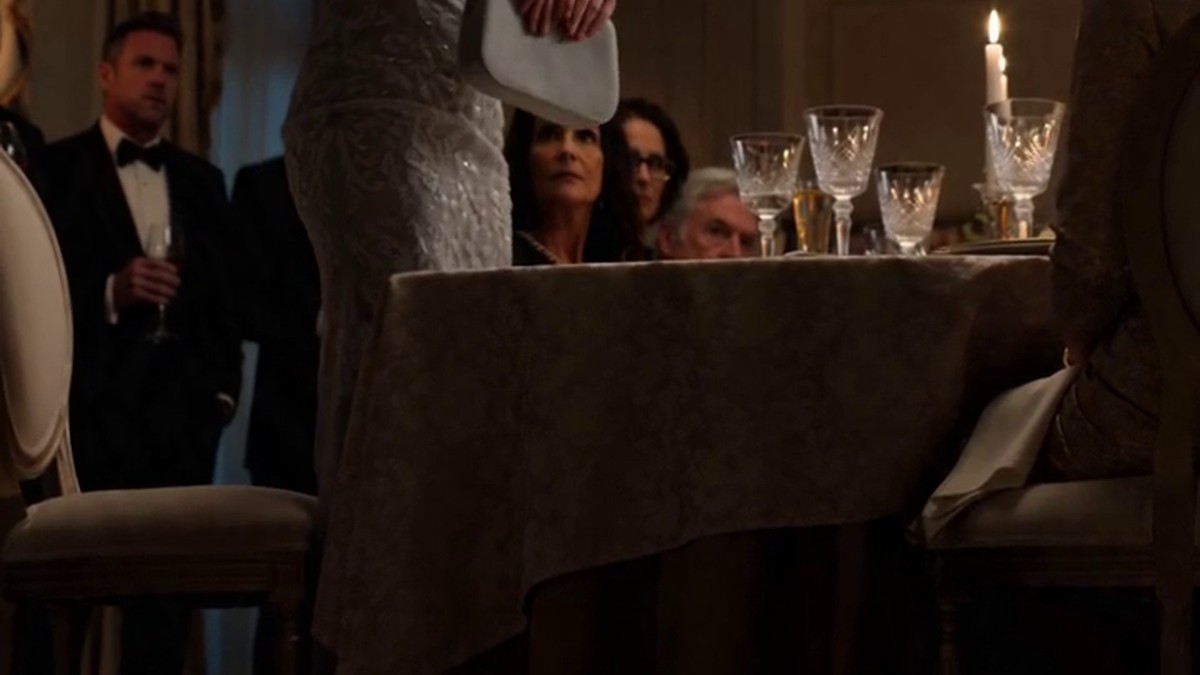
The finest families of high society watched in silence. Martha’s voice rang out across the candlelit table, dripping with contempt as she demanded to know what kind of food this *little pauper* intended to serve at a gathering of such distinction.
The words cut deeper than the crystal scattered across the floor.
The young woman blinked. A single tear traced the line of her cheek.
Then she stood up.
Slowly. Deliberately. With a stillness so absolute it chilled every person in that room to the bone.
She didn’t raise her voice. She didn’t flinch. She reached into her handbag, drew out a folded document, and placed it on the tablecloth — right beside the shattered stem of the broken glass.
She lifted her eyes to her mother-in-law’s.
And then she spoke.
One sentence.
The kind that doesn’t need to be repeated.
The mansion went completely silent.
—
The document was a deed.
Not any deed. The deed. Forty-three pages, notarized twice, bearing the seal of the city’s most senior property attorney — the same man, incidentally, sitting three chairs down the table, who had gone the color of old wax the moment he recognized his own signature.
The sentence the young woman had spoken was this:
“This house belongs to me now, and everyone at this table already knows why.”
—
The silence lasted exactly four seconds.
Doña Martha felt the room before she understood it. Felt the shift the way animals feel weather — that sudden drop in pressure, the air going still and electric at once. She watched the eyes. That was her gift, always had been: reading a room by its eyes. And right now, fourteen pairs of them were not looking at the *little pauper* standing at the far end of the table.
They were looking at her.
“That’s — ” Martha started, and her voice, her magnificent, weaponized voice, came out half a register too high. “That’s absurd. That document is —”
“Dated eight months ago,” the young woman said. Still quiet. Still terrifyingly still. “Three weeks before your son proposed to me. Which means you knew. You’ve known this entire time.”
The attorney — Señor Villalba, sixty years old, three decades of Martha’s personal legal work behind him — pressed two fingers against his lips and studied the tablecloth as though it contained scripture.
“Alberto.” Martha turned to her son. The name came out like a command, like it always had. Like he was nine years old and had tracked mud across the foyer. “Alberto, tell her. Tell everyone.”
Alberto Sandoval set down his wine glass with a gentleness that was somehow worse than violence.
He did not look at his mother.
He looked at his wife.
“Her name,” he said, “is Camila.”
—
It had started, as these things always do, before the beginning anyone in that room knew about.
Camila Reyes had grown up three hours south of the capital, in a town small enough that everyone’s business was everyone’s entertainment. Her father repaired shoes. Her mother taught primary school. They were not poor in the way that breaks people — they were poor in the way that makes people precise, careful, allergic to waste. Camila had earned her scholarship with the kind of relentless, joyless grinding that wealthy children never need to learn, and she’d arrived at the university with two suitcases, a detailed five-year plan, and exactly zero interest in the social architecture of people like the Sandovals.
She had met Alberto in a library, of all the clichéd places. He’d been hiding from a charity luncheon his mother had organized on campus. She’d been highlighting contract law. They had argued about whether Borges was overrated for forty minutes before either of them thought to introduce themselves.
By the time he told her his last name, she already knew who he was.
She married him anyway.
What she had never told him — what she had carried alone, like a stone in a coat pocket — was what she’d discovered six months into their relationship, during a routine title search for a university project that had somehow, improbably, impossibly, surfaced a property record that made her stop breathing for a full minute in the university archive.
The land. The original parcel. The foundation, legal and literal, on which the Sandoval fortune had been constructed two generations ago.
It had belonged to her grandfather.
—
Doña Martha knew. Of course she knew. She was the one who had found the girl’s background check — had commissioned it the moment Alberto mentioned the name Reyes with that particular softness in his voice — and had buried the report the second she read the name of the town, the name of the family, the name of the man whose land her own father-in-law had acquired in 1961 through a transaction that no reputable attorney would have touched with gloves on.
She had watched Camila walk down the aisle with a smile fixed so perfectly in place that not one photographer caught the calculation behind it.
She had planned the gala. Chosen the guests. Positioned every piece of the stage.
She had meant to shatter the girl publicly, thoroughly, before the girl could ever think to go digging.
She had been six weeks too late.
—
“You want to explain the document, Martha?”
It was Señora Fuentes who said it — Hortensia Fuentes, seventy-one, three generations of old money, and the only person in the city whose opinion Doña Martha had ever genuinely feared. She sat at the table’s midpoint with her hands folded, her champagne untouched, watching with the patient attention of someone who had waited a very long time for a very specific thing.
Martha opened her mouth.
“Because I have seen that document,” Hortensia continued, without raising her voice in the slightest. “Villalba sent me a copy in February. Professional courtesy, he said.” She tilted her head fractionally toward the attorney, who appeared to be attempting to achieve invisibility through sheer force of stillness. “I did wonder when it would surface.”
“That transaction was legal —”
“It was not.” Camila’s voice, still quiet, had acquired an edge that was not anger. It was something colder and more durable than anger. It was certainty. “It was coerced. My grandfather was threatened with a debt he didn’t owe, pressured into a sale at a quarter of the land’s value, and died two years later having never recovered from it. I have the letters. I have the original appraisals. I have the statement he gave to a notary in 1963 that no one in this family thought to look for because no one in this family thought a man like him would know to make one.”
The candles flickered.
No window had opened. No door had moved.
They flickered anyway.
“Alberto.” Martha’s voice had shed its weapons. What remained was rawer and more dangerous — the sound of a woman realizing the ground is no longer beneath her feet. “You cannot let her —”
“She’s not *letting* me do anything.” He stood now, and in standing changed the geometry of the entire room. “I’ve read every letter, Mamá. I’ve read the notary statement. I’ve sat with it for four months.” A pause that cost him something visible. “I’m sorry it took me that long.”
He wasn’t speaking to his mother.
—
What happened next was not dramatic. That was the thing no one who told the story later could quite convey — how undramatic it was, how quiet the machinery of consequence can sound when it finally arrives.
Señor Villalba excused himself. No one stopped him. He would spend the following week in consultation with his own attorney, and within a month he would have reached a private arrangement that spared him a bar review board hearing and cost him, among other things, a vacation property he had been particularly fond of.
Several guests remembered prior engagements and departed before dessert.
Hortensia Fuentes stayed. She moved to the seat beside Camila, accepted a fresh glass of champagne, and said, in a conversational tone, that she had met Camila’s grandfather once, at a regional agricultural conference in 1958, and that he had been one of the most quietly formidable men she had ever encountered.
Camila said she had heard that about him.
Hortensia said it was entirely believable.
—
Doña Martha did not leave immediately. That would have been an admission she wasn’t prepared to make in front of witnesses. She remained at her end of the table with the stillness of a woman who has gone so still she has stopped being present, her eyes fixed on the middle distance, the broken glass still scattered at the foot of Camila’s empty chair where no one had yet thought to sweep it.
At some point — no one could say precisely when — her son crossed the length of the table and crouched down beside the shards. He picked them up, piece by piece, with his bare hands, and set them on the tablecloth in a small pile.
His mother watched him do this.
“I would have given her a place in this family,” Martha said, finally. The aggression was gone. What was left sounded almost genuine, which made it harder to hear. “If she had just —”
“Been someone else?” Alberto straightened. “Been less?” He considered her for a moment. “No. You wouldn’t have. That was never the offer.”
He walked back to his wife.
—
The house — that particular house, the one named in the deed, the original property that had anchored the Sandoval portfolio for sixty years — did not transfer immediately. These things take time, and both Camila and her attorney were patient people. The legal process was precise and entirely without spectacle.
But the night of the gala, standing in the entrance hall while the remaining guests filtered out around them, Camila held the document against her chest and allowed herself one private moment. Not of triumph. She had not wanted a battle, had not wanted a gala, had not wanted any of the theater Martha had constructed around her. What she had wanted, since the day she’d sat in that university archive and felt her grandfather’s life suddenly click into focus, was simply the acknowledgment. The record corrected. The story told accurately, at last.
Outside, the city moved through its ordinary night — traffic and rainfall and people walking home under yellow streetlights, carrying their ordinary burdens.
Alberto found her in the hallway. He didn’t speak right away. He stood beside her, close enough that their shoulders touched, and looked out through the tall window at the rain.
“I’m sorry about all of it,” he said. “The dinner. Her. All of it.”
“I know.” She leaned into him, slightly. “She loves you. In her way.”
“Her way needed to change.”
“Yes.”
The rain came harder. The crystal chandelier above them scattered its light across the marble floor in fragments — dozens of small brilliant shards, nothing like the ones Martha had thrown, nothing like wreckage at all.
More like something broken open.
More like something finally let through.