She never spoke. Never smiled. Never asked for anything. Every morning she polished the brass door handles in silence while the employees laughed at her expense.
“Hey, mute! You missed a spot.”
She would let out the faintest sigh and keep working.
On her payroll form, she was listed as Aleptina. But years before, she had been Alia — a beloved teacher, a woman of genuine artistic soul.
Then came the fire.
Alia had thrown herself into the flames and pulled out a boy named Lesha and his mother. Her body eventually healed. But after losing the last person she had ever truly loved, Alia stopped speaking altogether. The words simply never came back.
One ordinary morning, a sleek black sedan rolled to a stop in front of the bank.
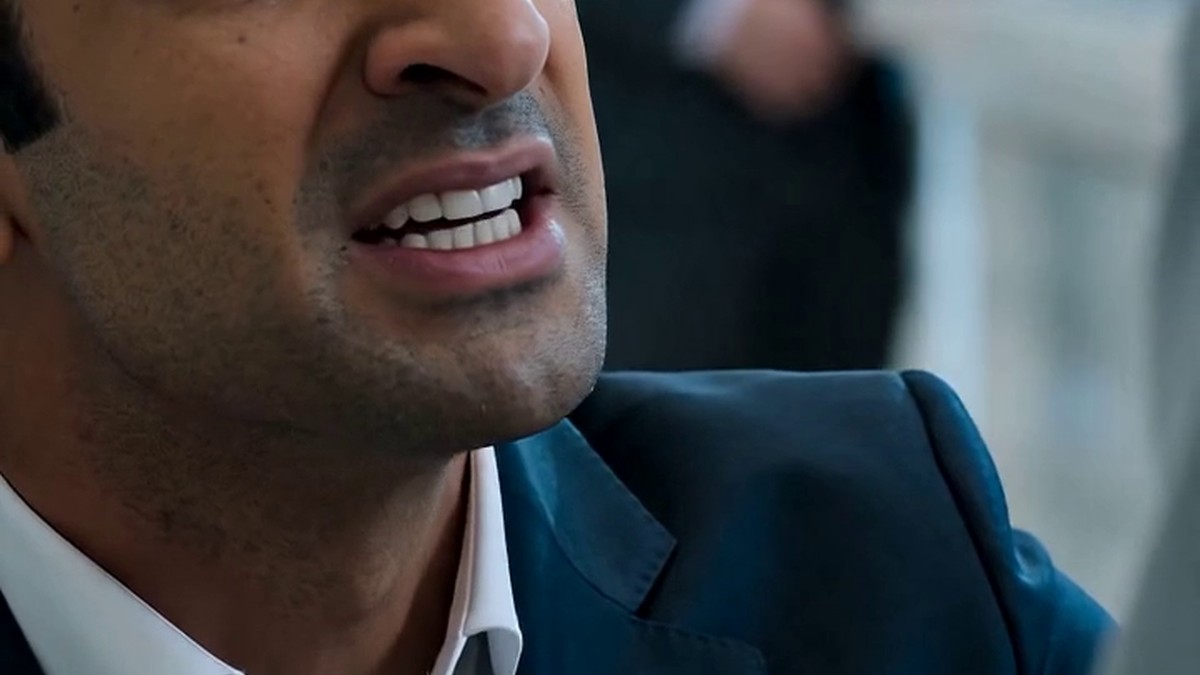
The regional director, Sergei Mikhailovich, walked through the doors. Every employee immediately straightened up, smoothed their clothes, stood a little taller. Aleptina didn’t look up. She just kept working the brass handles with slow, steady strokes.
The moment Sergei saw her, he went completely still.
Before the stunned eyes of everyone in that lobby, he crossed the floor, dropped to his knees, and gently peeled the work gloves from her scarred hands. Then he pressed his lips to her palms.
“Alia,” he whispered, his voice breaking. “I’ve been looking for you for years.”
The entire bank held its breath.
And then — for the first time in three years — the cleaning woman spoke.
Just one word.
*One.*
“Lesha.”
The word fell into the silence of the lobby like a stone into still water. No one moved. No one breathed.
Sergei — the regional director, the man whose phone calls made branch managers sweat through their dress shirts — stayed on his knees on the polished marble floor, holding her scarred hands in both of his. His jaw worked. His eyes were wet.
“You remember me,” he said. It wasn’t a question.
Behind the reception desk, Marina, who had called Aleptina “mute” every single morning for eleven weeks, stood with one hand pressed flat against her chest, as if trying to hold her heart in place.
The boy from the fire.
Nobody in that bank knew the story yet. But they could feel the shape of it — the way you feel a storm before it actually arrives. Something enormous was in the room with them. Something that had been in the room all along, scrubbing quietly at the brass while they laughed.
—
Sergei finally rose. He didn’t release her hands.
“I grew up,” he said softly, almost apologetically. As if she might not believe it. As if the boy she had pulled from the smoke could not possibly have become this man in the expensive suit. “Mama passed four years ago. She talked about you until the very end. Every year we tried to find you. Every single year.”
Alia looked at him. Really looked — the way she hadn’t looked at anyone in a long time. She studied his face the way you search a landscape for something you once knew: the jaw was stronger now, the eyes older, but the shape of the grief in them was exactly the same as in the boy she remembered. A boy who had stood in a hospital corridor with smoke still in his hair, crying because he didn’t know where the woman who saved him had gone.
Her lips parted. The words came slowly, like something being thawed.
“You were seven,” she said. Her voice was low and rough from disuse, the way a door sounds when it hasn’t been opened in years. “You had a red bicycle. It burned with everything else.”
Sergei let out a sound that was somewhere between a laugh and a sob.
“I still can’t ride one,” he admitted. “Never got back on one after that.”
—
The lobby had gone completely, uselessly professional. Every employee was staring at their desk, their computer, their hands — anything except the two people standing in the center of the floor. And yet every single one of them was listening with their whole body.
Dmitri from security had removed his cap and was turning it in circles.
Oksana, the loan officer who had once poured coffee directly over Aleptina’s freshly mopped section of floor and said *oops* without looking up, had gone the color of chalk.
Marina — the loudest, the one who had invented the nickname — had started crying with absolutely no warning, silently, the tears just sliding down her face while she stared at nothing.
Nobody said a word.
—
“Why here?” Sergei asked. He wasn’t accusatory. He was genuinely trying to understand something that hurt him. “Of all the places—”
“Because it was far from where I was before,” Alia said simply. “And because they hired me without questions.”
He looked down at her hands. The scars ran from her palms to her wrists, branching like rivers on a map, like something written in a language that required terrible courage to learn.
“You should have—” he started.
“No,” she said, and there was a quiet firmness in it that made him stop. She wasn’t angry. She was just certain. “There was no *should*. There was only what I could do each day. Some days it was only this.” She glanced at the brass door handle. Still gleaming. Still impeccable.
Sergei followed her gaze. Something moved across his face — understanding, maybe, or the particular grief of seeing how small a life can become when it has survived something too large.
“Mama left you something,” he said. “In her will. She never stopped believing we’d find you.”
Alia went very still.
“She didn’t owe me anything,” she said.
“She knew that,” Sergei said. “That’s not why she did it.”
—
He stayed for two hours.
They sat in the small break room, away from the lobby. Someone — no one would ever admit who — had quietly placed two cups of tea on the table and then disappeared.
Alia told him about the fire from her side. He told her what he remembered from his — the smell, the ceiling collapsing, waking up in the courtyard with a woman’s arms around him and not understanding why she was still running back inside.
“You went back in,” he said. “After you got me out, you went back in for my mother.”
“She was screaming,” Alia said.
“You didn’t have to.”
“No one ever has to,” she said. “That’s the whole point.”
He was quiet for a long moment.
“After the fire,” he said carefully, “after you healed — why did you stop speaking?”
Alia wrapped both hands around her tea. The steam rose between them.
“I lost someone,” she said. “The last one. And after that, I had nothing left to say to anyone. The words felt like — furniture in an empty house. What’s the use of arranging them.”
“And now?”
She thought about it honestly. He waited.
“Now,” she said, “someone remembered my name.”
—
When Sergei walked back through the lobby, his expression was calm and composed the way a person’s face is calm after something has been resolved that they had carried for a very long time.
He paused at the door.
He turned and looked at the assembled staff — every one of whom was pointedly, desperately busy with something. Then he said, in his regional-director voice, the one that carried across rooms without effort:
“The woman you’ve been calling *the mute* saved my life when I was seven years old. She went back into a burning building for my mother after she’d already pulled me out.” A pause. “I’d encourage everyone to think carefully about how the past three months have gone.”
He didn’t wait for a response.
The black sedan pulled away from the curb.
The lobby was absolutely silent.
—
Alia stood at the door with her cleaning cloth.
She looked at the brass handle. The same brass handle she had polished every morning for three months. Then she set the cloth down on the little cart, folded it neatly, and walked to the coat rack by the staff entrance.
Oksana appeared in the doorway of the break room.
“Are you leaving?” she asked. Her voice was strange. Small.
Alia put on her coat.
“Yes,” she said.
Oksana opened her mouth. Closed it. Tried again.
“I’m sorry,” she said. “For the coffee. And for — everything else.” The apology was clumsy and clearly cost her something. It wasn’t enough. They both knew it. But it was real.
Alia looked at her for a moment. Not with warmth, exactly. Not with coldness either. With the particular clarity of someone who has been through something that rendered cruelty very small and very unimportant.
“I know,” she said.
And she walked out.
—
The street was cold and gray and ordinary.
Alia stood on the sidewalk with her hands in her pockets — bare, scarred, ungloved — and breathed the winter air. A tram rattled past. Pigeons argued over a crust of bread near the curb. Someone’s dog pulled at a leash and looked at her with enormous, uncomplicated interest.
Sergei had left her a phone number. A meeting time. A lawyer’s address.
She had also, she realized, just spoken more words in a single morning than she had in three years.
They hadn’t broken her. They had come out, one by one, like lights being switched on in the rooms of an empty house — cautiously, then less cautiously, then simply because the house was not as empty as she had believed.
Someone had remembered her name.
Not *Aleptina*. Not *mute*. Not the woman with the scars.
*Alia.*
She started walking. No particular direction. Just walking, the way you do when a great weight has been lifted and your body hasn’t quite recalibrated yet, and moving feels better than standing still.
Somewhere behind her, in the brass of the bank’s front door, her reflection stretched and gleamed — distorted by the curve of the metal, but bright. Unmistakably there.
Unmistakably hers.