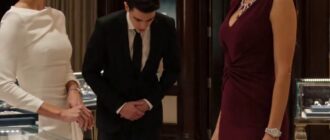
Champagne flutes. White flowers. Gold chairs. Crystal chandeliers. Expensive dresses. Everything caught the light and threw it back like a declaration — wealth as dominance, elegance as a weapon.
Sofía stood quietly beside Alejandro.
Her white dress was plain. No diamonds. No imported lace. None of the arrogance Doña Beatriz had expected to see draped across the shoulders of any woman entering this family. To most people in that room, her simplicity read as weakness. To Beatriz, it read as an insult.
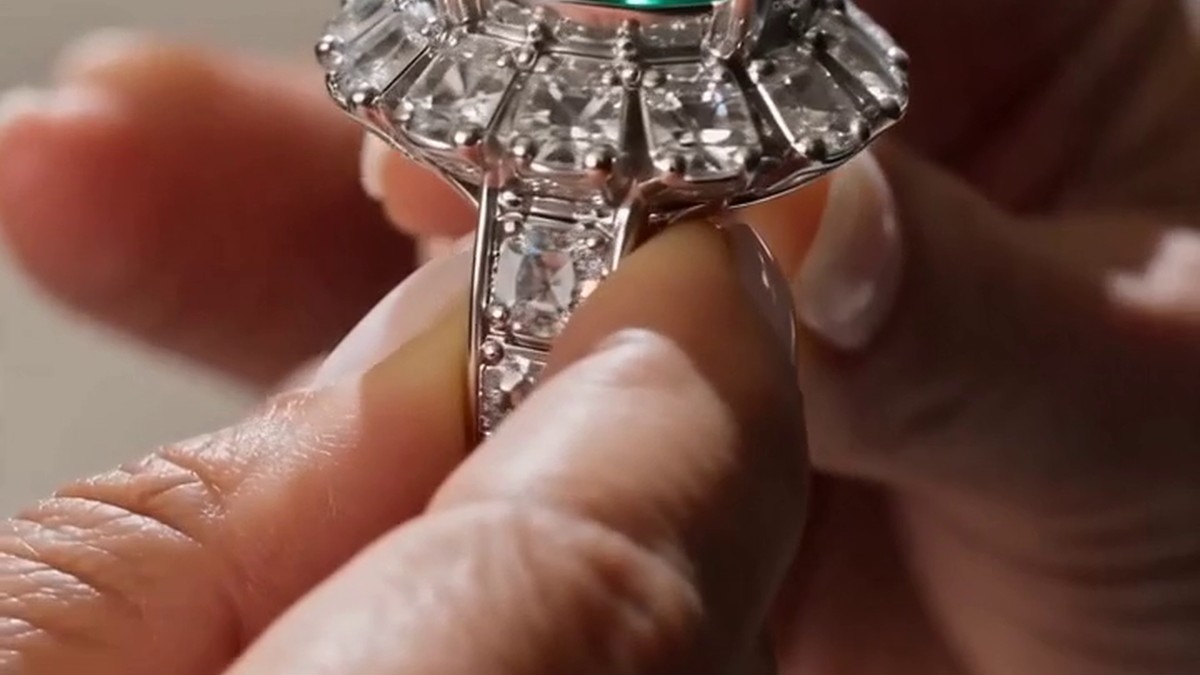
The matriarch approached with a smile that never quite reached her eyes, holding up a small ring set with an emerald stone.
“A poor girl doesn’t touch the jewelry of this family.”
The murmur moved through the hall like a current.
Sofía felt the blow land square in her chest — but she didn’t lower her head. She looked at the ring. Then she looked at the woman in the green dress, who was savoring every single second of this.
“Why would you humiliate me in front of everyone?” she asked, her voice barely above a whisper.
Doña Beatriz’s smile widened.
“Because you will never be one of us.”
Alejandro stepped forward, jaw tight.
“Mother. Enough.”
Sofía raised one hand to stop him.
She didn’t need anyone to fight for her. Not this time.
Beatriz lifted the ring high so the entire room could see it.
“This piece belonged to the true blood of this house. Not to girls who arrive in plain dresses with families that carry no name worth mentioning.”
Something inside Sofía went cold.
She had spent years absorbing versions of that sentence. That she didn’t belong. That she had no history. That her mother had refused to speak of the past because there was nothing noble to speak of. But before her mother died, she left behind a small wooden box containing exactly three things: a letter, a torn photograph, and a ring.
That ring.
The very one Beatriz was now using to cut her down in front of a room full of witnesses.
Sofía extended her hand.
“Give it back.”
Beatriz laughed — short and sharp, like a door slamming.
“Yours?”
Sofía didn’t answer. She simply took the ring, turned it slowly between her fingers, and pressed a small hidden groove tucked beneath the stone. The emerald shifted — just slightly — and what it revealed was a tiny mark engraved in gold.
A family crest.
The room went absolutely silent.
“Look at that mark carefully,” Sofía said.
Don Ricardo, who had been watching from the center of the hall, crossed the floor with a face drained of color. He studied the ring. Then he looked up at Sofía the way a man looks at something he thought was gone forever.
“That seal belonged to the lost heiress.”
The smile dropped from Beatriz’s face like something falling off a shelf.
Alejandro didn’t move.
Sofía reached into her bag and drew out the letter.
“My mother wasn’t poor, Doña Beatriz. She was made to look poor — by people who wanted what belonged to her.”
Beatriz took one step back.
Because the ring didn’t only prove that Sofía had a rightful place in this family.
It proved that someone had stolen an inheritance.
And the woman who had worked hardest to humiliate her may have been the very one who gave the order to erase her mother’s name entirely.
The silence in that hall had weight.
Not the polite pause between sentences. Not the held breath before a toast. This was the silence of a room full of people recalculating — who they’d smiled at, who they’d dismissed, and what exactly that was going to cost them.
Sofía kept her eyes on Beatriz.
The older woman had the practiced composure of someone who had survived decades of drawing rooms and dinner table politics. But her hands — both of them — had found the fabric of her green dress and gripped it. A small betrayal. The kind only worth noticing if you were looking.
Sofía was looking.
“I want to show you something else,” she said, her voice even now, the way a river goes quiet before it narrows into a gorge.
She unfolded the letter. The paper was old — cream gone to ivory, edges softened with handling — but the handwriting was firm. Deliberate. The kind of script that belongs to someone who chose every word with care because they knew the cost of careless ones.
Don Ricardo reached out for it, then stopped himself. He looked at Sofía first. Asking permission without saying so. She gave a small nod and passed it to him.
He read.
She watched his face do what faces do when the ground shifts — a flicker, a tightening around the jaw, something behind the eyes that isn’t quite grief and isn’t quite anger but lives in the same neighborhood as both.
“This is dated thirty-two years ago,” he said, to no one in particular.
“Yes.”
“And it’s signed by—”
“By my grandfather,” Sofía said. “Your father’s brother. The one you were told died without children.”
The room made a sound. Not a gasp — something quieter, more unsettled. The sound of a story people thought they knew developing a second ending.
Beatriz moved first.
Not toward Sofía. Away. Just half a step, the instinct of a person who has learned to put distance between themselves and evidence. But Sofía had been watching for exactly that.
“Don’t,” she said.
It came out low and clean and with enough in it that Beatriz actually stopped.
Alejandro was still standing two feet away, frozen in the particular stillness of a man whose entire architecture of the past is being taken apart brick by brick in real time. He hadn’t spoken since his mother’s smile had fallen. Sofía could feel the questions radiating off him — she could almost hear them — but she couldn’t attend to them yet. Not yet.
“The letter explains what happened,” Sofía continued, addressing the room now, not just the woman in green. “My mother — Elena — was the only child of Rodrigo Altamirano. Which made her the rightful heir to the eastern estate and the trust that was set aside in 1961. She was seventeen when she was told, in writing, that her father had died and left nothing. That she had no claim. That any attempt to contest this would be met with—” Sofía paused. “With consequences.”
She let the word sit there.
“She believed them. She was seventeen years old, alone, and she believed them. She changed her name. She moved away. She never told me because she thought the past was safer buried.” Her voice didn’t waver, but something in it shifted — just slightly, just enough to be human. “She didn’t want it to touch me.”
Don Ricardo set the letter down on the nearest table like it was breakable.
“Beatriz.” His voice was barely above a murmur, but in that silence it arrived like something thrown. “Did you know about this girl’s mother?”
Beatriz turned toward him with the remnants of a performance — the raised chin, the measured breath, the manufactured calm of a woman who had always relied on the room taking her side by default.
“Ricardo—”
“Did you know.”
Not a question anymore. The second time he said it, all the air had gone out of the room with it.
Her silence was an answer.
Alejandro made a sound — not a word, just a sound — and turned away from his mother. He walked to the tall window at the far end of the hall and stood with his back to the room, both hands pressed flat against the glass like a man trying to stay upright.
Sofía watched him and felt the ache of it. She had not wanted this for him. That was the truth she’d been carrying since before she walked into this room tonight — not the ring, not the letter, not the inheritance, but this: the specific damage of finding out that someone you love built their love for you on top of a lie.
But she hadn’t started this.
She turned back to Beatriz.
“I didn’t come here to take anything,” she said. “I came here because you held up that ring to humiliate me. And I needed you to understand what that ring actually means.”
Beatriz’s composure had developed cracks. They were hairline, barely visible — but Sofía could see them the way you see fractures in ice before it gives.
“You don’t understand what was at stake,” Beatriz said, the first honest thing she’d allowed herself all evening. “The estate was in debt. Rodrigo had made agreements with people who did not accept failure graciously. Elena’s claim would have—”
“Would have what?” Don Ricardo’s voice came down hard. “Would have complicated things? Would have forced you to share what you’d already begun thinking of as yours?”
“It wasn’t that simple—”
“A seventeen-year-old girl was threatened into silence.” His jaw was iron. “Her mother never knew who her father really was. And my cousin died in a rented room believing she had been forgotten.” He took a breath that sounded like it cost him. “You will tell me it was not that simple, Beatriz. And I will tell you that I don’t care.”
Beatriz looked around the room — the champagne flutes, the white flowers, the crystal catching light, the faces of every person she had ever trained to reflect her authority back at her — and found none of it useful. For maybe the first time in thirty-two years, the room was not with her.
She looked like someone who had just discovered that the foundation of a house they’d been living in was borrowed stone.
Alejandro came back from the window.
He didn’t look at his mother. He walked directly to Sofía and stood in front of her, and his face had the scraped-clean look of a man who has made a decision about what he is going to be from this moment forward.
“I’m sorry,” he said. “Not on her behalf. For myself — for every time I asked you to be patient, to give her time, to wait for her to come around.”
Sofía looked at him.
“You didn’t know.”
“No,” he said. “But you did. You came tonight anyway.” He said it with something close to wonder. “Why did you come?”
She thought about it. The real answer, not the clean one.
“Because I needed to stop letting people like her decide what I’m worth,” she said. “And because your grandmother’s ring deserved to be somewhere it was recognized.”
She held it out to Don Ricardo.
He shook his head — a slow, deliberate movement.
“Keep it,” he said. “It was always yours.”
—
The guests thinned out in the hour that followed. Some left quickly, with the restless energy of people who had witnessed something they needed to go somewhere private to discuss. Others stayed, circling the edges of the room with their champagne, casting sideways glances at the small group still gathered near the center.
Doña Beatriz left without saying goodnight to anyone. There was a conversation coming — between her and Ricardo, between her and Alejandro, between her and whatever accounting the next months would require. Sofía didn’t envy her that. She didn’t wish her cruelty, either. The woman had made herself into someone who could threaten a teenager into silence and call it pragmatism, and she was going to have to live in that truth now that the room knew it too. That seemed like enough.
Outside, the night had gone cool.
Sofía stood on the stone steps with the ring on her finger — she had put it on without entirely deciding to, and then decided she was glad — and looked at the garden below, the rows of white roses lit by small lamps, everything fragrant and still.
Alejandro came and stood beside her.
They didn’t say anything for a long moment. The party noise drifted through the open doors behind them — muted now, changed in register, the crystalline social performance of before replaced with something more human and uncertain.
“That photograph in your bag,” he said finally. “The torn one.”
“Yes.”
“The other half — do you know who’s in it?”
She looked at him sideways. “Your father. When he was young.” She paused. “He and my grandfather were close, apparently. Before everything.”
Alejandro absorbed this.
“So we were always going to end up in the same room,” he said.
Sofía almost smiled. “Maybe.”
He reached over and took her hand, carefully, in the way of a man who was not sure of his welcome but decided to try anyway. His thumb moved once across her knuckle, over the emerald, and stopped there.
“I would like to do this differently,” he said. “Whatever comes next.”
She looked at the garden. The lit roses. The long, patient rows of something beautiful that had been tended through seasons of weather it had no control over.
“So would I,” she said.
It wasn’t a promise of ease. It wasn’t a guarantee that the weight of the last hour, or the last thirty-two years, would fold itself away quietly. There were lawyers in the future, and accountants, and difficult conversations in rooms with bad lighting. There was her mother’s name to be restored to a family record that had deliberately omitted it.
There was work.
But she was standing on solid ground now. Her own. Recognized. Not because anyone had finally granted her permission, but because she had walked into that room with a letter and a ring and the particular quiet courage of a woman who had decided that being seen clearly was worth whatever it cost.
The emerald caught the garden light.
Small and green and absolutely steady on her hand.