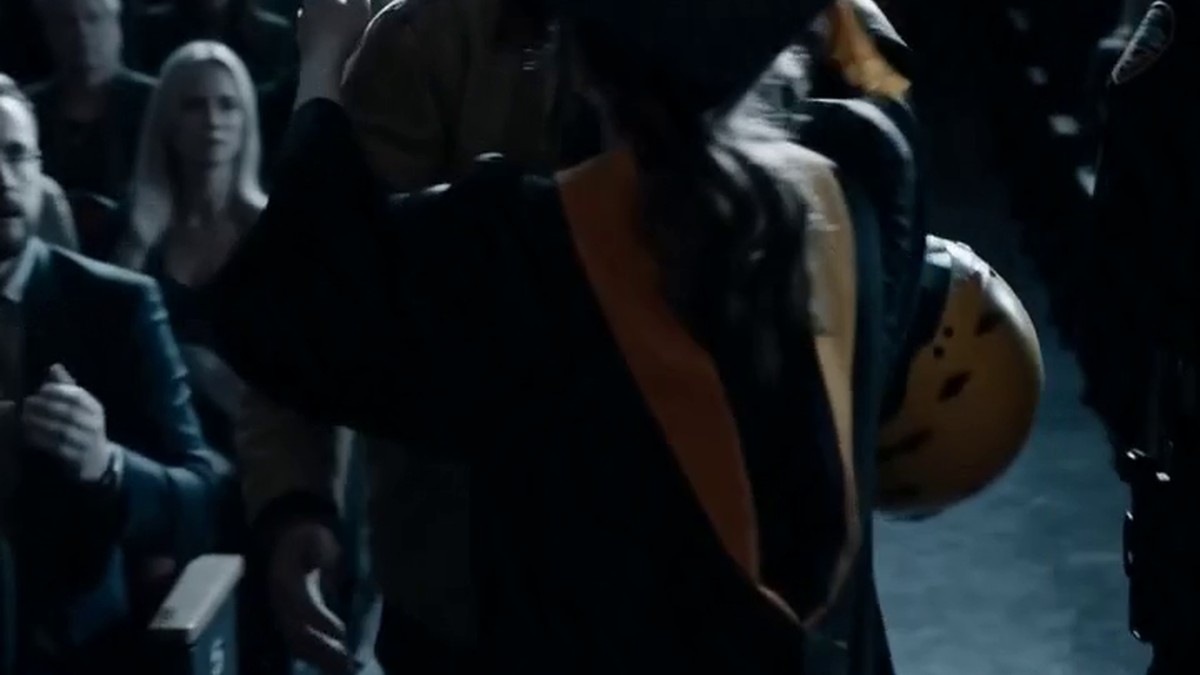
The security guard’s hand closed around Daniel Miller’s arm at the exact moment Sophie’s name rang out across the auditorium.
That was the detail Victoria Whitman would never shake loose.
Not the applause.
Not the rows of blue graduation gowns.
Not the little paper flowers the third-grade teachers had taped along the edge of the stage.
What she would carry with her — for years, maybe forever — was the precise second her daughter glanced away from the microphone and locked eyes with the man Victoria had spent seven years burying.
Daniel stood near the back exit of St. Catherine’s Academy, a delivery helmet wedged under one arm, a canvas bag draped over his shoulder. His jacket was wrinkled from a long shift. His shoes were still damp from the rain outside. He looked exhausted, unassuming, and entirely wrong for the room full of linen blazers and pearl necklaces arranged in neat rows around him.
Victoria turned from her seat in the front row.
The air went out of her like a punctured tire.
No.
Not here.
Not this day.
She was on her feet before she’d decided to stand, her chair screeching against the floor.
“Get him out,” she said.
Quiet. Controlled. But the parents on either side of her heard every syllable.
The security guard moved toward Daniel.
Daniel didn’t resist.
Somehow, that was the worst part.
He simply looked past the guard, eyes scanning the stage, searching for the small girl in the blue gown and cap who was holding her rolled diploma with both hands like it might shatter.
Sophie Whitman.
Seven years old.
Soft brown hair tucked under her cap. Eyes wide and electric with the joy of the morning. A child who had asked, at least four times before leaving the house, whether everyone she loved would be there.
Everyone.
Victoria had told her yes.
She had said it without flinching.
“Sophie Grace Whitman,” the principal announced warmly into the microphone.
The room filled with applause.
Sophie stepped forward.
Then she saw him.
The smile dropped from her face.
For one suspended moment she looked disoriented — the way a person looks when something deeply familiar surfaces somewhere it was never supposed to be, when the heart recognizes what the mind has been told to forget.
Then, into the thin silence between waves of clapping, she spoke.
“Dad?”
One word.
Barely above a whisper.
It didn’t need to be loud.
Victoria felt it move through the room like a current.
Daniel went still.
The guard’s grip stayed on his arm. Around him, parents began turning their heads. A few children on stage craned sideways to see what was happening at the back.
Victoria forced a smile so tight it ached.
“Sophie.” She kept her voice soft — maternal, measured, the voice of a woman absolutely in control. “Sweetheart, stay on stage.”
Sophie looked at Victoria.
Then at Daniel.
Then she ran.
The principal reached out instinctively, but Sophie was already past him — her gown billowing around her knees, her cap tilting off her head, her diploma rolling across the stage floor until it came to rest against the base of the microphone stand.
“Sophie, stop.” Victoria’s voice dropped to almost nothing.
The child did not stop.
She flew down the stage steps, cut through the center aisle, streaked past rows of stunned parents, and ran straight to the man standing at the back of the room.
Daniel’s bag slipped from his shoulder as she crashed into him.
He caught her the way you catch someone you’ve been catching your whole life — without thinking, without hesitation, like the movement lived in his bones.
For just a moment, something in his face gave way.
Not loudly.
Not in the way people collapse in movies.
Quietly. The way a man breaks when he’s spent years learning not to.
“You came,” Sophie sobbed against his jacket.
Daniel pressed his eyes shut and held her close.
“I told you I would, Button.”
Several parents turned toward Victoria.
Button.
A father’s name for his child.
Not a stranger’s.
Not a delivery man passing through.
A father’s.
Victoria’s hands went cold.
The security guard stepped back, uncertain now, a little ashamed to have touched him at all.
Sophie pulled away just enough to look up at Daniel’s face. She pressed her small palm to his cheek — slowly, carefully, like she was confirming he was real and not something she’d imagined.
Then she turned around.
The entire auditorium was watching.
Her eyes traveled straight to Victoria in the front row.
“Why did Mom say you weren’t my real father?”
The room stopped breathing.
Something shifted in Daniel’s expression.
Victoria stood motionless in her cream silk dress, pearls at her throat, every detail of her precisely constructed. The composed mother. The polished wife. The version of herself she had worked years to perfect.
But a carefully built image can only hold so long against the truth.
A woman in the second row whispered, “Oh my God.”
Victoria’s mouth opened.
Nothing came out.
Then the man seated beside her rose slowly to his feet.
Edward Whitman.
Her husband.
The man Sophie called Daddy at school events and on birthday cards.
The man whose signature was on every tuition check.
He looked at Sophie. He looked at Daniel. Then, last of all, he looked at Victoria.
“What did she just say?”
The color drained from Victoria’s face.
Daniel lowered his gaze, his arm still curved protectively around Sophie’s shoulders.
And at the front of the room, the principal reached down to retrieve the fallen diploma — and noticed something tucked beneath the ribbon.
A folded envelope.
Daniel’s name written across the front.
CHAPTER 2 — THE ENVELOPE
The principal straightened slowly, the envelope resting in his palm like something he hadn’t meant to find.
He looked at it once.
Then he set it quietly on the edge of the podium and stepped back, the way a careful man removes himself from something that doesn’t belong to him.
Nobody in the room was looking at the stage anymore.
They were looking at the front row, where Edward Whitman stood with his suit jacket perfectly pressed and his jaw working silently around something he couldn’t yet form into a sentence. They were looking at the back of the room, where a seven-year-old girl had her face turned up toward a man in a wrinkled jacket and damp shoes. And they were looking at the woman standing between those two points — the woman at the center of it all — as if waiting to see which direction she would finally break.
Victoria looked at the envelope.
Her breath came out of her slowly. Carefully. The way you exhale when you’ve been holding something in so long the muscles have forgotten how to let go naturally.
“Sophie,” she said. “Come here, please.”
Sophie didn’t move.
“Sophie.” Softer now. Almost pleading.
The child turned her face into Daniel’s jacket.
Edward took a step forward. His voice, when it came, was low and even — the voice of a man who had learned to speak quietly in rooms where he held all the cards.
“Victoria.”
One word. Her name. The way he said it made the pearls at her throat feel like a collar.
She turned to face him.
“Tell me,” Edward said, “what the child is talking about.”
“Not here.” Victoria glanced around at the rows of parents, their faces carefully arranged into expressions of polite neutrality that fooled no one. “Edward, not in front of—”
“Tell me here.” His voice didn’t rise. It didn’t need to. “Tell me in front of whoever needs to hear it.”
Something passed across Victoria’s face — not shame, not exactly, but the recognition that the architecture of seven years was coming apart in real time and the only question left was how much of it she could keep standing.
She looked at Daniel.
Daniel was watching her the way a man watches a storm he’s been waiting for — without surprise, without triumph, without anything much at all except a kind of exhausted readiness.
“Daniel,” she said quietly. “You shouldn’t have come.”
“She asked me to,” he said.
The simplicity of it landed like a stone in still water.
Victoria’s gaze dropped to Sophie, who was still pressed against Daniel’s side, her small fingers twisted in the fabric of his jacket. Sophie, who had her father’s eyes. Who had always had her father’s eyes. The particular shade of gray-green that Edward had never questioned because he’d never had reason to, and Victoria had spent years making sure he never would.
Seven years of careful management.
Seven years of a particular story, told with precision and maintained with discipline.
It had taken four minutes and one small girl with a diploma and a rolled-up secret to end it.
—
The principal — a thin, careful man named Gerald Okafor who had spent fifteen years steering St. Catherine’s Academy through a remarkable variety of parental crises — cleared his throat gently from the stage.
“Perhaps,” he offered, “we might give the remaining children a short recess—”
“Yes,” Edward said, without looking at him. “Do that.”
The teachers mobilized quickly. Children were ushered out in small clusters, most of them looking backward over their shoulders, the way children do when they sense the adult world cracking open somewhere nearby. Parents began filing out more slowly, in pairs, in murmurs, in the particular silence of people who are mentally drafting the phone call they’re going to make the moment they hit the parking lot.
Within three minutes, the auditorium held only four people.
Edward. Victoria. Daniel. Sophie.
And on the edge of the podium, the envelope.
—
Sophie was the one who moved first.
She separated herself from Daniel’s side with the careful deliberateness of a child who has made a private decision. She walked back up the center aisle. She climbed the three steps to the stage. She picked up the envelope herself.
She looked at it for a moment — at the name written in her own handwriting, her letters still large and unsteady and achingly sincere — and then she walked it back down and held it out toward Daniel.
“I made this for you,” she said. “Before Mom said you weren’t coming.”
Daniel took it without opening it.
“Sophie.” Victoria moved toward her daughter. “Sweetheart, let me explain—”
“She knows.” Daniel said it quietly, still looking at Sophie. “She doesn’t need it explained. She’s known for a while.”
Victoria stopped.
“She called me,” Daniel said, and now he did look up. “Three weeks ago. From her friend Lily’s phone because she said you’d blocked my number on hers.”
Edward made a sound that wasn’t quite a word.
“She told me about the ceremony,” Daniel continued. “She told me the exact time and the exact seat she’d be in and what color her gown was going to be.”
He looked at Victoria, and there was nothing aggressive in his face. Only a steadiness that had cost him something.
“I wasn’t going to not come,” he said.
Victoria’s composure, which had been bending since the moment she turned and saw him at the back of the room, made one final effort to hold.
Then it didn’t.
“You don’t understand,” she said. Her voice came out thin and stripped of its usual precision. “What I built here — what I made for her — you can’t understand what that took—”
“What you built.” Edward’s voice stopped her cold.
He looked at her for a long moment. The kind of look that doesn’t require volume because it carries its own weight.
“Is she mine?”
The question sat in the air of the empty auditorium like smoke.
Victoria looked at Sophie.
Sophie looked back at her mother with her father’s gray-green eyes, and said nothing.
Victoria’s answer came out barely above a breath.
“No.”
—
The silence that followed had a texture to it.
Edward sat down slowly in a chair near the end of the front row, as if his knees had simply made the decision without consulting him. He didn’t look at Victoria. He didn’t look at Daniel. He sat with his elbows on his knees and his face pointed at the floor, at the pale linoleum where one of the paper flowers had fallen from the edge of the stage and been trampled by someone’s dress shoe.
Sophie watched him.
She had always known, in the wordless way that children sense the architecture of things, that the man called Daddy at school events was not the same as the man who called her Button from the other end of a telephone, the man whose voice made the knot in her chest loosen the way a window lets in air. She hadn’t had language for it at four years old, or five, or six. But at seven, children develop a ruthless clarity about the shape of the world, and Sophie Whitman was not an ordinary seven-year-old.
She crossed the auditorium in her blue gown and her tilted cap and stopped in front of Edward.
“I still like you,” she said. “You help me with math.”
Something in Edward’s face fractured quietly and then reassembled itself into something softer than what it had been a moment before.
He nodded once. He couldn’t speak yet. But he reached out and briefly, gently, pressed the cap back straight on her head.
—
Victoria was the last one standing.
She stood in the middle of the auditorium in her cream silk dress and her pearls, with her carefully built world rearranged around her, and she looked at Daniel.
“I was afraid,” she said.
She hadn’t planned to say it. She hadn’t admitted it to herself in seven years, because admitting it required sitting with the version of herself that had made the choices she’d made — not the composed version, not the managed version, but the one that had stood in a doctor’s office at twenty-six weeks and understood that her life was about to become something she hadn’t prepared for, and made a decision from fear so pure it had no name.
Daniel waited.
“You were twenty-four,” she said. “You were working doubles. You were living in that apartment with the broken heat. I looked at you and I saw someone who wanted to be good but didn’t have — I didn’t think you could—”
“You didn’t ask me,” Daniel said.
“No,” Victoria said. “I didn’t.”
Another silence. This one softer.
“I’m sorry,” she said. Not the managed version of sorry, the one deployed in arguments to neutralize opposition. The stripped-down kind. The kind that costs something.
Daniel looked at Sophie, who was now sitting beside Edward in the front row, chattering in a low voice about something that made the corner of Edward’s mouth lift despite himself.
“She’s extraordinary,” Daniel said.
“I know,” Victoria said.
“You did that.”
She looked at him sharply, and he met her gaze steadily.
“I’m not absolving you,” he said. “I’m just — I can hold two things at once.”
—
Outside the auditorium, the sun had broken through the rain clouds and was laying long bars of light across the wet parking lot. Children were chasing each other around the playground behind the building. Someone was playing the piano badly and joyfully in one of the practice rooms down the hall.
Gerald Okafor stood in the corridor with a cup of coffee and the quiet dignity of a man who had already filed this morning under *things I will never fully explain to my wife.*
When the four of them emerged from the auditorium — Sophie between the three adults, holding Daniel’s hand on one side and Edward’s on the other, Victoria walking slightly apart — Okafor simply held the door open and said nothing.
Sophie passed through and looked up at the light.
“Can we get pancakes?” she asked.
Nobody answered immediately.
Then Daniel said, “Yes.”
Edward glanced at him. A long, complicated look that covered significant territory in a short distance.
Then he looked at Sophie.
“Extra blueberries?” he asked.
“Obviously,” she said.
—
They didn’t all go together. That would have been a story for a different kind of afternoon, a tidier kind, the sort that wraps up cleanly at a round table with orange juice and a check split four ways. Life is rarely that generous.
Edward walked to his car alone. He sat in it for a long time before starting the engine. He would call his brother that evening. He would not return to the house on Harlow Street that night. There were conversations ahead of him that would take months, maybe longer, and he knew it.
But he left the extra blueberries on the table for Sophie.
He had stopped at the diner long enough for that.
—
Victoria sat across from Daniel in a corner booth while Sophie demolished a stack of pancakes with the focused intensity of a child who has been through a great deal of morning and intends to recover from it with carbohydrates.
The envelope lay on the table between them, still unopened.
Daniel pushed it gently toward Sophie.
“Open it,” she said. “It’s yours.”
He unsealed it slowly. Inside was a drawing in crayon — the particular ambitious crayon-work of a child who means it. A woman and a man and a small girl, standing in front of a building with a sun above it. At the bottom, in Sophie’s large careful letters: *my family when I grow up I will have everyone there.*
Daniel studied it for a moment.
Then he folded it back up, tucked it into his jacket pocket, and looked across the table at his daughter.
“Next year,” he said.
Sophie pointed her fork at him. “You’ll be in the front row.”
“Front row,” he agreed.
Victoria watched the two of them. The ease of it. The particular, unearned ease of people who belong to each other in a way that can be delayed but not erased.
She thought about the word *everyone.*
She thought about what it had taken to get all the way here, to this diner booth on a rainy Tuesday morning, with a child in a blue graduation gown and a man she had kept at arm’s length for seven years and a version of her life that had finally, catastrophically, mercifully come apart.
She thought about what it might take to build something real out of the wreckage.
It was, she thought, not the worst place to start.
Sophie reached across the table and stole a piece of bacon off Daniel’s plate.
He didn’t stop her.
She chewed it triumphantly and looked out the window at the parking lot, where the morning sun was still working through the last of the clouds.
“Dad,” she said, not looking at him.
“Yeah, Button.”
“I knew you’d come.”
He looked at her.
“I know you did,” he said.
Outside, the last of the rain cleared off. The sun came through full and clean. And in a corner booth of an ordinary diner on an ordinary Tuesday that had been neither ordinary nor small, a little girl in a blue gown finished her pancakes and finally had everyone there.