The Beaumont Grand had been designed for people who needed to be seen.
Chandeliers hung overhead like shattered ice caught mid-fall. The marble floors caught everything — every heel strike, every glint of stone, every careful smile concealing a harder truth. Women in silk moved through the space without glancing sideways, and men in bespoke suits murmured into phones as though the world beyond their earpiece simply didn’t merit attention.
Victoria Hale fit right in.
That, at least, was what the room believed.
She moved through the lobby in a black dress that could only have been Parisian, diamond earrings throwing sparks at her jawline, her hair arranged with the sort of ruthless precision that required both money and discipline. Draped over one arm was a cream designer handbag — the kind fashion editors described as unobtainable unless your name already meant something to the right people.
Heads turned as she passed.
They always did.
Not out of warmth.
Out of recognition. The recognition you give to someone who looks like she could ruin your afternoon without raising her voice.
Victoria had spent two decades constructing exactly that effect.
Then a child dismantled it in seconds.
It happened at the heart of the lobby, just beside the grand staircase where guests liked to pose for photographs that made their lives look better than they were.
A small girl in a plain white dress darted out from behind a flower arrangement and seized the strap of Victoria’s handbag with both hands, the way you grab something you are terrified of losing.
Victoria lurched backward.
The child hit her knees on the marble but held on.
For one suspended moment, no one in the lobby could process what they were witnessing.
Then Victoria’s voice shattered the quiet.
“Let go of my bag!”
It cracked across the room like something thrown against stone.
Phone screens rose in unison.
A man at the front desk straightened.
Two security guards broke into motion from across the lobby.
The little girl gripped harder.
She couldn’t have been older than eight. Maybe nine. Her cheeks were smudged, her dark hair a tangle of knots, and her white dress had the particular look of something washed by someone who cared deeply but didn’t have much to work with — clean through effort, worn through circumstance.
Victoria pulled.
The child skidded across the marble on her knees.
A woman near the piano drew a sharp breath.
The girl made no sound.
She simply locked her fingers around the strap the way a person holds a rope above a very long drop.
Victoria bent toward her, fury tight in every line of her face.
“You filthy little liar. You stole it.”
The girl raised her eyes. They were swimming.
Her voice came out barely above a whisper — but every word landed clean.
“It isn’t yours.”
That did what the scream hadn’t.
It stopped the room cold.
Victoria went still.
Not for long. Half a second, maybe less. But half a second is an eternity when a woman has spent years training her face to reveal absolutely nothing.
The head of security reached them first. His name tag said MARTIN.
“Ma’am,” he said, measuring each word, “please release the child.”
Victoria turned on him.
“Release her? She assaulted me.”
The little girl shook her head once.
“No.”
Martin crouched to the girl’s level.
“Sweetheart, what’s your name?”
The child’s eyes never left the bag.
“Ellie.”
“Ellie — did you take this woman’s handbag?”
“No.”
Victoria let out a sharp, contemptuous laugh.
“Then why is she clinging to it like a stray?”
The insult moved through the lobby like a bad smell. Several guests looked away.
Not enough of them.
That was how cruelty persisted in beautiful rooms. Enough people glanced elsewhere before it became something they’d have to answer for.
Ellie’s small fingers moved toward the zipper.
Victoria crushed the bag to her ribs.
“Don’t you dare touch that.”
Ellie looked at Martin.
“There’s a photograph inside.”
Victoria’s expression shifted again. A micro-fracture. Gone in an instant.
But Martin caught it.
So did the woman behind the hotel counter.
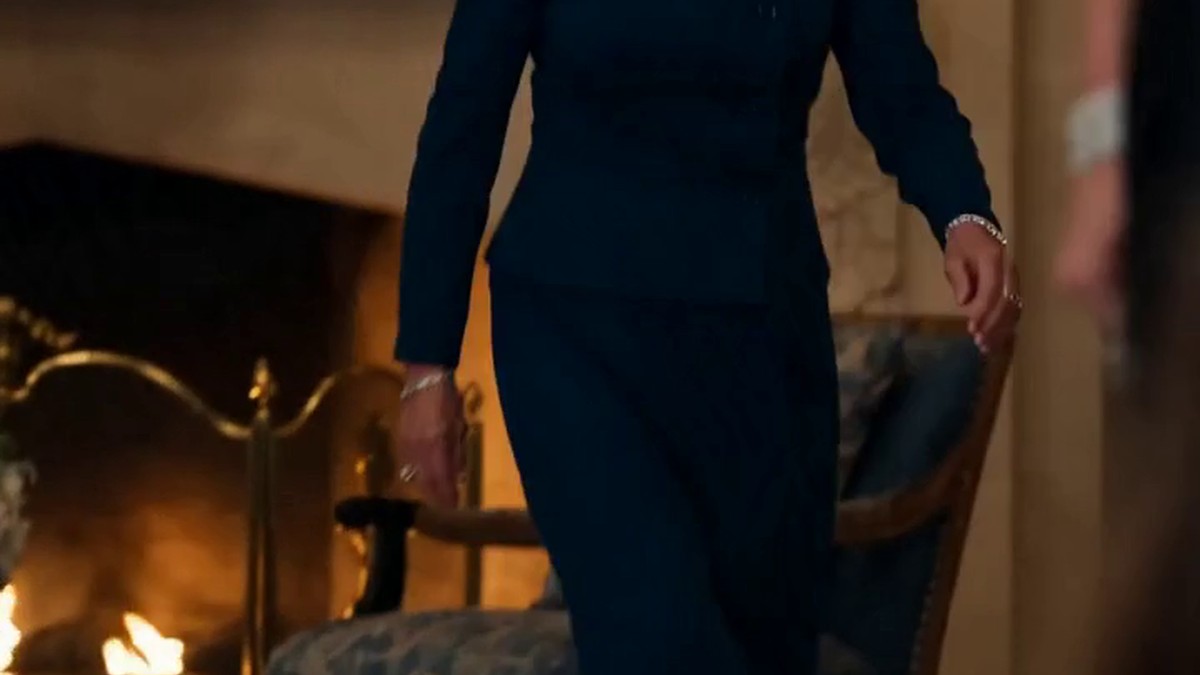
So did an older guest sitting near the fireplace in a navy coat — a woman who had been watching everything quietly, the way people watch when they already suspect they know the ending.
Martin kept his voice even.
“What photograph?”
Ellie swallowed.
“My mama told me — if I ever found this bag, I had to open the inside pocket.”
Victoria’s lips parted slightly.
Then came the smile. Slow. Polished. Deeply unpleasant.
“I suppose your mama was a thief as well.”
Ellie flinched as though something had struck her.
Her chin shook.
But her hands did not move.
“My mama is dead.”
The lobby softened around the girl — just slightly, just enough. But Victoria didn’t soften at all.
“Then she left you poor lessons.”
A murmur rippled through the room.
The older woman by the fireplace rose slowly from her chair.
Martin’s jaw set.
“Ms. Hale, I think we should take this into the office.”
“No,” Victoria said flatly. “This ends right here.”
She looked at the second guard.
“Remove her.”
Ellie went rigid with panic.
“Please — no!”
Victoria yanked the bag again. The strap torqued sideways. Ellie’s fingers slipped.
For a beat, it looked like Victoria had simply won.
Then Ellie lunged, shoved her hand into the open side pocket, and came out with a folded photograph.
Victoria made a sound with no word inside it.
“Give me that.”
But Ellie had already opened it.
The lobby went absolutely silent.
In the photograph: a younger Victoria Hale. No diamonds, no designer anything. Just a woman in a denim jacket, smiling stiffly beside another woman cradling a newborn wrapped in a pale pink blanket.
The woman holding the baby had Victoria’s eyes.
Not similar eyes.
The same eyes.
Same cut at the corners. Same sharpness. Same grief buried just beneath the surface of the pride.
Ellie pressed the photograph to her chest.
The woman in the navy coat took two careful steps forward.
Victoria’s voice dropped to a hiss.
“Where did you get that?”
Ellie’s cheeks were wet now.
“From Mama.”
“Your mother stole from me.”
Ellie shook her head.
“She said you left us behind.”
The words landed in the lobby the way a glass lands when it finally hits the floor.
Victoria looked around. Too many phones. Too many eyes. Too much already recorded.
She dropped her voice.
“Child, you have no idea what you’re talking about.”
Ellie looked straight up at her.
“Aunt Victoria.”
Several people gasped audibly.
Martin glanced from the photograph to the girl’s face, then back to Victoria.
Now that he was looking for it, the resemblance was impossible to dismiss. Same eyes. Same set of the mouth. Same stubborn tilt of the chin, as though the jaw itself refused to concede anything.
Victoria attempted a laugh.
“I don’t have a niece.”
Before anyone could react, Ellie reached into the bag again and pulled out a small square of pale pink fabric. Old. Faded at the edges. Folded with great care, the way people fold things they consider sacred.
The same blanket from the photograph.
The color left Victoria’s face.
The older guest breathed, “My God.”
Victoria spun toward her.
“Stay out of this.”
The woman did not stay out of it.
She stepped forward. Her silver hair was cut neatly at the chin, and though the years had softened her frame, they had done precisely nothing to her eyes.
“Victoria,” she said, quietly enough that it was meant only for her daughter. “Who is this child?”
Victoria’s entire posture locked up.
“Mother.”
The lobby inhaled.
Mother.
The woman in the navy coat was Eleanor Hale.
Not an ordinary guest. The owner of the Beaumont Grand. The woman whose family name was pressed into the brass of the front doors.
Ellie looked at her with an expression that was equal parts hope and terror.
Eleanor studied the girl as though her heart had just been handed a question her mind wasn’t prepared to answer yet.
“She’s no one,” Victoria said.
The little girl seemed to shrink inside herself.
One word. It did more damage than anything physical could have.
No one.
Eleanor’s gaze hardened.
“No child standing in my lobby is no one.”
Victoria’s mouth went tight.
“She’s running some kind of scheme.”
Ellie said softly, “Mama said you’d say that.”
Victoria turned on her.
“Stop saying mama.”
Ellie clutched the pink blanket.
“She said if you got angry, I should ask about the silver locket.”
Victoria stepped backward.
One step. Involuntary.
Eleanor’s eyes went straight to her daughter.
“What silver locket?”
Victoria said nothing.
Ellie reached for the bag again.
Victoria grabbed her wrist. Hard. Her nails bit into the girl’s skin.
Ellie cried out.
Martin moved immediately.
“Ma’am — let go of her.”
Victoria didn’t.
Her fingers pressed tighter.
“You have absolutely no idea,” she breathed, “what that woman did.”
Eleanor’s voice came down like a blade.
“Victoria.”
It carried the particular weight of a mother who has defended a child for too long and has just begun to wonder whether she defended the right one.
Victoria released Ellie’s wrist.
Ellie stumbled back into Martin’s arm.
Eleanor lowered herself slowly to the child’s level.
“What was your mother’s name?”
Ellie looked from Eleanor to Victoria. Then she said it.
“Rose.”
Eleanor’s face broke apart.
Not with noise. Not with drama.
Just quietly, completely — the way a face breaks when it has been holding something in place for years and finally cannot.
Every woman of a certain age in that lobby would have known it immediately. The expression of a mother hearing the name of a daughter she had grieved in private.
“Rose is gone?” Eleanor asked.
Ellie nodded.
“Last month.”
Eleanor’s hand went to her mouth.
Victoria looked somewhere else.
Eleanor’s voice came out fractured.
“How?”
Ellie looked at the floor.
“She got sick. She said rich people get doctors. People like us get prayers.”
Victoria closed her eyes.
Guilt got close enough to touch her for just a moment.
Then pride turned it away at the door.
Eleanor rose slowly.
“You told me Rose ran off with some man and wanted nothing more to do with us.”
Victoria’s expression went rigid.
“She did.”
Ellie shook her head.
“She didn’t.”
“You don’t know anything about it.”
Ellie reached into the pocket of her dress and produced a small envelope — folded and refolded so many times the creases had gone soft.
“Mama wrote everything down.”
Victoria stared at it.
“No.” The word came out stripped of everything.
Ellie extended the envelope toward Eleanor.
“Mama said to give this to Grandma Eleanor.”
The lobby fell silent again, all the way down.
Eleanor reached for it with unsteady hands.
Victoria moved.
“Don’t open that.”
Martin stepped between them.
“Ms. Hale.”
And then it happened — Victoria’s composure didn’t crack into grief. It cracked into something rawer than that.
Fear.
Eleanor looked at her daughter. Really looked at her.
“What did you do?”
Victoria’s eyes glistened, but nothing fell. Only the careful working of a mind deciding how much to offer.
“Mother,” she said, “if you read that letter, you will tear this family apart.”
Eleanor looked at the girl in the worn white dress.
Then at the photograph.
Then at the daughter she still loved, and no longer trusted.
“No,” she said, very quietly. “I think someone tore this family apart a long time ago.”
She opened the envelope.
Inside: a letter. And a key — small, brass, with a piece of red thread knotted through the bow.
Eleanor read the first line to herself.
Her knees nearly went out from under her.
Victoria said, barely above a whisper, “Mother. Please.”
Eleanor looked at Ellie. Then at the key. Then at the bag.
And she read aloud, her voice fracturing on every other word.
“My darling Mama — if Ellie found Victoria’s bag, it means my daughter finally got close enough to the truth.”
Victoria turned toward the front entrance.
Every line of her body said she was going to run.
The older woman in the navy coat saw it before anyone else.
“Lock the doors,” Eleanor said.
Martin nodded once.
And for the first time in her life, Victoria Hale understood that the hotel she had always worn like a crown had just become a prison.
She took one step toward the revolving glass doors.
Then another.
Her heels rang sharp against the marble, the sound carrying the way sound always carried in the Beaumont Grand — up through the vaulted ceiling, back down the walls, returned to its source amplified and unavoidable.
Martin reached the door before she did.
He planted himself with the particular stillness of a man who has handled difficult guests for twenty years and has never once enjoyed it.
“Ms. Hale.”
Victoria stopped.
She was three feet from the exit. Close enough to feel the air pressure change, the ghost of the outside world pressing back against the glass. She stood there with her spine rigid and her cream bag clutched to her side, and for a moment she was simply a woman in a doorway deciding whether the life she had built was worth defending.
She decided it was.
She turned around.
Her face had been reorganized into something almost tranquil.
“Mother,” she said, moving back toward Eleanor with the measured grace of someone who had never admitted to anything in a room with witnesses. “I understand how this looks.”
Eleanor did not look up from the letter.
The pages were pale blue, covered in handwriting that had clearly been composed in stages — the ink changed shade in places, as though the writer had set it down and come back to it across different days, different states of mind, different levels of strength.
Ellie had stepped back against the wall near the fireplace. Martin’s hand rested lightly on her shoulder. She was watching her aunt the way small animals watch things that have already hurt them once.
Victoria stopped a few feet from her mother.
“There are things in that letter that are out of context.”
Eleanor turned a page.
“Rose’s handwriting,” she said, to no one in particular.
“Mother—”
“She always pressed too hard with the pen.” Eleanor’s voice was very quiet. “She wore through notebooks. I used to scold her for it.”
Victoria’s composure flickered.
“She exaggerated everything. You know that. She always dramatized.”
Eleanor looked up.
Her eyes were the color of winter water — grey and deep and cold with a particular cold that comes not from temperature but from the arrival of a truth that has been swimming toward you for years.
“She writes that you paid someone to tell me she’d left voluntarily.”
Victoria said nothing.
“She writes that she was pregnant. That she came to you first, before she came to me. Because she was frightened of my reaction and she thought you’d help her.”
“She came to me with her hand out,” Victoria said. Quietly, but with precision. The precision of someone who has rehearsed a version of events so many times it has calcified into personal mythology. “She wanted money. She wanted me to go to you on her behalf and negotiate some kind of — allowance. For her and this man she barely knew.”
“His name was Thomas,” Ellie said from the wall.
Victoria’s eyes cut to her.
“I didn’t ask you.”
“He died when I was two,” Ellie continued, as though the interruption hadn’t happened. Her voice was utterly steady. “Mama said he was good. She said he fixed cars and he made her laugh and she loved him more than she knew how to say.”
Something moved through Victoria’s face. It was not contempt. It was harder to name than that.
Eleanor resumed reading.
The lobby had not resumed its normal operations. Guests stood with their phones lowered now, because this had become something they understood even if they couldn’t have articulated why — a reckoning happening at full public volume, the kind you don’t film. The kind you simply witness.
A young woman near the concierge desk pressed her fingers to her lips.
The man who’d been murmuring into his phone had stopped entirely.
Eleanor turned the final page.
She read it in silence this time. When she finished, she folded it back along its worn creases and held it closed between both hands, the way you hold something you’ve been handed that you will carry for the rest of your life.
She didn’t speak immediately.
The fire crackled in the hearth. A log shifted. The chandelier threw its cold beautiful light down across all of them.
“She tried to call me,” Eleanor said finally. “Rose. She tried to call me.”
“She wanted money—”
“She wanted her mother.” Eleanor’s voice fractured on the last word and then rebuilt itself into something harder. “She was twenty-two years old, she was alone, and she wanted her mother. And you told me she never tried to contact us.”
Victoria’s jaw moved without producing sound.
“You intercepted her calls.” It wasn’t a question. Eleanor looked at the letter again as though verifying what she already knew. “For how long?”
Victoria said, “You would have given her everything. The whole estate would have been divided and handed to a girl who couldn’t manage it and a man you’d never vetted, and—”
“How long, Victoria.”
The name came out like a door being closed.
“Three years.” Barely a word at all.
Eleanor pressed her hand flat against the letter.
“Three years.” She repeated it to herself, measuring the weight of it. “And then?”
Victoria said nothing.
Ellie spoke from the wall, small and precise as a nail being driven home.
“And then Mama stopped trying.”
The lobby held its breath.
Eleanor looked at her granddaughter. The word arranged itself slowly, the shape of it new in her mind. Granddaughter. A child who had spent the night before this in God knows where. A child who had found a cream handbag and understood that it was her only key, and had walked into this room and held on.
She crossed to Ellie.
She didn’t rush it. She walked steadily across the marble floor with all the deliberateness of a woman who has been wrong about something important and is not going to be careless with what comes next.
She crouched — knees protesting, years of them — until she was level with the girl.
Ellie watched her with those exhausted, careful eyes.
“May I see the photograph?” Eleanor asked.
Ellie unfolded it from her chest and held it out.
Eleanor took it in both hands. She looked at the younger version of herself on the left. At the rigid smile. At the coat she remembered — wool, charcoal, bought in London the winter before everything went wrong between the sisters.
At Rose.
Rose in her denim jacket with her hair loose, cradling the pink bundle, lit up with the particular joy of someone who has just made something new in the world and hasn’t yet been told they’ll have to do it alone.
“She was beautiful,” Eleanor said.
“Yes,” Ellie said.
“You have her eyes.”
Ellie’s chin trembled.
“Everyone says that.”
“It’s true.” Eleanor set her thumb gently against the edge of the photograph, not touching Rose’s image directly, just holding the border of it. “And she was brave. To raise you alone the way she did.”
“She used to say she had enough love for two parents.”
The sound Eleanor made was not quite a laugh and not quite a sob. It was the specific noise of recognition — of hearing something so perfectly in keeping with the sister she had lost that it hurt like a new wound and a healing one simultaneously.
She looked at the small brass key still resting in her palm.
“Do you know what this opens?”
Ellie shook her head. “Mama said you would.”
Eleanor turned it over. The red thread through the bow was frayed, the knot tight and old.
She did know.
A safety deposit box at the Beaumont’s private banking branch three floors up. She had given Rose a key to it the summer Rose turned eighteen — a private account, set up quietly, meant to be a safety net that bypassed the formal estate structure. Something Eleanor had arranged without telling Victoria, because even then she had felt, dimly and guiltily, that one daughter needed protecting from the other.
She had assumed the key was lost. She had assumed the account had gone dormant and been absorbed.
She had assumed Rose had chosen not to use it.
She stood.
She looked at Victoria.
Victoria stood very still now, the cream handbag pressed against her side, her face a controlled portrait of a woman who knows the ground under her has shifted but refuses to let her footing show it.
“The box,” Eleanor said.
Victoria’s eye twitched once.
“Mother, whatever Rose put in there—”
“You knew about it.”
Not a question this time either.
Victoria said, “I knew she had a key.”
“And?”
The silence stretched.
“And I had the contents reviewed,” Victoria said. “Years ago. There was nothing material. Some papers. A recording.”
“A recording,” Eleanor repeated.
Victoria’s voice tightened at its edges. “Of a private conversation. That Rose — that she manufactured into something that sounded far worse than—”
“A recording of you,” Eleanor said. “Telling her to disappear.”
The lobby might as well have stopped breathing entirely.
Ellie was watching her aunt.
Victoria met her niece’s gaze for the first time since the girl had seized her strap.
It lasted only a second.
But in that second, something passed between them that no manufactured composure could cover. Victoria saw, in those dark eyes, not hatred. Not accusation. Just the clear, unwavering sight of a child who had been told the truth by a woman who loved her and who had arrived at this marble floor prepared to believe it.
It was worse than hatred.
Victoria looked away first.
She set the bag down.
It was a small movement. Unhurried, controlled, placed with precision on the lobby floor as though she were setting it down by choice. As though it had always been her decision.
But her hands were trembling.
“I was protecting this family,” she said. To the bag. To the marble. To the particular middle distance where people direct confessions when they are not ready to direct them at another human face.
“You were protecting your inheritance,” Eleanor said.
“It amounts to the same thing.”
“It does not.”
Victoria finally looked at her mother. Full on. Nothing shielded.
And for a moment — just a moment — what lived in her face was not the polished cruelty the lobby had catalogued, nor the cold architect of every careful move. It was something older and more ordinary. The fear of a woman who made a choice at twenty-eight years old that she told herself was rational, and has been defending it ever since with increasing ferocity because to stop defending it would mean acknowledging what it actually was.
“If you’d divided it,” Victoria said, “there would have been nothing left worth having.”
Eleanor looked at her for a long time.
“You’d better hope,” she said quietly, “that when your account is settled, you’re not judged on what you chose to protect.”
She turned to Martin.
“Please take Ellie upstairs and see she has everything she needs. The Carrington suite. And call Dr. Fenwick — I want her checked over.”
Martin nodded. He touched Ellie’s shoulder gently.
Ellie took a step forward, then stopped.
She turned back to her grandmother.
She held out the photograph.
Eleanor shook her head.
“You keep it. She’s yours.”
Ellie folded it back to her chest.
“Will you come upstairs?” Ellie asked. “After?”
Eleanor looked at her. This child with Rose’s eyes and Rose’s stubborn chin and a worn white dress and eight years of a life lived at the exact edge of enough.
“Yes,” she said. “I’ll come.”
Martin guided Ellie toward the elevator. The lobby moved again — quietly, carefully, the way a room resumes itself after something real has happened in it.
Eleanor picked up the bag from the floor. She held it out to Victoria.
Victoria didn’t take it.
“What happens now?” Victoria asked.
Eleanor considered.
“Now,” she said, “I go upstairs and I meet my granddaughter. And you call your attorney. Because what Rose put in that box is going to require some difficult conversations, and I would rather they happen with legal counsel present than in a hotel lobby on a Tuesday morning.”
Victoria said, “And us?”
Eleanor was already moving toward the elevator.
She paused. Didn’t turn.
“I don’t know yet,” she said.
It was honest. It was the most honest thing said in that lobby in twenty years.
The elevator doors opened. Eleanor stepped inside.
The lobby held for a moment — chandeliers throwing their cold brilliance, marble holding the sound of everything that had just happened inside it like water holds a stone.
Then the doors closed.
And upstairs, in the Carrington suite, a small girl in a worn white dress sat on the edge of a bed large enough to seem impossible, holding a photograph and a square of pink blanket, and waited for her grandmother to arrive.
She waited with her hands in her lap and her back straight, the way her mother had taught her to wait — with patience, not defeat.
The elevator opened down the hall.
Footsteps.
Slow, deliberate, carrying the weight of years and grief and the particular resolve of someone who has just discovered they have far more left to do than they believed.
A knock.
Ellie looked at the door.
“Come in,” she said.
And it opened.