The old Italian piazza hummed with life — tourists drifting in lazy currents, street musicians pulling melodies from the warm air, voices bouncing off walls that had stood for centuries. A ordinary afternoon in an ancient place.
Then it happened.
All three girls went still.
Not one. Not two. All three — at the exact same instant — as if someone had cut a single wire running through all of them.
They turned. In unison. Toward the far corner of the square, where an old homeless woman sat hunched beside a fountain, draped in tattered gray shawls that had long forgotten their original color.
The mother laughed softly, nervously, and called their names.
The girls didn’t look back.
They ran.
Hard and fast, the way children run toward something they recognize in their bones — straight into the arms of a stranger who was, somehow, not a stranger at all.
The old woman sucked in a sharp breath as all three of them climbed into her lap at once, arms wrapping around her neck, small faces pressing into her collarbone, holding on the way you hold on after a very long time apart.
Then the woman shattered.
Her sobbing came from somewhere deep and old, rocking her whole body.
People stopped mid-stride.
Cameras dropped to their sides.
The musicians let their songs die in the air.
And then came the thing that drained the blood from the mother’s face.
All three girls whispered the same word at the same moment, their voices threaded together like a single sound.
*”Nonna…”*
Grandmother.
The mother stood completely rigid.
She had never taught them Italian. Not one word. Not once.
Then one of the toddlers lifted her tiny hand and pressed it gently against the old woman’s weathered cheek.
“You cried,” the little girl murmured, “when the train left.”
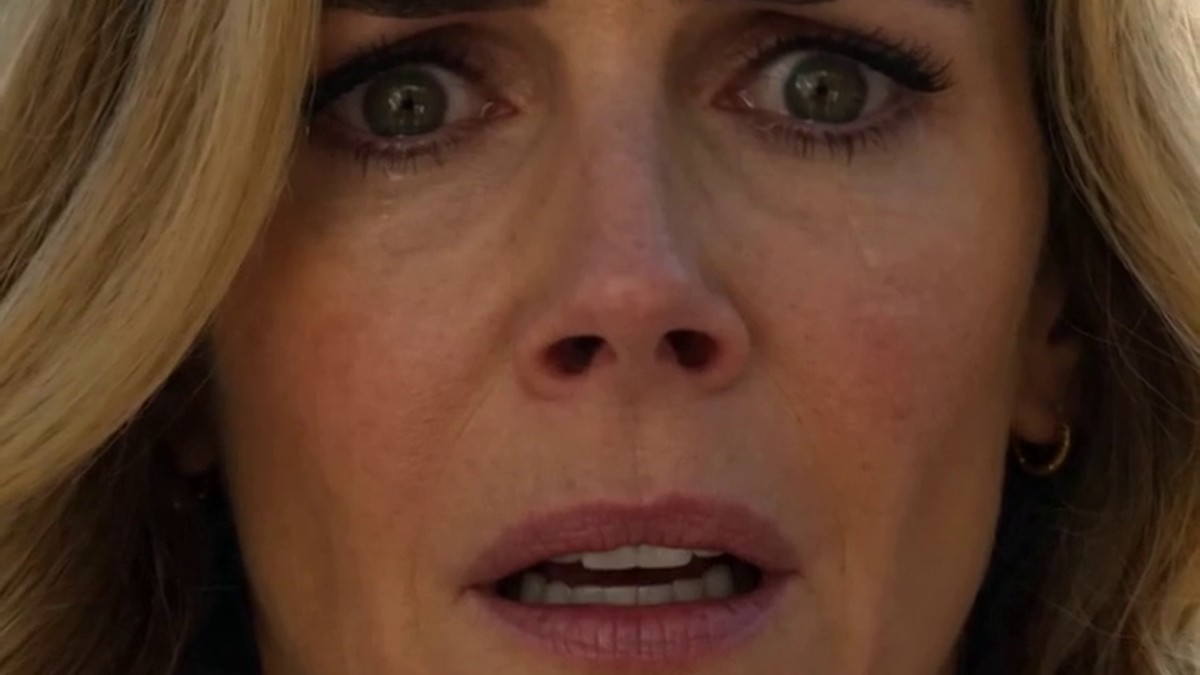
The mother’s knees buckled.
Those words meant nothing to a child who had never heard them before.
But they were everything to her — the last image locked behind her eyes from before she was found without a name, without a history, without a country, and quietly adopted to a life far away.
The father stood motionless, his face a map of confusion, as one of the other girls reached beneath the fold of the old woman’s shawl. Her small fingers closed around something. She pulled it free.
A tiny silver locket.
The mother didn’t hesitate. She screamed.
She knew it before she could explain how she knew it — from the single surviving photograph, taken before she vanished as a small child, the locket hanging at her throat like a detail from a life that no longer existed.
The old woman’s hands flew to her mouth, trembling violently.
When she finally spoke, her voice barely reached a whisper. But the whole piazza heard it.
“I buried that locket with your mother.”
A silence fell over the square that felt almost sacred.
And all three girls slowly raised their eyes — together, calm, certain — as if they had been waiting for that sentence. As if, somehow, they had always known exactly what it meant.
The mother couldn’t move.
Her legs had simply stopped working, the way they do in dreams when the ground turns to water beneath you. She stood in the middle of that ancient piazza, sun beating down on the cobblestones, the whole world suddenly too bright and too loud and too much — and also, somehow, completely, terrifyingly silent.
The father reached for her arm. She didn’t feel it.
“I buried that locket with your mother.”
The sentence played again behind her eyes. And again. A record with a skip in it, the needle catching the same groove over and over until the sound became meaningless and then, suddenly, devastatingly full of meaning.
“What did you say?” she whispered.
Her voice came out wrong. Too small. The voice of a child, not a woman.
The old woman looked up at her from the edge of the fountain, the three girls still draped across her lap like they belonged there, like they had always belonged there. Her eyes were very dark and very steady — eyes that had done a great deal of waiting, that had grown accustomed to the particular weight of years.
“I said,” she repeated, each word deliberate as a footstep on ice, “I buried that locket with your mother. Thirty-one years ago. In the churchyard of San Benedetto. I placed it in her hands myself.”
The father stepped forward then, instinct overriding confusion. His hand went gently to his wife’s back.
“I’m sorry,” he said carefully, in slow tourist Italian, “I don’t understand. Who are you?”
The old woman looked at him. Then she looked at the mother. A long look. The kind of look that sorts through time and settles something.
“My name is Orsolina Ferretti,” she said. “I was housekeeper to the Marchetti family for forty-one years.” She paused. “This woman’s family.”
The word landed in the mother’s chest like a stone dropped into still water. *Family.* A word she had spent a lifetime building from scratch, assembling piece by piece from people who chose her — her husband, her daughters, the quiet accumulation of a life made from love rather than blood. And now here it was, the original thing, surfacing from beneath thirty-one years of water.
“My family,” she repeated, and the words felt foreign and electric in her mouth, like touching a live wire with bare hands.
“You were three years old,” Orsolina said softly. “When they took you to the train. Your mother — your real mother — was very ill by then. She knew she was dying. She wanted you safe. She had a cousin in the north, someone she trusted. She put you on that train herself.” The old woman’s voice fractured, just slightly, then held. “She stood on the platform and she cried until the train was gone.”
The mother’s hand flew to her mouth.
*You cried when the train left.*
Her daughter’s voice. Her three-year-old daughter’s voice, pressing a small palm to a stranger’s cheek in the middle of an Italian square.
She looked at her girls now — really looked at them. They were watching her from Orsolina’s lap with those calm, certain eyes, and something about their stillness was almost unbearable. They didn’t look frightened. They didn’t look confused. They looked, all three of them, like people who had delivered a message and were now simply waiting to see it received.
“How?” the mother managed. Her voice was barely sound. “How could they know that?”
Orsolina shook her head, very slowly. “I have asked myself this every day since I sat down here and they came running.” She stroked the hair of the smallest girl with one trembling hand. “I have no answer. I stopped believing in easy answers a very long time ago.”
The father exhaled. He was a practical man — an engineer, a man who trusted load-bearing walls and measurable quantities — and he stood now in the ruins of every category he had ever relied upon. But he was also a father, and he could see his wife disintegrating in front of him, and so he did the only useful thing he could think of. He pulled out a crumpled receipt from his pocket and a pen, and he sat down on the edge of the fountain beside Orsolina.
“Tell us,” he said simply. “Everything. From the beginning.”
—
Orsolina told them.
She talked for a long time. Her Italian was heavily accented with something regional and old, and the father understood perhaps a third of it and his wife, discovering language she hadn’t known she carried, understood somehow much more. Orsolina talked about the Marchetti house — a tall narrow building two streets over that was now a boutique hotel — and about Giovanna Marchetti, who had been beautiful and serious and had died of a fast, merciless cancer at thirty-four years old. She talked about the cousin in the north who was supposed to take the child and didn’t — who sent the child on instead, to a church charity, to a social worker, to the quiet machinery of the Italian welfare system, which eventually lost track of one small girl among many. She talked about the search that followed — years of it, fruitless and agonizing. She talked about Giovanna’s last days and the locket — a family piece, old silver, with two tiny portraits inside — that Giovanna had held until the final hour.
“She made me promise,” Orsolina said. “If I ever found the child, I was to give it to her. I promised. And then I buried it with her, because I believed — I had no choice but to believe — that the child was gone.”
The mother was crying by now, silently, tears moving down her face in steady lines, the way rain moves down glass.
“Open it,” said one of the girls.
They all turned. The middle daughter — five years old, gap-toothed, the one who had once spent twenty minutes solemnly explaining to a houseplant that it needed to *try harder* — was sitting very straight in Orsolina’s lap, pointing at the locket in the mother’s hand.
The mother looked down. She hadn’t realized she was still holding it.
Her fingers fumbled with the clasp. Old silver, slightly tarnished, warm from the sun. The mechanism resisted, then gave.
Inside, on the left: a young woman. Dark-eyed, serious, beautiful in the particular way of old photographs — every feature rendered in careful light and shadow. A woman the mother had never seen and recognized immediately, in the helpless cellular way that you recognize certain music, certain smells, the angle of afternoon light in a room where something happened to you a long time ago.
Inside, on the right: a small child. Three years old, perhaps. Round-faced, caught mid-laugh by whoever held the camera.
The mother had seen this face before. In a photograph taken on a spring day before she vanished into the system. In the bathroom mirror, every morning of her life.
She made a sound she had never made before. It had no name. It came from a place in her chest that had been sealed for thirty-one years, and when it opened, it opened completely.
Her husband caught her. The girls scrambled down from Orsolina’s lap and wrapped themselves around their mother’s legs, all three of them at once, holding on — the way they had held the old woman, the way children hold when they understand something adults don’t yet have words for.
Orsolina rose to her feet, slowly, the way old bodies rise — with effort and with patience. She straightened her gray shawls. She looked at the little family folded together on the cobblestones of the piazza, this woman who had been lost and her daughters who had somehow known where to find the thread that would lead her back.
The tourists who had stopped to watch began, quietly, to look away. Not from disinterest. From the opposite. Some things are too whole to stare at directly.
The street musician — a young man with a violin who had let his song die in the air — lifted his bow again now, without quite knowing why, and began to play something slow and old that his grandmother had taught him.
—
Later — much later, after the long afternoon had turned to the purple dusk that settles over old Italian cities like a held breath — they sat in a small restaurant two streets from the piazza. Orsolina, who had no place she needed to be, was across the table from them. The girls were eating pasta with the focused dedication of children who have had an emotionally exhausting day and are now replenishing. The father had ordered wine. The mother held her glass but didn’t drink from it.
“There is a grave,” the mother said. It wasn’t a question.
“Yes,” said Orsolina. “San Benedetto. I will take you.”
“And the house — the hotel—”
“The family sold it many years ago. There is nothing left in it that remembers.” Orsolina spread her hands. “But I remember. I have remembered all of it, every day. It is perhaps why I am still here, walking around.” A small, dry smile. “Someone has to.”
The mother nodded slowly. She turned the locket over in her fingers, open, the two small portraits facing upward. Her thumb moved across the face of the woman — her mother, a word she was only now learning for the first time in its truest and most irreversible sense.
“She would have liked you,” Orsolina said. “Giovanna. She was serious, like you. She thought too much. She loved fiercely.” The old woman’s eyes were very bright. “She never stopped looking, even at the end. Even when the pain was very bad. She kept asking — *have they found her, have they heard anything.* I told her yes. I lied.”
The mother set down her glass.
“I’m glad you lied,” she said.
Orsolina nodded, once. Agreement, absolution, both at once.
The smallest girl had finished her pasta and climbed into the mother’s lap and was now inspecting the locket with the grave scientific interest she applied to all small objects. She touched the portrait of the young woman. She looked up at her mother’s face. She looked back at the portrait.
“Same eyes,” she announced.
The mother laughed — a real laugh, sudden and unguarded, the kind that arrives after crying and carries both things in it at once. She pulled her daughter close and pressed her face into the child’s hair and stayed there for a moment, just breathing.
The father reached across the table and covered her hand with his.
Outside, the piazza was quieting. The tourists had scattered to their dinners. The fountain caught the last of the light and threw it in small bright pieces across the old stones. Somewhere nearby, the violin was still playing — the grandmother’s song, that slow, unnamed thing — moving through the warm evening air and out across the rooftops of the ancient city, above the streets and the centuries and the long, impossible distances between the people who belong to each other.
The locket lay open on the table between them.
Two faces. Thirty-one years. Three small girls who had run across a piazza on a Tuesday afternoon as though they had always known exactly where they were going.
Some threads, it turns out, are too strong to stay buried.
Some things that are lost are only waiting — in the hands of an old woman by a fountain, in the instincts of children who know without knowing, in the particular gravity that pulls what belongs together back toward itself across every distance time can make.
The mother closed her fingers around the locket.
And held on.