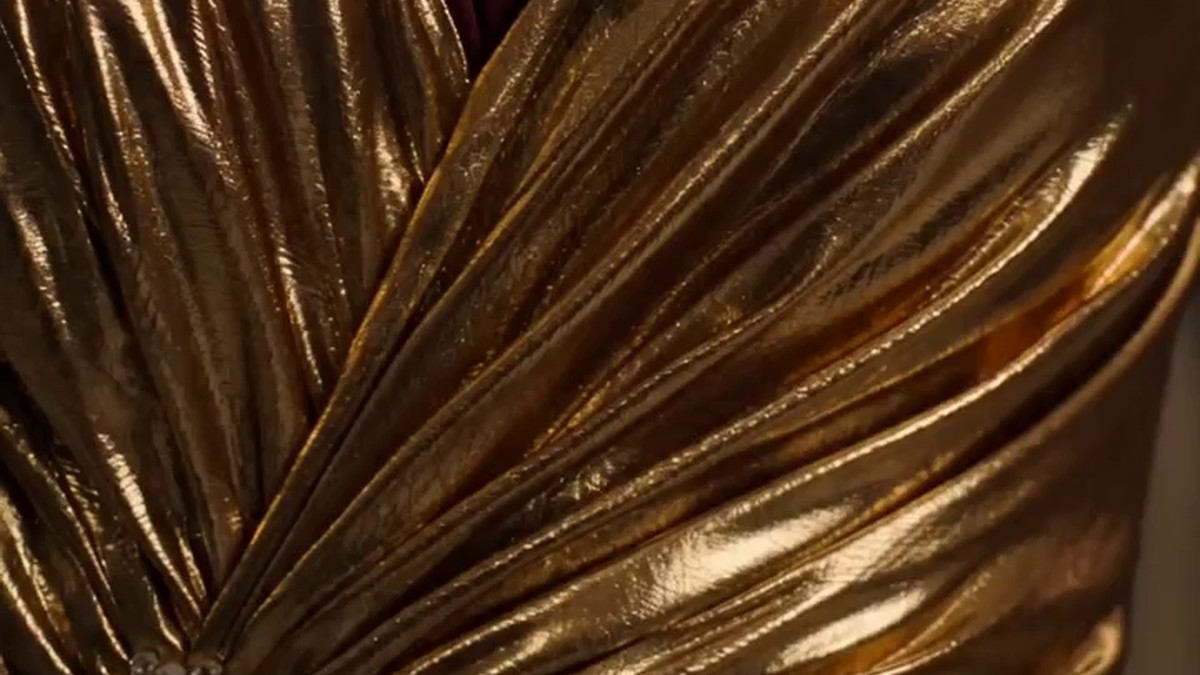
Every evening, his estate came alive.
The marble hall filled with the kind of people whose names appeared in headlines — businessmen, models, politicians, actors. Everyone knew the rule: if Arthur invited you, the night would cost someone something.
There was another rule. A quieter one. The guests only whispered about it.
Arthur liked to humiliate his staff.
Leila had worked for him for several years. She was around forty-five, soft-spoken, a little heavy-set, and built entirely from silence and patience. She never argued. She moved through the rooms like smoke — invisible by design, careful never to catch the eye of the man who signed her checks.
Arthur had noticed that, too.
Which is why, almost every single day, he would reach into his jacket, pull out a thick roll of bills, and scatter them across the perfectly clean floor with the lazy satisfaction of someone feeding pigeons.
— Looks like you missed a spot. Pick it up.
Leila would collect every bill. Stack them. Hand them back without a word.
The guests laughed. Arthur laughed loudest.
That particular evening, the centerpiece of the great hall was something new.
Beneath a glass dome stood a mannequin dressed in a gown that stopped conversation cold — gold and crimson, hand-embroidered, threaded with what appeared to be actual gemstones catching the chandelier light like trapped fire.
Arthur had acquired it at a closed European auction. Several million dollars. According to historians, the dress had once belonged to a European queen, locked away in a private collection for generations, considered beyond price.
Now it stood in the middle of his living room so that every guest would see it first.
Leila passed by with a mop and bucket.
She stopped. Just for a moment.
She had never seen anything like it.
A small, quiet smile crossed her face, and she whispered almost to herself —
— What a story this dress must carry… All those years…
A mocking voice cut through the air behind her.
— Don’t you have somewhere to be?
She turned. Arthur stood there with his young date on his arm and a cluster of friends at his back, all of them already grinning.
He reached slowly into his inner jacket pocket. Pulled out a thick stack of hundreds.
No preamble. He released them into the air.
The bills rained down across the floor.
— There you go. Back to work.
Leila looked at him calmly.
— I was just looking at the gown. It’s not just a dress. It’s a piece of history.
Arthur’s smile sharpened into something cruel.
— History. That’s rich, coming from the cleaning lady.
Laughter rippled through the room.
He turned slightly toward the glass dome, raising his voice just enough to be sure every guest in earshot could hear him.
— You love it so much? Fine. Tonight, put it on and walk out in front of my guests.
The laughter swelled.
His date pressed her fingers over her mouth, eyes dancing.
Arthur let the silence stretch before he finished it.
— And here’s the deal — if you actually show up in that dress tonight, I’ll grant you any wish you have. Absolutely anything.
He held her gaze.
— But if you don’t come… you work for me for free. For however long I decide.
The room went quiet.
Everyone looked at the gown.
It was small. Narrow. Cut for a woman from another century entirely. There wasn’t a single person present who believed Leila could fit into it. Not even close.
This was the game. Everyone understood what it was.
Another evening’s entertainment at Leila’s expense.
Arthur had already won in his own mind. He could feel it — the anticipation of watching her try and fail and flush red in front of everyone.
Leila was quiet for a few seconds.
Then, with a steadiness that didn’t belong in the moment, she said —
— All right. I’ll be there tonight.
She turned, bent down, gathered every bill from the floor, placed them back in Arthur’s hands, and walked away.
Arthur laughed like a man who had just been handed a gift.
— Tonight is going to be one for the books.
But what happened a few hours later made every single guest forget the legendary dress entirely.
The dress was smaller than anyone had imagined up close. Arthur made a point of mentioning this to three different guests in the hour that followed, each time with fresh amusement, each time letting the punchline land a little heavier.
“There’s simply no world in which she fits into that thing.”
He was right, and everyone knew it. The gown had been designed for a woman of court proportions — corseted, narrow, impossibly structured. It looked less like clothing and more like a work of architecture. A museum piece in the truest sense. Something to be admired from a safe distance.
By ten o’clock the party had reached its full velocity. Champagne moved through the crowd on silver trays. A jazz quartet played somewhere at the back of the house. Arthur moved through the rooms like a man who owned the weather — accepting compliments the way others accept breathing, already composing the version of tonight he’d be telling for the next decade.
He had almost forgotten about Leila entirely.
Then the music stopped.
Not faded. Not ended. *Stopped.* Mid-phrase, mid-note, as though someone had lifted a needle from a record.
Every head in the room turned toward the main staircase.
Leila stood at the top of it.
And she was wearing the dress.
Not struggling with it. Not seams straining, not a desperate compromise, not the spectacle of failure everyone had quietly been waiting for. The gown sat on her as though it had been cut for her body and no other. The gold and crimson caught the chandelier light and threw it back across the ceiling in broken fragments that moved like something alive. The embroidered hemline swept the marble step. The gemstones along the collar traced a pattern across her collarbone that looked, in that light, less like decoration and more like a crown that had simply slipped.
She walked down the stairs slowly.
Her spine was straight. Her chin was level. Her hands were still at her sides.
The room watched her the way rooms watch things they don’t yet have language for.
Arthur didn’t move.
He stood with his champagne glass raised to a height that no longer made any sense, arm suspended mid-gesture, the word he’d been about to say evaporated somewhere between his brain and his mouth. His date reached over and quietly lowered his arm for him.
Leila reached the bottom of the staircase and walked to the center of the room. To the empty glass dome. She stopped there, turned, and faced the crowd with an expression so composed it carried its own kind of gravity.
Arthur found his voice somewhere deep in his chest.
— How.
It wasn’t really a question.
— It needed to be let out along the side seams, Leila said. And the bodice lining required adjusting. I worked with fabric for twelve years before this job. I know what a dress needs to breathe.
Someone in the crowd made a sound that wasn’t quite a laugh and wasn’t quite a gasp.
— You *altered* it? Arthur said.
The word came out flat. Dangerous.
— I repaired it. There was damage along the left panel that no one had noticed. I documented everything — the original stitching pattern, the thread count, every adjustment point. It’s all photographed and logged. The dress is in better condition now than when it arrived in this house.
A silence settled over the room like weather.
Arthur set his glass down on the nearest surface without looking at where it landed.
— You had no right, he said quietly.
— You told me to put it on. You didn’t specify conditions beyond appearing in it tonight. Which I’ve done.
She met his eyes steadily.
— I believe you owe me a wish.
The room was so quiet they could hear the candles.
Arthur stared at her. The muscle in his jaw worked twice.
— Fine. He said it like a door slamming shut. *Fine.* Name it.
Leila reached into the hidden pocket sewn into the lining of the gown — the kind of pocket that existed in dresses from that era, functional and invisible, made for women who carried things that mattered. She produced a single folded envelope and held it out toward him.
— I want you to open that. And read what’s inside. Out loud. To your guests.
The laughter that had been gathering somewhere in the room died before it started.
Arthur took the envelope.
He looked at it. Then at her.
Something moved across his face that no guest had ever seen there before — not anger, not amusement, not the easy cruelty that had been his default expression for as long as anyone in this room had known him. Something older. Something that lived underneath the expensive suits and the scattered hundreds and the glass dome at the center of his hall.
Something that looked, unmistakably, like recognition.
He opened the envelope.
The paper inside was a single sheet, dense with clean, methodical text. He unfolded it slowly. His eyes moved across the first line.
Then stopped.
— Where did you get this, he said very quietly.
— I’ve worked in your home for several years, Mr. Wayland. People tend to forget the woman with the mop is in the room.
He looked up at her. His face had gone a color that didn’t belong on it.
— *Read it*, said a voice from somewhere in the crowd.
Then another. Then a third.
Arthur looked out at the room — at the faces watching him. At the senator he’d been cultivating for three years, standing near the fireplace holding a whiskey with an expression like carved stone. At the investor who had built a second empire on Arthur’s word alone. At the journalist who’d been promised an exclusive profile the following month. All of them. Watching.
He looked back down at the paper.
And he began to read.
It took four minutes.
No one moved. No one spoke. The jazz quartet had packed up and slipped out sometime during the second page, and no one noticed them go.
The document laid out, in language stripped of all mercy, eighteen months of financial decisions that the public record did not reflect. Contracts awarded to companies that existed only on paper. Money routed through accounts belonging to employees who had never been informed. Inspections passed without being conducted. Agreements signed in private rooms with public figures — several of whom were present in this very house tonight.
Names. Dates. Account numbers.
All of it.
Leila had not written it. She had found it. Three separate times, in three separate locations — a desk drawer left unlocked after a late call, a waste bin not fully emptied before the cleaners came through, a printer tray loaded with pages from a meeting that had no official record. She had photographed everything. Quietly. Patiently. In the way that people do when no one is watching them.
As people in her position were so easily forgotten to do.
— Copies of this document, Leila said when Arthur’s voice reached its end, have already been submitted to the Financial Crimes Enforcement Unit and two separate investigative journalists. That happened approximately one hour ago. I mention it only so that no one in this room is under any illusion about what tonight actually is.
She paused.
— This isn’t blackmail. This is documentation. It was always going to reach the right people. The dress was simply the occasion I was waiting for.
Arthur set the paper down on the edge of the display stand. His hand was perfectly steady, she noticed. Whatever else he was, he was not a man who shook.
He looked at her for a long moment.
Then, very quietly —
— You planned this.
— I waited, Leila said. There’s a difference.
The senator had already slipped out. She heard the front door close — soft, controlled, the exit of a man who had done it before. The investor was turned toward the wall with his phone pressed to his ear, voice too low to carry across the room. Several others had discovered reasons to be elsewhere in the house. Or outside of it entirely.
Arthur’s date was gone. Leila hadn’t seen her leave.
What remained was a smaller room now. Quieter. The chandelier overhead suddenly seemed designed for a grander space than this.
Arthur stood alone beside the empty glass dome. He looked at the stand where the dress had been, and then at the woman wearing it, and something in his expression moved through several things at once before it came to rest somewhere exhausted and without performance.
— You could have left, he said. Years ago. When you first found something. You could have walked out.
— I could have, Leila said.
— Why didn’t you?
She considered this honestly.
— Because you would have replaced me with someone else. And they wouldn’t have known what they were looking for. Or where. Or how long to wait.
He nodded — slow, deliberate — the nod of a man receiving a verdict he already knew was coming.
— The dress, he said finally.
— What about it?
— It belongs in a museum.
Leila looked at him for a moment.
— Yes, she said. It does.
— I’ll arrange it.
— I know. That’s outlined in the second envelope. The one your attorney receives in the morning.
He almost smiled. The ghost of it crossed his face and didn’t land.
— You thought of everything.
— I’ve spent several years in your house, Mr. Wayland. I had time to think.
She turned then, without ceremony, and walked back toward the staircase. Her steps on the marble were even and unhurried. The gown moved around her like something that had always understood what motion was — alive in the way that objects are sometimes alive when they find their way back to purpose.
At the foot of the stairs she paused. Her hand rested lightly on the banister.
She didn’t look back.
— I’ll leave the dress with your housekeeper tomorrow morning. Properly folded, fully documented, ready for transport.
And then she walked up the stairs and out of the room and out of Arthur Wayland’s life, wearing a dead queen’s gown as though she had always known the exact weight of it.
—
The great hall was nearly empty now.
Arthur stood alone beside the glass dome, his reflection caught faintly in its curved surface — smaller than life, slightly warped, tilted at an angle that didn’t quite match the man he believed himself to be.
Outside the tall windows, the first gray suggestion of dawn was pressing against the dark edge of the sky. Somewhere across the city, an inbox was filling. A phone on a nightstand was about to begin ringing. A fax machine in a government office was receiving pages one by one, each one clean and precise and irrefutable.
Arthur Wayland looked down at his hands.
They were still clean.
For now.
The chandelier above him flickered once — a brief, sourceless tremor — and then settled back into its steady light, illuminating a room that felt, for the first time in years, like it belonged to no one at all.





