“Move aside, beggar!”
Merchants fell silent. Villagers scrambled away from the city gate.
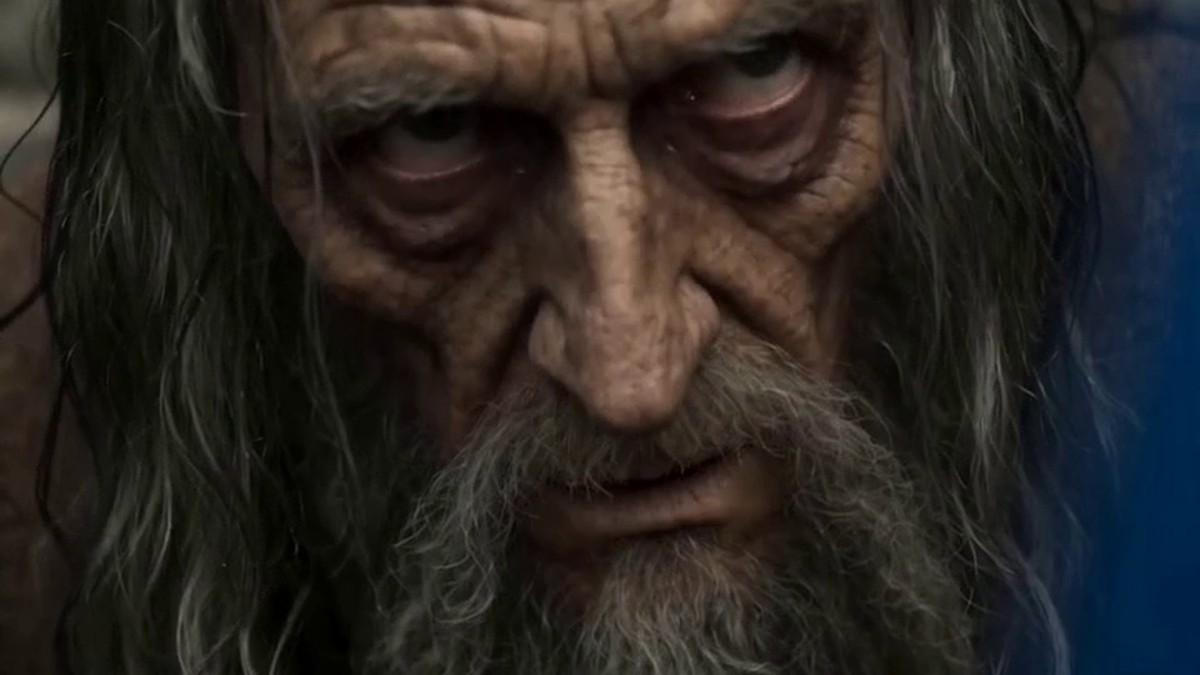
But the old man didn’t move. He sat against the stone wall with his back straight and one weathered hand resting on a wooden staff, wrapped in a torn cloak as though it were armor.
Before the guard could reach him, a trumpet split the air from somewhere inside the city.
The crowd parted in one swift, practiced motion.
Queen Evelyn Ashford emerged through the gate with her royal procession, her white coat catching the light, gold embroidery running along every seam.
Five years. Five years since her husband, King Daniel, had vanished on a hunting expedition.
No body recovered.
No witnesses.
Not a single trace.
The entire kingdom had long since buried him in their hearts.
Only Evelyn refused to sign the declaration of death.
As she passed the gate, the guard raised his voice again.
“I said move!”
The queen turned.
The old beggar lifted his head — slowly, as though the weight of it cost him something.
And her world stopped turning.
The gray beard. The hollowed face. The deep lines that aged him by decades beyond what she remembered.
But those eyes.
The particular way he tilted his head to one side.
Evelyn knew them. She had always known them.
“Daniel?”
The name came out barely a breath.
The entire marketplace went still.
The old man held her gaze for a long, terrible moment — and then shook his head.
“I believe you’ve mistaken me for someone else.”
The words hit her like cold water.
She stepped closer, unable to look anywhere but his face.
Lady Sophia leaned in and whispered, “Do you know this man?”
Evelyn steadied herself. Fought to keep her voice level.
“He looks exactly like the king.”
Whispers broke across the square like a wave.
But the beggar simply dropped his eyes to the ground — quietly, deliberately — as though he were desperate for the conversation to end before the queen had the chance to look one moment longer.
The guard seized the old man by the arm.
“On your feet.”
“Let him go.”
Evelyn’s voice was quiet. That particular quiet that her court had learned, over years of careful study, meant the opposite of calm.
The guard released him instantly.
She crouched down — in her white coat, in front of the entire marketplace, in front of her court and her guards and every merchant and beggar and child who had stopped breathing to watch — and she looked at him the way a woman looks when she is willing the truth out of something.
“Tell me your name.”
The old man kept his eyes on the ground. His jaw worked slowly, as though he were deciding what to swallow.
“Edmund,” he said. “Just Edmund.”
“Edmund.” She let the word sit between them. “Where are you from, Edmund?”
“Nowhere worth mentioning.”
Lady Sophia touched her arm. “Your Majesty. We have the trade negotiations—”
“Cancel them.”
A beat of stunned silence from the procession behind her.
Evelyn didn’t look away from the man’s face.
“Have him brought to the east wing.” She stood. “Quietly.”
—
They put him in a room that wasn’t quite a cell and wasn’t quite a guest chamber — a room with a view of the courtyard garden, a fire already lit, food on the table, and two guards posted outside the door who had been given their instructions in a tone that left no room for interpretation.
Evelyn stood at the window with her back to him for a long time.
The fire popped. Outside, a crow called once and went silent.
“You were thinner when we met,” she said finally. “At your father’s estate. I remember thinking you looked like you hadn’t eaten in a week. You said hunting made you forget.”
Nothing from behind her.
“You used to tilt your head when you were thinking. To the left. Always the left.” She paused. “You did it at the gate.”
The chair shifted. A long exhale.
“Evelyn.”
She closed her eyes.
The sound of her name in that voice — frayed at the edges, scraped hollow by years she hadn’t been there for — hit her somewhere behind her sternum and didn’t stop.
She turned around.
He looked worse in the firelight. The lines in his face were deep and strange. His hands — Daniel had always had a nobleman’s hands, she remembered thinking that once, guiltily — were cracked at the knuckles, darkened with old labour.
“Five years,” she said.
“I know.”
“No body. No word. Nothing.” Her voice was steady. She needed it to be steady. “I did not sign the declaration. They asked me every year and I refused every year, and half my council believes I’ve gone mad with grief and the other half is simply waiting for me to—” She stopped. Pressed her fingers against her mouth for a moment. “Why?”
He looked at her for a long time.
Then he reached inside his cloak.
She didn’t move. Didn’t flinch. Even when two of her own instincts told her to call for the guards, she held herself still and watched him draw out a folded piece of parchment, stained and worn thin at the creases, and set it on the table between them.
She crossed the room and picked it up.
She read it once.
Then again.
Then she sat down.
—
The letter was written in Lord Chancellor Harwick’s hand.
She knew his writing the way she knew the castle corridors — from years of navigating it, from the particular slant of his R’s, from the way he always pressed too hard on the final word of each line as though trying to leave a mark.
*The king must not return from the expedition. If he does, ensure he does not return afterward. The succession cannot survive his line. You will be compensated accordingly.*
“Who carried this?” she asked.
“The hunting guide.” Daniel’s voice was even, as though he’d had years to practise saying it. “I found it on him the second night. He didn’t know I’d seen it.” He paused. “There were four of them. The guide and three men dressed as servants.”
“What happened?”
“I ran.” He said it without shame, or maybe with so much that it had come full circle. “I’m not proud of that. I’ve spent five years not being proud of it. But there were four of them and I had no weapons and I’d read that letter, and I knew — I knew if I came back they would finish it properly. With more men. More planning.” His eyes found hers. “I knew Harwick would expect a body. When I didn’t produce one, he’d assume the guide had failed and fled. He’d spend his energy looking for the guide, not for—”
“A beggar,” Evelyn said.
A long silence.
“I didn’t know how to come back,” he said quietly. “Every time I thought I’d found a way — every time I got close to the border — there were Harwick’s men. He has more reach than you know.”
“I know exactly how much reach he has.” She set the letter down on the table with great care. “He’s been my chancellor for four years.”
Daniel went very still.
—
She gave herself twenty minutes.
That was all she allowed — twenty minutes in which she sat in that room with her husband who was not dead and a letter that changed everything, and let herself feel the shape of it. The grief that had been grief and turned out to be something else. The fury. The five years of a kingdom held together by a woman who kept refusing to sign a piece of paper because something in her bones wouldn’t let her.
Then she stood up, smoothed the front of her coat, and went to work.
She sent for Captain Aldric first. Her own man, not Harwick’s — she had been careful about Aldric from the beginning, in the way she had learned to be careful about everything. She gave him the letter and a list of six names, and she watched his face change as he read it.
“Tonight,” she said.
“Yes, Your Majesty.”
“He will not know it’s coming. He attends the evening council session. He will walk in expecting — whatever it is he expects. You’ll be waiting inside.”
“And if he runs?”
“He won’t get far. He has nowhere to run to — he just doesn’t know that yet.”
—
Harwick was a tall man. That was the thing she always noticed first — the way he filled a doorway, the way he had learned to use his height as its own kind of argument. He swept into the council chamber in his formal robes with the confident, unhurried stride of a man who had spent four years believing he had already won.
He stopped.
Evelyn was seated at the head of the table.
Six of her guards stood in a line behind her.
And beside her, cleaned and dressed in plain clothes that were nevertheless unmistakably a gentleman’s — his beard trimmed, his back straight in a way that no amount of years could quite erode — sat Daniel Ashford, King of Ashenmere, watching the door.
The colour dropped out of Harwick’s face like a curtain falling.
“Your Majesty.” His voice found steadiness somewhere — she’d grant him that. He was a man of significant nerve. “I wasn’t aware the king—”
“No,” Evelyn said. “You weren’t.”
She placed the letter on the table and turned it to face him.
He looked at it. His eyes went to Daniel. Back to the letter.
“This is a forgery.”
“Sit down, Harwick.”
“I will not be—”
“Sit. Down.”
He sat.
The nerve was still there — she could see him calculating, even now. Exits. Angles. Allies in the room.
“There are no allies in this room,” she said, reading him the way she’d spent four years reading him. “There’s no version of tonight in which you walk out of here as you walked in. The only question still open is how much you decide to say.”
Harwick’s jaw tightened.
He looked at Daniel with something that might, in another man, have been shame.
“I had nothing personal against you,” he said. “You understand that.”
Daniel looked back at him steadily. “I understand.”
“The succession—”
“Is not your concern any longer.” Evelyn’s voice was flat. Final. “Captain Aldric.”
—
They took him out through the south corridor.
Evelyn watched the door for a moment after it closed.
The room was very quiet.
Daniel reached across the space between their chairs and set his hand, palm up, on the table between them — not taking, just offering. The way he used to wait for her to decide things, in the early years. Giving her the choice.
She looked at his hand. The cracked knuckles. The years folded into the lines of it.
She placed her hand in his.
Neither of them spoke.
Outside, the courtyard torches were being lit for the evening. She could hear the distant ordinary sounds of the castle settling into night — footsteps on stone, a door somewhere, the crow that had been calling all afternoon finally going quiet.
“There will be an inquiry,” she said.
“I know.”
“And a trial. And months of it, probably. The council will need restructuring. Half of them are his men, and half of those don’t know they are.”
“I know.” He turned her hand over. Looked at it as though it were something he’d been trying to remember exactly. “You held it together.”
“I refused to bury you.”
“I noticed.” A pause. Something that wasn’t quite a smile moved across his face. “From a distance. For a while.”
She looked at him sharply.
“You were watching?”
“I needed to know you were safe.” His voice was careful. “I needed to know that whatever Harwick was planning next — that you were still—”
“Daniel.” She exhaled slowly. “If you tell me you were within range of this castle for any significant period of time—”
“I won’t tell you that, then.”
“God.” She pressed her other hand briefly over her eyes. Then dropped it. Looked at him. “You are an absolutely impossible man.”
“Yes.”
“You always were.”
“Yes.”
The fire had burned lower. The room had the particular warmth of late evening, of things that had been held at enormous tension finally allowed to rest.
She didn’t let go of his hand.
“It’s going to be complicated,” she said. “The announcement. People have been mourning you. Some of them will be relieved. Some of them will be angry. A resurrected king is — politically speaking — an enormous problem.”
“I imagine.”
“I’ll need you to be patient.”
“I’ve had practice.”
“And visible. And cooperative with the inquiry. And—”
“Evelyn.”
She stopped.
He was looking at her the way he used to — that particular way, the one she had almost let herself forget, the one that made her feel located in the world.
“I know,” he said. “We’ll manage it. All of it.” A pause. “We always did.”
She held his gaze.
Outside, the last of the daylight finally gave way, and the torches took over, and the castle of Ashenmere moved into the night with its king alive and its queen still at the head of things and a letter folded on the council table that would, in the weeks to come, undo a great deal that needed undoing.
But that was tomorrow’s work.
Tonight, she kept her hand in his, and let the fire burn.