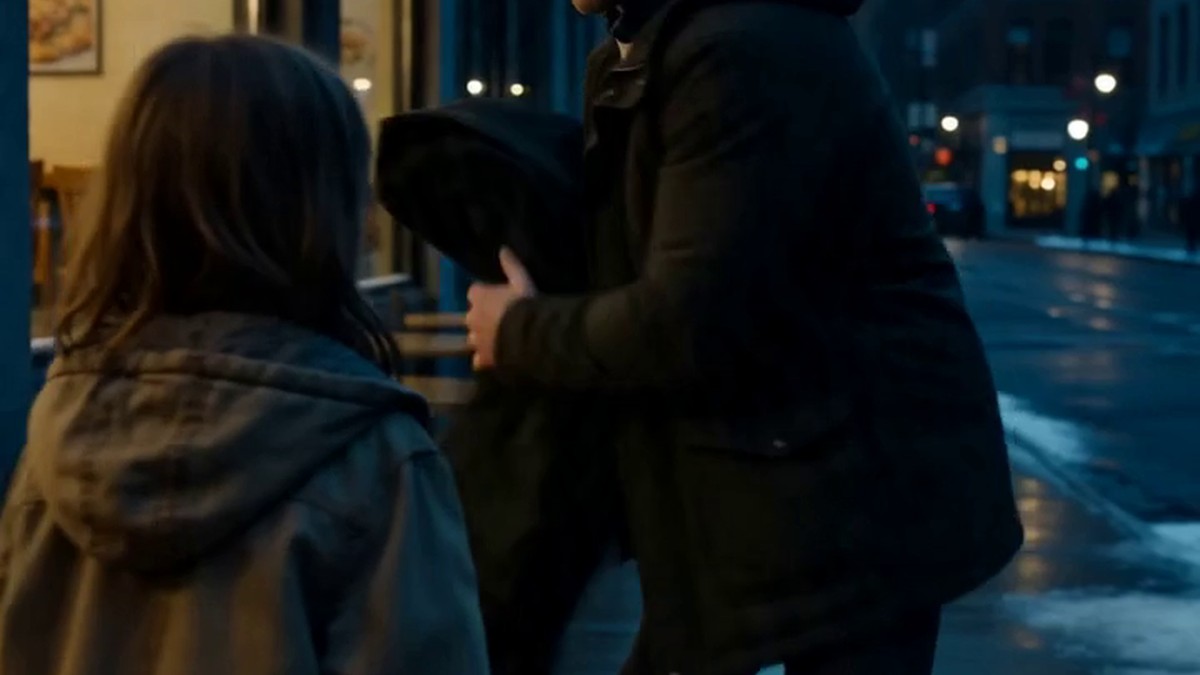
A little girl. No older than seven. Standing outside the restaurant window like a small ghost, watching the last customers finish their meals.
She never knocked. Never asked. Just waited.
So Nathan fed her.
A warm plate. Whatever was left. A small thing — the kind of gesture you make without thinking too much about it.
But something nagged at him.
Because she never ate.
Not a single bite. She would take the container, flash him a quiet smile, say thank you in that careful way children do when they’ve been taught to be polite under pressure — and then she’d vanish into the dark street like she was never there.
Night six, Nathan stopped pretending he wasn’t curious.
He followed her.
Through streets that had gone hollow and silent. Past the last working streetlamp. Down a narrow alley that seemed to narrow further with every step, until it ended at a building that looked like the city had simply forgotten about it.
He stopped at the entrance. Watched through the gap in the door.
The little girl knelt on the floor and opened the takeout box.
Four younger children crawled toward her like they’d been waiting for hours.
Because they had.
Then a voice came from the corner of the room. Thin. Exhausted. Coming from a figure lying on a bare mattress.
*”Lucy… you have to eat too, baby.”*
The girl didn’t miss a beat.
She smiled the way children smile when they’re protecting someone they love.
*”I already ate, Mama. I’m full.”*
Nathan’s chest caved in.
He pushed the door open.
The woman on the mattress turned her head slowly — the movement of someone running on nothing — and the moment her eyes found his face, they filled with tears.
Not surprise. Not fear.
Recognition.
*”Nathan?”*
He couldn’t move. Couldn’t speak.
Because the woman saying his name was the same woman he had buried in his memory a decade ago. The one everyone said was gone. The one he had spent years learning to stop looking for in crowds.
The silence lasted only a second.
Then Lucy looked up at him, her small face tilted, studying something she didn’t yet have words for.
*”Mom,”* she whispered. *”Why does that man have the same eyes as me?”*
The question hung in the air like smoke.
Nathan felt the floor shift beneath him. Not literally — but the room recalibrated, the walls moved an inch closer, the shadows deepened. He gripped the doorframe with one hand and said nothing because there was nothing in his vocabulary for this moment. Nothing that had been prepared.
“Sarah.” His voice came out wrong. Too quiet. Too careful.
The woman on the mattress — this pale, hollowed-out version of someone he once knew the way you know your own heartbeat — closed her eyes for just a second. Like she was deciding something. Like she’d been rehearsing this exact moment and still wasn’t ready.
“Sit down,” she said. “Please.”
There was nowhere to sit. The room held a mattress, a cracked plastic crate, four smaller children who had gone completely still around the open takeout container, and Lucy — standing between Nathan and her mother like a seven-year-old bodyguard who didn’t fully understand the threat but understood everything about loyalty.
Nathan sat on the floor. His chef’s coat was still on. He smelled like garlic and dish soap and the end of a long night. He pressed his back against the wall and looked at Sarah and tried to remember how to breathe normally.
“How long?” he asked.
“Here? Four months.” She shifted on the mattress, winced. Her left arm was wrapped in a bandage that had been changed recently but not professionally. “In the city? Almost a year.”
“And you didn’t — ” He stopped. Started again. “You knew where I worked.”
“I knew.”
“Sarah.”
“I know.” She looked at the ceiling. “I know, Nathan.”
Lucy was still watching him. The other children — three boys and a girl, ranging from maybe two to five — had resumed eating with the focused, wordless efficiency of kids who understood that food was not guaranteed. They ate with their hands. They didn’t spill a drop.
“She looks like you,” Sarah said quietly.
“I can see that.” He could. The jawline. The eyes — that particular shade of dark green that his grandmother had called sea-glass. He could see it across the room in a child he had never met, in a face he had never touched, and the recognition was the strangest pain he’d ever felt. Like something being returned that he hadn’t known was missing.
“I found out after,” Sarah said. “After everything fell apart. After I left.” She glanced at Lucy. “She doesn’t know the whole story.”
“Mom.” Lucy’s voice was steady. “I’m seven. You can say things.”
Sarah almost smiled. Almost.
“She’s been like this since she could talk,” she said to Nathan. “Like she was already an adult. Already keeping score of everything.”
Nathan looked at Lucy directly for the first time. Really looked at her. The careful posture. The way her hands were still at her sides even though she was clearly afraid. The way she kept her body slightly angled toward her mother, toward the younger kids. Ready.
“You walked six blocks every night,” he said to her.
She nodded.
“In the dark.”
Another nod. No apology in it.
“You’re brave,” he said.
“I’m hungry,” she said simply. “Being brave is just what hungry looks like sometimes.”
Something cracked open in his chest. Quietly. Completely.
—
He didn’t call anyone that night. Didn’t make any speeches. Didn’t ask for explanations he hadn’t earned yet.
He went back to the restaurant and came back with two bags — everything remaining in the walk-in that could be eaten without a stove: bread, sliced turkey, cheese, three kinds of fruit, a container of cold pasta that had been tomorrow’s staff meal. He brought paper cups and a carton of orange juice. He brought a first-aid kit from the supply closet because the bandage on Sarah’s arm had been bothering him since he first saw it.
He sat back down on the floor and re-dressed the wound while Lucy supervised with the intensity of a small surgeon observing technique.
“It got infected,” Sarah said. “Two weeks ago. I didn’t have — I couldn’t go to a hospital. We don’t have — ” She stopped.
“I know,” he said. “Hold still.”
“Nathan.”
“Hold still, Sarah.”
She held still.
The little boys ate. The small girl fell asleep against the plastic crate with a piece of bread still in her fist. Lucy ate finally — really ate, not just pretended — and Nathan watched the tension leave her shoulders one degree at a time, the way snow melts, slowly and then all at once.
—
The story came out in pieces over the next hour. Not all of it — some of it was sealed up behind Sarah’s eyes in places he couldn’t reach yet and maybe never would. But enough.
She’d left ten years ago because she was afraid. Of what they were becoming. Of what she’d already become. She’d made choices — bad ones, then worse ones — and somewhere in the wreckage of those years there had been Lucy. There had been the others. Kids she’d meant to provide for and couldn’t. A network of temporary shelters and expiring goodwill and exhausted social workers and gaps — always the gaps, the spaces between the systems where people like Sarah fell and kept falling.
“I didn’t want you to see me like this,” she said. “That’s why I didn’t come to you.”
“That’s the worst reason I’ve ever heard.”
“I know that too.”
“You sent Lucy.”
“I didn’t. She figured out where you worked. I didn’t even tell her your name — she found an old photo. She’s — ” Sarah laughed, a thin sound with no humor in it. “She finds things. She figures things out. She gets that from you, I think.”
Nathan looked at the girl, who had finished eating and was now quietly stacking the empty containers into a neat tower with the precise satisfaction of someone who couldn’t control much but could control this.
“Lucy,” he said.
She looked up.
“You found me on purpose.”
Not a question. She heard that.
“You needed to know,” she said. Like it was obvious. Like it was simple. Like being seven years old and making a decision that large was just what the situation required.
He nodded slowly.
“Yeah,” he said. “I did.”
—
By four in the morning the younger children were asleep in a pile. Sarah had drifted off too, finally, the exhaustion of however many sleepless nights catching up all at once. The first-aid kit was open on the floor. The orange juice was gone.
Lucy sat across from Nathan, wide awake, her back straight, her hands folded in her lap.
“Are you going to make us leave?” she asked.
“No.”
“Are you going to call people? Government people?”
He thought about that honestly, because she deserved honesty. “I’m going to call some people tomorrow who might be able to help. But I won’t do anything without telling your mom first. Nothing happens without her knowing.”
Lucy considered this with the gravity of a judge reviewing evidence.
“Okay,” she said.
“Okay,” he said.
Silence settled between them — but not the uncomfortable kind. The kind that meant something had been agreed upon. Something small and serious and real.
“She was scared you’d be angry,” Lucy said.
“I was.”
“Are you still?”
Nathan looked at Sarah sleeping. At the rise and fall of her breath. At the bandaged arm resting across her chest. At the ten years that had happened inside this room, that he’d never been part of, that had produced this fierce and exhausted child sitting across from him on a cold floor in the middle of the night.
“No,” he said. “Not anymore.”
Lucy nodded. She unfolded her hands. She looked at them for a moment — small hands, his grandmother’s hands — and then she looked up at him with that sea-glass gaze.
“I knew you wouldn’t be,” she said. “That’s why I came.”
She lay down then, on her side, curled close to her mother without waking her. She was asleep within a minute. Just like that. Like she’d been holding herself upright for weeks and had finally decided it was safe to let go.
Nathan stayed until sunrise.
He sat against the wall in his chef’s coat and watched the light come in through the gap in the boarded window, a thin grey line that slowly turned gold. He listened to the breathing in the room. Five children and one woman and the particular silence that follows a crisis that hasn’t ended yet but has, at least, been witnessed.
When the light was full enough to see clearly, he took out his phone and started making a list. His cousin with the empty apartment above the dry cleaner. The nurse practitioner he played cards with on Thursdays. The lawyer from down the block who’d once told him to call if he ever needed anything and had seemed like she meant it.
He made the list long. He made it careful.
Then he sat back and waited for the room to wake up, for the day to begin, for the next thing that would need doing.
He was good at that. At showing up. At feeding people.
He was only just understanding how much he’d always had enough for.