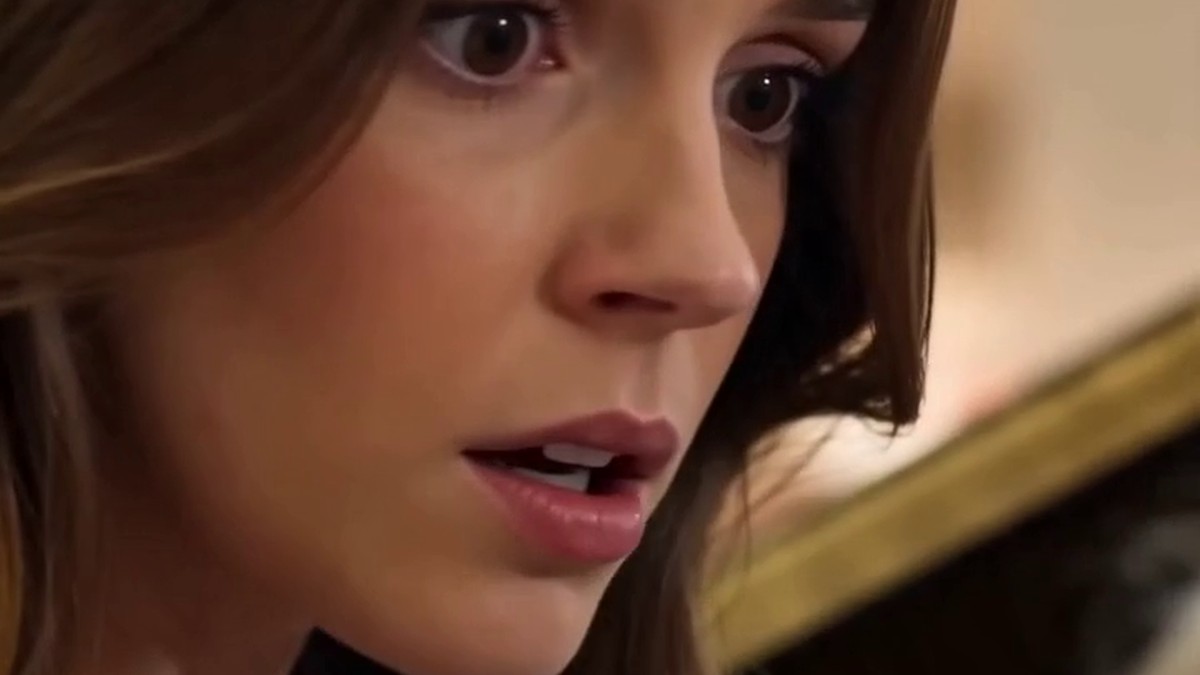
Shoppers streamed around her like water splitting at a stone. Escalators hummed. Shopping bags swung and bumped past her knees. The whole world kept moving.
She didn’t.
A piano melody drifted through the noise — soft, delicate, achingly familiar. She couldn’t have explained how she knew it. She just did. The way you know something that lives in your bones.
Her eyes filled.
The stuffed rabbit slipped from her fingers and hit the floor, and she ran.
“Mommy!”
The woman who’d been holding her hand went rigid with panic. “Honey — come back! Stop!”
The girl didn’t stop. She cut through the crowd with the single-minded certainty of someone following a heartbeat back to its source.
At the piano, the music died.
The pianist’s hands lifted from the keys the moment the small fingers closed around her sleeve.
“That’s my mommy’s song,” the girl whispered.
The pianist looked down. She couldn’t speak.
There, resting at the hollow of the little girl’s throat, was a tiny locket — heart-shaped, gold worn thin at the edges. The kind of locket you’d press to your lips before letting go of something you could never get back.
It was the same locket she had fastened around her newborn daughter’s neck.
Before everything fell apart. Before the baby was gone. Before Elena was told, quietly and firmly, to stop searching.
The woman who had raised the girl finally pushed through the crowd, breathless and frightened. She reached for the child’s shoulder.
The girl held on tighter.
Elena’s fingers found the locket. They were shaking so badly she could barely feel it — but she felt it. Every worn edge. Every curve.
“Where did you get this?” Her voice came out barely above a breath.
The little girl tilted her face up.
“Mommy sings it every night,” she said simply.
And Elena broke open.
Because that lullaby had never belonged to anyone else. She had written every note of it for a daughter she had spent years believing she would never hold again.
The woman behind the girl — the one who had raised her, who knew every curl of her hair and every nightmare that woke her at 3 a.m. — her name was Diane. And she understood, in the space of a single heartbeat, exactly what was happening.
She had always known this moment might come.
She had just prayed it wouldn’t.
“Lily.” Her voice was controlled. Careful. The voice she used when she needed the girl to listen. “Come here, sweetheart.”
But Lily didn’t move. She was still looking up at Elena with those wide, serious eyes — the ones Diane had loved since the first hour she’d held her, wrapped in a hospital blanket that was two sizes too big.
Elena couldn’t look away from her. Couldn’t breathe. The locket was warm from the child’s skin, and her fingers wouldn’t let go of it.
“How old is she?” The words came out cracked, barely held together.
Diane’s jaw tightened. Around them, the mall kept its indifferent rhythm — muzak, footsteps, the mechanical sigh of a stroller. A woman laughed somewhere nearby, loud and easy.
“This isn’t the place,” Diane said quietly.
“How old.”
A beat. Then, barely: “Six.”
Six years. Elena did the math she had done a thousand times in the dark — lying in bed, staring at the ceiling, counting backward from the date they’d taken her baby away. The date a hospital social worker had sat across from her in a beige room and explained, with professional gentleness, that the adoption had been finalized. That the birth mother had consented. That consent was irrevocable.
Except Elena had never consented to anything.
She had been nineteen and alone and so sick after the birth that she’d barely been conscious. She had signed papers she didn’t understand, papers someone had pressed into her hand with a pen and a tight, efficient smile. She had asked — more than once, through the fog of fever and grief — *when can I see her?*
She had never gotten an answer. Only silence. Then a locked door. Then lawyers.
Six years of locked doors.
“Her name,” Elena said. “Was it always Lily?”
Something shifted in Diane’s face. A crack, quickly sealed. “I named her Lily, yes.”
“I named her Grace.”
The word landed between them like a stone dropped into still water.
Lily — Grace — was watching them both. Children understand more than adults remember. She didn’t know the details. She didn’t have the vocabulary for what was spreading through the air like something catching flame. But she felt it. She pressed closer to Elena’s side, one small hand still fisted in her sleeve.
“She sings it,” the girl said again, as if this settled something. “Every night before I sleep. She taught me all the words.”
Elena looked down at her. “What words, baby?”
The girl thought about it seriously, the way six-year-olds approach important things. Then she sang, barely above a whisper, in a small clear voice:
*Sleep now, little heart of mine, the stars are keeping watch.*
Elena’s hand flew to her mouth.
Those were the words. The exact words she had written at seventeen, sitting at an upright piano in a rented rehearsal room with bad fluorescent lighting and a broken C-sharp. She had never written them down anywhere. She had never recorded them. She had sung them — once — to a baby who was four hours old, before they took her away for tests she was told would take only a moment.
That moment had lasted six years.
“Where did you learn that?” she asked Diane. Her voice was different now. Not fragile. Something harder underneath.
Diane’s composure was beginning to show its seams. Her eyes were wet and she was holding herself like someone standing against a current. “I don’t know what you’re talking about.”
“You know exactly what I’m talking about.”
“I need you to step back from my daughter.”
“She’s my daughter.”
The sentence hit the air like a hand on a table. People nearby glanced over. A woman with a stroller slowed, then moved on.
Diane stepped forward. She was taller than Elena, and she used it — not aggressively, but deliberately. Years of holding things together lived in her posture. She had built a life around this child. She had been there for every fever, every first day of school, every night terror that drove small feet down the hallway to her bed. She had loved Lily with a ferocity that was real and total and hers.
And she had known — somewhere beneath all of it — that it had begun with a lie.
“I didn’t know,” she said, very low. “In the beginning, I didn’t know.”
Elena stared at her.
“They told me the birth mother had agreed. That she’d signed off. That it was clean.” Diane’s voice faltered. “I believed them. I wanted to believe them. I had wanted a child for so long, and here she was, and I—” She stopped. Pressed her fingers to her lips. “I found out two years later. What they’d actually done. How they’d gotten the signature.”
“And you said nothing.”
“She was two years old.” Diane’s voice broke on it. “She was two years old and she knew my face and she called me Mama and I—” A breath. “I couldn’t.”
The silence between them was not empty. It was full of six years. Full of a lullaby passed from one woman to another like a lit match, neither of them knowing how it had traveled or what it would eventually ignite.
Elena looked down at Lily.
The girl had been following all of this with her serious eyes. She didn’t understand the whole of it. But she had heard enough. She was smart — *God*, she was smart, Elena could see it in her face, in the particular way she tilted her head — and she had heard her name said in two different voices now, and she understood that something enormous was happening that involved her completely.
“Are you real?” Lily asked Elena.
The question broke something open in the room.
“Yes,” Elena said. She crouched down to eye level, right there in the middle of the mall, with the world moving past them like they were standing at the center of a wheel. “I’m real. I’m very, very real.”
“Were you looking for me?”
“Every single day.”
The girl considered this. Then: “Why didn’t you find me sooner?”
Elena felt the question like a hand pressed flat against a bruise. “I tried, baby. I didn’t stop trying.”
Lily looked at Diane. Then back at Elena. Two women, both of them undone, both of them hers in different ways and different measures.
“I don’t understand,” she said.
“I know.” Elena’s voice held steady, barely. “You don’t have to yet.”
What happened next did not happen quickly. There was no single scene that resolved it — no courtroom thunderbolt, no door flung open to revelation. Life doesn’t work that way. The truth moves the way water moves: slowly, patiently, finding every crack until something eventually gives.
Diane made the call herself. That same evening, while Lily slept, she sat at her kitchen table and dialed the number she had carried in the back of her mind for two years — the attorney she had hired when she found out, the one who had told her what exposure might look like and who to contact if she ever decided to come forward.
She had never decided. Until now.
The people who had arranged the adoption — the agency, the social worker who had pressed a pen into a sick girl’s hand — they did not disappear quietly. There were lawyers and depositions and months of documented difficulty. There were nights when Elena sat with her own attorney going over the same papers until her eyes burned. There were nights when Diane sat at Lily’s bedside watching her sleep, terrified of a future she had set into motion herself.
But she had set it into motion. That mattered.
Elena didn’t fight for erasure. She wasn’t asking anyone to tell a six-year-old that the only mother she remembered had never loved her. She was asking for what had always been hers: acknowledgment. Presence. A chance.
The first supervised visit happened on a Saturday morning in a park.
Lily arrived holding Diane’s hand and clutching a stuffed rabbit — a new one, purchased to replace the one abandoned on the mall floor. She walked toward Elena with the gravity of someone who had thought about this moment very seriously.
Elena had a piano app on her phone. It was a ridiculous, small thing, and she felt slightly absurd about it. But she sat on the park bench and she pulled it up, and she looked at Lily, and she said, “Do you want to hear the whole song?”
Lily sat down beside her. Close enough to feel. Not quite touching.
“Yes,” she said.
Elena played it from the beginning. Every note she had written in that bad-lit rehearsal room at seventeen. The melody she had carried for six years like a coal she refused to let go cold. She played it through, and then she sang the words in a low voice, and Lily listened with her whole body — very still, head slightly tilted.
When it ended, the girl was quiet for a long moment.
Then she said: “You wrote it for me.”
“I wrote it for you.”
Another silence. A bird landed on the path and left.
“Okay,” Lily said.
It wasn’t forgiveness — she was six, and didn’t have enough to forgive yet. It wasn’t understanding. It was something smaller and more fundamental than either of those things.
It was a door, cracked open.
Elena didn’t rush through it. She had learned, across six years of locked doors, that the only way to move through an open one is slowly, with your hands where everyone can see them.
She reached out, very carefully, and tucked a curl behind Lily’s ear.
The girl let her.
Above them, the sky was the specific pale blue of early autumn, and somewhere across the park a kid was chasing pigeons, and the world was still doing what it always did — moving, indifferent, relentless. But at the center of it, on a bench in the thin morning sunlight, a mother was learning the face she had memorized from a photograph, and a daughter was learning a song she had somehow always known.
The locket caught the light as Lily leaned in a little closer.
Gold worn thin at the edges. The kind of thing you’d press to your lips before letting go.
And this time — for the first time in six years — Elena didn’t have to let go.