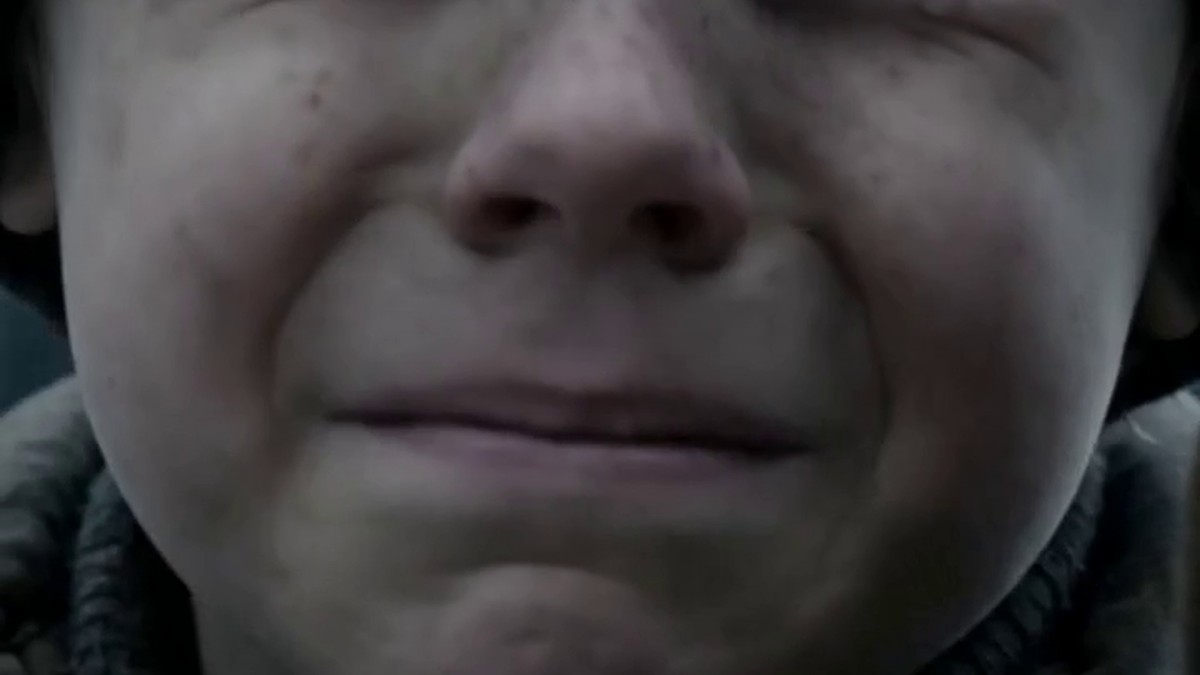
The younger one was barely three. He wept quietly, the kind of crying that comes not from stubbornness but from genuine suffering — deep, hollow hunger. His tears carved clean lines through the grime on his face. His tiny body shook without stopping.
The older boy, ten years old, sat beside him holding a small tray of food. He hadn’t eaten all day. Not a single bite. But he didn’t hesitate — not for a second. He set the tray gently into the little one’s lap and said, quietly and without ceremony, “You eat.”
The toddler stared at the food as though he didn’t quite trust it. Then his lips trembled and he breathed out the words, “I haven’t eaten.”
Four words. That was all. But they landed somewhere deep inside the older boy — because he knew that feeling from the inside out. He carried it every single day.
Around them, the city kept moving. Hundreds of people, maybe more, flowing past in coats and scarves, eyes forward, somewhere else entirely. Not one of them stopped. Not one of them saw.
The older boy tilted his head back toward a gray and indifferent sky. His eyes filled. And from somewhere in his chest, barely a sound, came a single word — “Please.”
Not rage. Not despair. Something quieter and more enduring than either of those things. It was the sound of hope — raw and thin, but still burning.
Poverty had stripped them of nearly everything a child deserves. But it hadn’t reached the one thing that mattered most. Between the two of them, in the cold and the hunger and the invisibility, something remained whole — a gentleness, an instinct to care for each other that no amount of hardship had been able to touch.
Some things, it turns out, are simply beyond what the world can take from you.
That single word dissolved into the frozen air and disappeared. No one heard it. The crowds kept moving.
But something shifted anyway.
A woman stopped.
She wasn’t remarkable to look at — middle-aged, plain coat, grocery bags in both hands. She had walked past the boys once already. Then something pulled her around. Maybe it was the older boy’s face, tilted up toward that concrete sky. Maybe it was the absolute stillness of him against all that movement. Whatever it was, she came back.
She set her bags down on the pavement. Crouched until she was level with them both.
She didn’t say anything right away. She just looked — really looked — at the little one with his food tray, at the older boy whose eyes were still wet, at the two of them pressed together against the cold like they were the last warm things left in the world.
“When did you eat last?” she finally asked the older one.
He didn’t answer. He glanced away. The question itself seemed to embarrass him somehow, as if need were something to be ashamed of rather than something done to him.
She understood without needing to be told.
She reached into one of her grocery bags and pulled out a sandwich still wrapped in white paper — the kind she’d bought for herself twenty minutes ago. She held it out to him. He looked at it the way the toddler had looked at his tray. That same cautious disbelief, that same pause before trust.
He took it. Held it in his lap without opening it.
“Go ahead,” she said softly.
He ate. Not fast — carefully, as if each bite required a decision. The little one watched him and then went back to his own tray, eating with both hands now, fully committed, his earlier tears already drying in the cold air.
The woman sat down on the curb beside them. Right there on the frozen pavement in her plain coat, grocery bags on either side of her. People moved around the three of them like water around stone. A few glanced over. Most didn’t.
She asked his name. He told her — quietly, testing the word in the open air as if he weren’t sure it still belonged to him.
She asked where they slept. He told her that too. A doorway on the far side of the next block, behind a dumpster that broke some of the wind. He said it plainly, without drama, the way you describe a fact so familiar it no longer surprises you.
She was quiet for a long moment. The wind pushed down the street between them.
“You’ve been taking care of him,” she said. It wasn’t really a question.
He nodded. Like it was obvious. Like what else would you do.
Something moved through her face that was difficult to name — it wasn’t pity, exactly. It was something closer to recognition. The look of someone who has just understood a thing they hadn’t understood before.
She made a call. Standing a few feet away, one hand pressed to her ear against the noise, talking in short, firm sentences. The older boy watched her and kept one hand resting on the toddler’s back — steady, automatic, the way you hold onto something you cannot afford to let go.
She came back and crouched down again.
“There’s a place,” she said. “Warm. They’ll have food tonight. A real bed.” She looked at him carefully. “Both of you.”
He studied her face for signs of something false. Kids who’ve lived on the street learn to read people fast — they have to. What he saw in her face was not performance. It was not charity being worn like a badge. It was just a person, sitting on a cold curb, meaning what she said.
He looked down at his little brother, who had finished eating and was now leaning quietly into the older boy’s side, one small fist wrapped around the fabric of his jacket.
He looked back at her.
He nodded.
—
The shelter was warm in a way that felt almost aggressive after the cold — a dense, pressing heat that hit them at the door and didn’t let go. It smelled like soup and old wood and something clean underneath all of it. A woman with gray-streaked hair met them in the entryway and spoke to the older boy at eye level, the same way the woman in the plain coat had done.
He kept the toddler’s hand in his the entire time. Through the intake questions, through the hallway, through the small room with two low cots and a window that looked out on a lit courtyard. He didn’t let go until the little one was sitting on one of the cots, looking around with huge eyes, taking the room in with the kind of careful wonder that belongs to children who have learned that good things sometimes disappear.
The older boy sat beside him. Put his arm around him.
“It’s okay,” he said. Simple and absolute. The voice of someone who had made a promise a long time ago and intended to keep it no matter what the world put in front of him.
The toddler leaned his head against his brother’s arm and closed his eyes.
—
Later — much later, after the soup and the questions and the long careful work of finding out who these two boys were and where they’d come from — the woman in the plain coat sat in the hallway outside their room. She could hear the older boy’s breathing through the door, slow and even. He was asleep. For the first time in what was probably a very long time, there was nothing he needed to hold together. Nothing he needed to watch. Someone else was watching.
She thought about that word he had said — that single, quiet *please* aimed at a sky that doesn’t answer.
The sky hadn’t answered. She had. Entirely by accident. By walking past once and coming back.
She didn’t think of herself as someone who changed things. She bought groceries. She took the same route home. She didn’t usually look up from the forward movement of her own life.
But she had looked up. Just that once.
And here was the thing she kept turning over in the quiet hallway, with the heat pressing down and the sound of two children finally sleeping —
It hadn’t taken much.
That was the part that stayed with her. Not the difficulty of it, but the smallness. A pause. A crouching down. A sandwich. A phone call. Acts so ordinary they barely deserved the name *acts* at all.
And yet.
There are moments when the world narrows to a single point — one intersection, one child’s upturned face, one word let go into the cold — and everything that happens next depends entirely on whether one person chooses to stop.
She had stopped.
The boys slept.
Outside, the winter kept its teeth in the city streets. The crowds kept moving. The indifferent sky did what it always does.
But in a small warm room at the end of a hallway, two brothers held onto each other in their sleep, the way they always had — and for the first time, they didn’t have to hold on quite so hard.