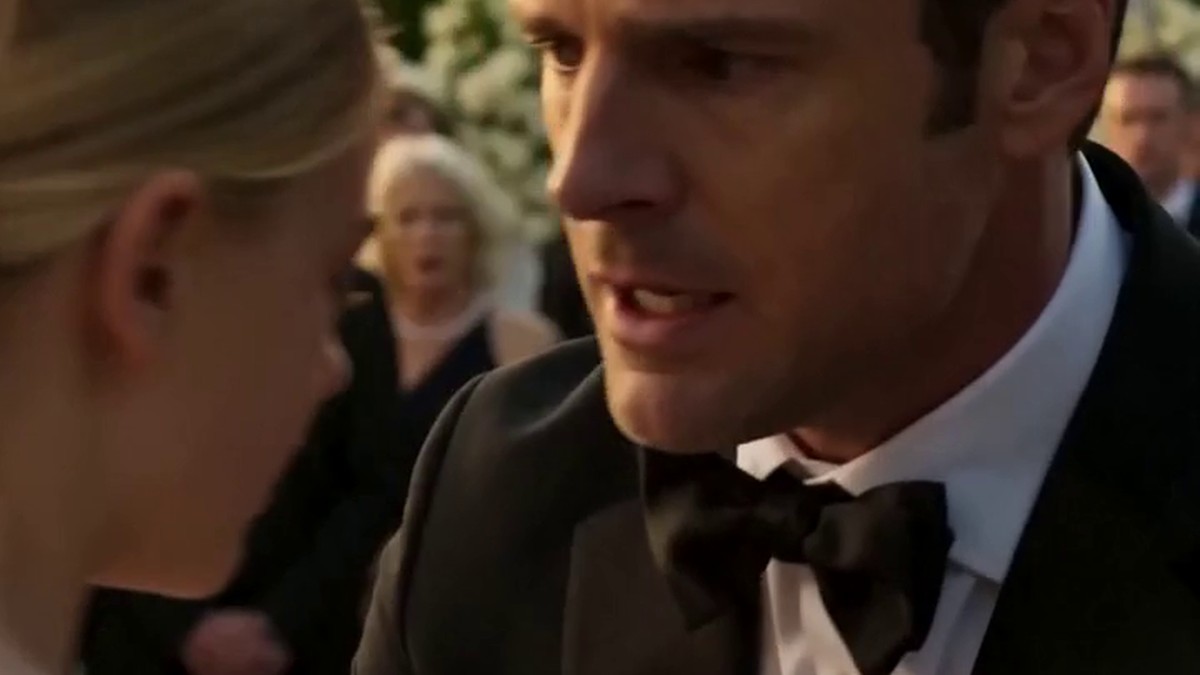
Charleston in late April smells like wisteria and old money, and the Leighton wedding was no exception. The courtyard of Magnolia Hall was dressed in candlelight and cream-colored peonies — two hundred guests, champagne flutes catching the dusk, a string quartet playing something soft enough to be forgotten.
Savannah Leighton was the bride every Charleston society page had already crowned. Her gown was a waterfall of silk, her diamond earrings a family heirloom, her smile sharp enough to cut. When she looked across the crowd, she owned it.
Then a girl walked in.
No invitation in her hand. No jewels on her neck. Her dress was the color of oatmeal — clean, ironed, but unmistakably thrifted. She moved like someone who’d practiced this moment a thousand times and still wasn’t sure she’d survive it.
Savannah’s head turned first. Then her maid of honor’s. The bridesmaids stopped mid-laugh. The string quartet didn’t miss a note, but the silence between the guests was louder.
Savannah closed the distance before anyone could intercept her. Her heels clicked on the flagstone like a countdown.
“Who let you in here?”
The girl’s chin stayed level. “I just wanted to congratulate you, Savannah.”
Three steps, and Savannah shoved her. It wasn’t a warning — it was a dismissal backed by pure force. The girl’s worn flats slid on the stone, her body reeled backward into a high-top table, and a glass of merlot tipped, somersaulted, and splashed across the toe of Savannah’s ivory shoe.
The splatter looked like a wound.
Savannah’s shriek sucked the air out of the courtyard. The quartet faltered.
“Look what you did!” She grabbed the edge of the table as if she might throw that too. “You come to my wedding uninvited, you ruin my shoes, and you stand there like you have any right — any right at all — to be in my life.”
The girl’s lips parted. The sting of the push was still settling in her shoulder blades, but what cracked her face was the volume of it — two hundred people witnessing her shame.
Savannah lifted her chin and spoke loud enough for the back rows to hear.
“Kneel. Right now. Kneel and clean my shoe.”
The girl’s eyes, overbright, caught the candlelight. A single tear balanced at the edge of her lower lashes. Then, with the slow, terrible grace of someone who’d been broken long before tonight, she began to fold at the knees.
The starched linen of her dress brushed the stone. The quiet was absolute.
And then a voice — low, confused, carrying the weight of someone who’d just stepped out of the groom’s suite and into a nightmare — cut through it all.
“Don’t.”
Harlan Webb moved through the frozen crowd like he was walking underwater. The bow tie he’d struggled with half an hour ago was already loosened, his dark hair still damp from the shower. He didn’t look at his bride. He looked only at the girl now wobbling in a half-kneel, her fingers hovering inches above the wine stain.
“Stop,” he said again, softer now, reaching her. “Please, stand up.”
The girl — her name was Daisy — refused to lift her gaze. A tear dropped onto the stone. “I didn’t mean to cause trouble.”
“You’re not causing trouble.” Harlan’s hand found her elbow and gently eased her upright. The guests exchanged glances; Savannah’s face was hardening into something venomous.
“Harlan, step away from her.” Savannah’s voice was ice water. “She’s nobody. She’s been stalking my social media for months. I had security warned.”
“She’s not nobody.” Harlan’s jaw tightened. He was studying the girl’s face — the curve of her brow, the stubborn set of her mouth that suddenly, painfully, reminded him of his own reflection at eighteen. “I know you. How do I know you?”
Daisy finally met his eyes. “My name is Daisy Cade,” she whispered, her voice raw. “I’m your daughter.”
The word hit the courtyard like a thunderclap. A bridesmaid dropped her bouquet.
Savannah laughed — a brittle, ugly sound. “That’s insane. Harlan, she’s lying.”
But Harlan wasn’t listening to her anymore. He was staring at the girl, at the slight cleft in her chin, at the photograph she was now pulling from a small clutch bag — a faded snapshot of a teenage girl and a boy who was unmistakably him, both with the same shy smile.
“Your mother,” Harlan breathed. “Katherine Cade. We were… I was seventeen. She moved away. No one told me—”
“I know.” Daisy’s voice cracked. “I tried to find you six months ago. I sent letters here, to this house. I wrote to Savannah, because her name was on the wedding website. I begged her to let me meet you just once.”
Harlan’s head snapped toward Savannah. The bride’s expression flickered — something fast and feral was skittering behind her eyes.
“She’s lying,” Savannah repeated, but the color had drained from her cheeks. “I never got any letters.”
“You wrote back,” Daisy said, and now the tears were coming faster. “You told me if I ever showed up, you’d have me arrested. You said Harlan didn’t want to see me — that I was a mistake he’d pay to keep buried. I came anyway, because I couldn’t spend another year not knowing.”
The string quartet had stopped. Somewhere a cell phone camera was recording.
Harlan turned fully to his bride. The tenderness their vows had held that morning was gone, replaced by something far older and far more dangerous. “You looked at a photograph of a child begging to meet her father, and you told her she was a mistake.”
Savannah’s composure shattered into a desperate, jagged smile. “I was protecting you! She could have been anyone, Harlan. Any gold-digging nobody trying to claw into this family. I did what was necessary.”
“You asked her to kneel.” He said it like a verdict. “You pushed her, and you asked her to kneel in front of two hundred people. That’s what you think necessary looks like.”
He turned back to Daisy and took both her hands in his. They were cold and trembling, and he squeezed them anyway. “I’m sorry,” he said, and the great cathedral of lies Savannah had built began to crumble in the space between those two words. “I am so sorry.”
“You can’t do this.” Savannah’s voice pitched upward. “We have a marriage license. We have three hundred guests flying in tomorrow. Harlan, I’m your wife.”
“No,” he said, and his voice was steady enough to hold the whole courtyard. “You’re not. The ceremony is tomorrow. And it’s not happening.”
A collective gasp rippled through Magnolia Hall. Savannah’s mother stood up, her hand flying to her mouth. Savannah lunged forward, grabbing Harlan’s arm.
“You’ll humiliate me for some orphan you don’t even know? She’s a stranger, Harlan!”
He peeled her fingers off one by one. “She’s my daughter. You’re the stranger.”
He guided Daisy past the tables, past the frozen photojournalist with her camera still hanging from her wrist. The girl stumbled once, and he caught her as easily as if he’d been doing it her entire life.
Behind them, Savannah screamed something that fractured into a sob. Forks clattered. Someone began to clap — a lone guest who’d had too much champagne and suddenly remembered what justice felt like. Then another. A quick, defiant ripple of applause for the girl in the oatmeal dress who had almost knelt.
Harlan walked her out of the courtyard and into the velvet Carolina night, where the air smelled like jasmine and second chances. He didn’t know the first thing about being a father, and Daisy didn’t know the first thing about being found. But the streetlamps lit the path home, and for the first time in seventeen years, the weight in his chest felt less like regret and more like hope.