Instead, she stood alone — exposed, trembling — in front of hundreds of people who had come to celebrate.
The groom had just turned her away. Right there, at the altar.
His mother had made sure the entire room heard every word of it.
And the whispers were already moving through the ballroom, table to table, like a lit fuse chasing powder.
Then the doors burst open.
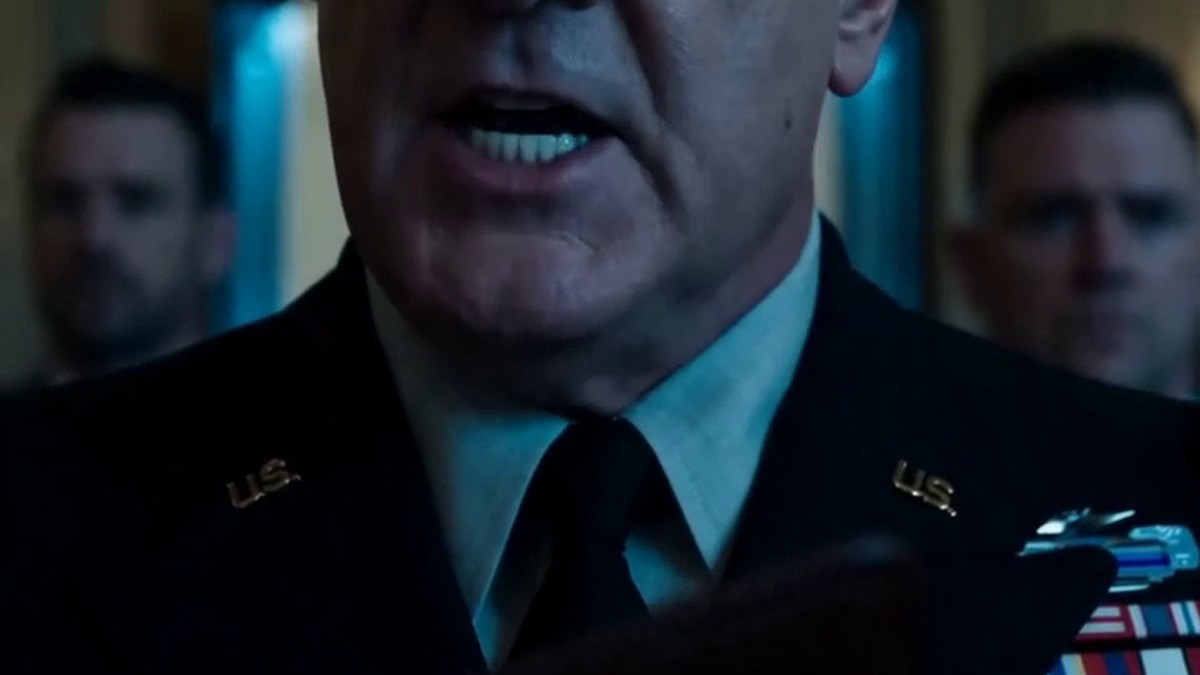
A decorated Army general walked in. Two soldiers flanked him, rigid and deliberate.
The bride’s breath caught in her throat.
“Dad…”
One word. Barely a whisper.
Every voice in the room died at once.
The groom’s confidence visibly cracked. His jaw tightened. His eyes darted sideways.
His mother went pale.
Because the woman they had spent months treating like she was beneath them — she had been carrying a secret they never once thought to look for.
But that wasn’t the thing that scared them most.
Moments later, one of the soldiers stepped forward and handed the general a worn leather folder.
The general opened it without ceremony.
And began reading aloud — financial records, transactions, a paper trail leading directly back to the groom’s family business.
A murmur rolled through the crowd.
Phones appeared. People started recording without thinking twice.
Then the bride turned to face them — calm, unhurried, like someone who had already won — and told the room she had known about the scheme for days.
She knew they were going to humiliate her.
She knew they wanted to strip her of everything she’d built.
And she knew exactly what was driving it.
The groom stared at her like he was seeing a stranger.
His mother couldn’t lift her eyes from the floor.
The bride took one slow step forward and asked the only question that mattered:
*”What were you so terrified I might find out?”*
Silence.
Complete, suffocating silence.
And in that exact moment —
A group of investigators materialized at the entrance to the ballroom.
The mother’s face went the color of ash.
Because she understood, with absolute certainty, that they hadn’t come for the wedding.
They had come for her.
The lead investigator — a woman in a charcoal blazer, badge clipped at her hip, moving with the practiced economy of someone who had done this a hundred times — crossed the ballroom floor without hesitation. Her heels didn’t click. She wore flats. That somehow made it worse.
The crowd parted for her the way crowds part for inevitability.
The groom’s mother, Margaret Caldwell, didn’t move. Couldn’t. Her whole body had become a thing of stone and poor decisions, rooted to the marble floor in four-thousand-dollar shoes while the world she had constructed so carefully began to come down around her ears.
Her son — Brandon, handsome Brandon, who had stood at that altar twenty minutes ago radiating the particular confidence of someone who has never once been held accountable for anything — took a single step backward.
The investigator noticed.
“Mr. Caldwell.” She said it pleasantly. “I’d appreciate it if you stayed where you are.”
Brandon stopped.
—
The bride’s name was Claire Ashworth.
She was twenty-nine years old, a structural engineer who had spent three years designing bridges in places where the winters were brutal and the budgets were worse. She had met Brandon at a charity gala, fallen in love with his laugh and his easy generosity, and spent eighteen months believing she had finally found someone worth building a life with.
She had been wrong about the laugh. The generosity, it turned out, was borrowed.
But she had not been wrong about her own instincts — the ones that started whispering six months in, quiet and persistent, like a crack in a foundation you can feel before you can see.
She had started paying attention.
That was her gift. And her curse, for a while. Because paying attention meant she had to stop pretending.
—
“Claire.” Her father’s voice was low. General Richard Ashworth had not raised it once since walking through those doors. He didn’t need to. “You don’t have to stay for this part.”
“I know.” She didn’t move. “I want to.”
He studied her face for a moment — the same way he had looked at her across a hundred difficult dinners, a hundred hard phone calls, when she was twelve and her mother died, when she was twenty-two and her first project collapsed under bureaucratic rot and she had called him from a parking garage at midnight, not crying, just silent with the specific silence of someone recalibrating.
He nodded.
And stepped to one side, so she had a clear view of everything that was about to happen.
—
The leather folder contained forty-seven pages.
Claire had put it together herself, working with two financial analysts her father had quietly connected her to — not through military channels, but through a network of people who had once owed Richard Ashworth their careers or their freedom or, in one memorable case during a deployment that never made the news, their lives.
The Caldwell family business was a construction firm. Reputable on the surface. Generous donors. Their name was on a hospital wing.
Underneath that surface was a payment structure that had been diverting municipal contract funds for eleven years. Infrastructure projects — roads, drainage systems, a school in a flood zone that had been built to spec on paper and to nothing on the ground. Three of those projects had since failed. One catastrophically. A retaining wall in 2019. Two people had been injured. The case had been settled quietly, sealed, and buried.
Claire had found it anyway.
She had found it because she was a structural engineer, and she knew what questions to ask, and she had gone looking specifically because something about the way Margaret Caldwell spoke about her son’s “legacy” made the hair on the back of her neck stand up.
She had found the sealed settlement in week two.
By week three, she had the payment trail.
By the time Brandon stood her up at the rehearsal dinner — not with cruelty, just with the casual thoughtlessness of someone who considered her auxiliary — she had already made the calls.
—
“Margaret Caldwell.” The investigator stood directly in front of her now. Up close, Margaret looked smaller. The bones of her face were sharp and expensive, the kind of face that had spent decades being formidable in rooms full of men who underestimated her. “I have a warrant for your arrest in connection with the fraudulent diversion of municipal construction funds, obstruction of a federal safety investigation, and two counts of filing false documentation with state contractors.”
The room had gone absolutely airless.
Somewhere near the back, a champagne glass was set down very, very carefully on a table.
“You cannot —” Margaret started.
“I can.” The investigator’s voice carried no heat. Just information. “The warrant was signed this morning. Your attorney has already been notified.”
Brandon turned toward Claire.
It was the first time he had really looked at her since before the ceremony — before he had stood at that altar with rehearsed regret in his eyes and told her, with his mother’s hand metaphorically on his shoulder, that this wasn’t going to work out. That she wasn’t quite right for the family. That he hoped she understood.
She had understood perfectly.
“You knew,” he said. Not an accusation. Something rawer than that.
“Yes.”
“For how long?”
Claire considered the question with the same precision she gave to load-bearing calculations.
“Long enough,” she said, “to make sure it mattered.”
—
Brandon Caldwell was not a cruel man. That was, in some ways, the most complicated thing about him.
He was weak. He was used to convenience. He had been raised in the specific way that produces men who are pleasant at dinner parties and catastrophic in a crisis — men who let their mothers make the hard calls and then live in the comfortable story that they hadn’t been involved.
He had known something was wrong with the business. Not the specifics. He had chosen not to know the specifics the way you choose not to look at the check engine light.
Claire had known this about him too.
It was why she had aimed everything at Margaret.
“The retaining wall,” Brandon said. His voice had gone strange. Hollow. “The one in 2019.”
“Two people were hurt,” Claire said. “A woman lost the use of her left hand. Her daughter was six years old.”
He closed his eyes.
“The settlement money came from the same account as the diverted funds,” Claire said. Not to wound him. Simply because it was true, and true things had weight, and weight was something that needed to be felt. “It’s in the folder.”
One of the soldiers handed him a single page from the folder.
He read it.
He did not look up for a long time.
—
Margaret was escorted out between two investigators.
She walked with her chin still slightly elevated — a woman who had spent her entire adult life refusing to be diminished — but her eyes were fixed somewhere past the middle distance, somewhere private and collapsing, and Claire thought: *there it is*. The thing underneath the performance. The understanding that it was over.
At the ballroom doors, Margaret stopped.
She turned.
And she looked at Claire — really looked at her, perhaps for the first time — with something that wasn’t quite an apology and wasn’t quite contempt. It was more complicated than either. It was the expression of someone who had spent years moving pieces on a board and had just realized the other player had been watching the whole time.
“You should have told him,” Margaret said. “Before this.”
“I gave him every chance to find out himself,” Claire said. “He chose not to look.”
Something shifted in Margaret’s expression. Brief. Almost imperceptible.
Then she was gone.
—
The ballroom began to empty slowly, with the stunned deliberateness of people who had witnessed something they would be describing for years.
Claire’s father came to stand beside her. He didn’t say anything for a moment. He was a man who had learned, through long practice, that silence was often the most useful thing you could offer.
“You could have told me sooner,” he finally said. “When you first found it.”
“I know.”
“I would have moved faster.”
“I know that too.” She looked at the empty altar. The flowers were still perfect — white peonies, her mother’s favorite, which she had chosen in a moment of sentimentality that now felt like a message she had sent to herself. *This is for you. Not for him.* “I needed to do most of it myself.”
He made a sound that wasn’t quite a laugh. Something quieter. The sound of a father recognizing his daughter in a moment where she looked exactly like herself.
“Your mother would have —” He stopped.
“I know, Dad.”
They stood there for a moment in the wreckage of the beautiful room.
—
Brandon found her before she left.
He was without his jacket by then. Without the careful composure that had been his armor all afternoon. He looked, for the first time in the eighteen months she had known him, like an actual person rather than a performance of one.
“I’m sorry,” he said. “For the altar. For letting her —”
“You don’t have to explain it.”
“I want to.”
“I know.” Claire picked up her bouquet from the table where she’d set it down. The peonies were still fresh. “But it doesn’t change anything, Brandon. The apology belongs to other people. The woman who lost her hand. Her daughter.” She looked at him directly. “Start there.”
He swallowed. “Will you —”
“No,” she said, gently. “I won’t.”
She walked out through the side door, into the late afternoon, where the light was doing something extraordinary with the clouds — that particular golden fracture that happens at the end of a day that has broken you and remade you, not quite simultaneously.
Her father fell into step beside her.
Neither of them spoke for half a block.
Then he said: “Where do you want to eat?”
And she laughed — real and sudden and a little ragged at the edges, the laugh of someone who has been holding something enormous for a very long time and has finally, finally set it down.
“Anywhere,” she said. “Somewhere loud.”
He hailed a cab.
She climbed in with her bouquet still in her hand, peonies nodding gently in the city air, and she didn’t look back.
She had already seen everything she needed to see.