The boutique held its breath.
Every head turned.
Phones rose like periscopes.
The woman in the worn-out coat lurched back, one hand flying to her throat. Tears came fast — the kind that don’t wait for permission.
“Did you really think you’d get away with it?” The wealthy customer lifted the necklace high, letting it catch the light, letting everyone see. “This piece costs more than everything you’ve ever owned.”
The woman shook her head — desperate, frantic.
“It was my mother’s.”
A few people snickered. The rich woman let out a slow, theatrical eye-roll.
“Sure it was, honey.”
Then came the single word that cracked the room in two.
“Thief.”
Silence.
Dense.
Suffocating.
The woman in the coat went perfectly still. For one terrible moment, she looked like she’d forgotten how to breathe.
Then a door exploded open from the back workshop.
An elderly jeweler burst into the showroom, eyes wide, chest heaving.
“What on earth is happening out here?”
The wealthy woman wasted no time. She thrust a finger toward the necklace.
“This woman walked through your door wearing jewelry she has no business owning.”
The jeweler’s gaze dropped to the piece.
Every last bit of color left his face.
“Hand that to me.”
His voice wasn’t steady. Not even close.
The boutique went church-quiet. The wealthy woman’s confidence flickered, but she placed the necklace in his palm.
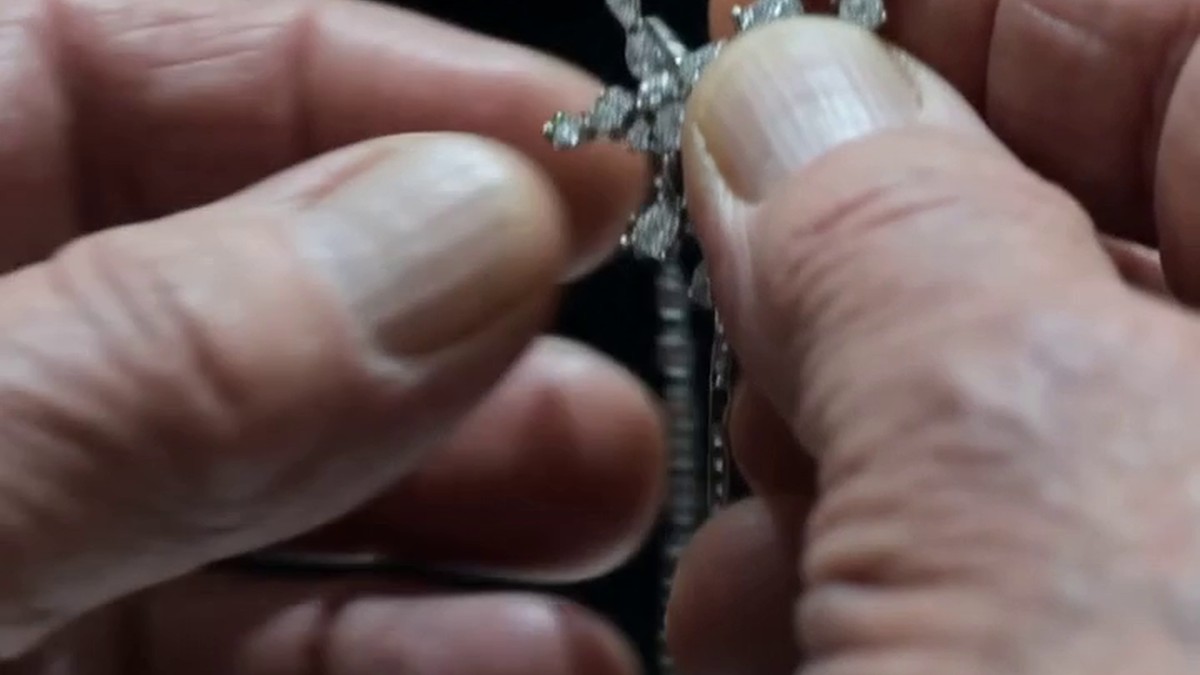
He turned it over slowly. Deliberately. Then his thumbnail found a tiny hidden clasp no one else had noticed.
It clicked open.
His hands began to shake.
“It’s still here.”
No one understood what that meant.
The woman in the coat dragged a tear across her cheek with the back of her hand.
The jeweler looked straight at her — really looked, the way you do when a ghost walks into the room wearing a familiar face.
“Your mother’s name was Elena.”
Not a question.
The woman’s whole body locked up.
“How could you possibly know that?”
The old man’s eyes went glassy.
“Because I built this necklace for her with my own hands.”
A low murmur rolled through the room. The wealthy woman’s polished composure was crumbling at the edges now, piece by piece.
Then the jeweler said something that nobody saw coming.
“Elena didn’t come in alone the day she ordered it.”
The woman blinked.
“What are you saying?”
The jeweler turned. Slowly. Until he was facing the elegant customer directly.
His expression had gone to stone.
“She had another little girl with her.”
The room stopped.
The wealthy woman went the color of chalk.
The woman in the faded coat stared across the space between them — confused, gutted, afraid of what the next sentence would mean.
And then the jeweler spoke just above a whisper, and several people audibly caught their breath.
“Your mother had two daughters.”
As he tilted the hidden clasp toward the light and read aloud what was engraved inside, the wealthy woman’s eyes went wide —
— and she looked like she was calculating exactly how far away the door was.
The engraving read two names.
Side by side.
*Margot. Claire.*
The jeweler’s thumb pressed gently beneath each letter as he said them aloud, and the room received both names the way a church receives a confession — in absolute, airless silence.
The woman in the coat — Claire — mouthed her own name without making a sound.
Then she looked up.
And for the first time, she really looked at the woman across from her. Not at the cashmere coat. Not at the flawless hair or the rings stacked on every finger. She looked at the bone structure. The line of the jaw. The particular way grief, when it’s being suppressed, pulls at the corners of a person’s mouth.
Recognition doesn’t always arrive gently.
Sometimes it hits like a fist.
“You knew,” Claire said.
It wasn’t a question either.
Margot — because that was her name now, that was the shape of her, suddenly, irrevocably — Margot lifted her chin. The gesture was pure reflex. The kind of thing you do when you’ve spent a lifetime making yourself look untouchable.
“I don’t know what you’re talking about.”
“You took it off my neck.” Claire’s voice cracked on the last word, but she held it together. Just barely. “You looked right at me and you took it.”
Someone near the front of the boutique lowered their phone. Slowly. Like even they understood that recording this felt wrong.
Margot’s eyes cut to the door.
The jeweler moved first.
He didn’t block her — he was eighty years old and moved like it — but he stepped into the center of the room with a quiet authority that made the air rearrange itself around him.
“I remember your mother,” he said, addressing Margot directly. “She came to me twice. The first time, she was pregnant with you. She sat in that chair —” he gestured toward a worn velvet stool near the window, “— and she told me she wanted something her daughter could carry forever. Something that couldn’t be sold or contested or taken away in court.”
He paused. Let that land.
“The second time she came, she had a little girl with her. Three years old. Red shoes. Wouldn’t sit still for a minute.” The ghost of a smile crossed his face, then faded. “That was Claire.”
Margot’s composure was doing something complicated. It wasn’t breaking — it was more like it was trying to recalibrate, searching for a new configuration that still let her walk out of this room with her identity intact. There wasn’t one. You could see the moment she understood that.
“My mother passed when I was nine,” she said quietly. All the theater had bled out of her voice. What was left sounded almost human.
“I was six,” Claire said.
The space between them seemed to contract.
“I was raised by my father,” Margot continued. Each word came out measured, controlled, but her hands had stopped moving. They hung at her sides like she’d forgotten what to do with them. “He never — he said there was no one else. He said she was alone when she died.”
“She wasn’t alone,” the jeweler said. “She had another daughter. And from what she told me, she loved you both in a way that kept her up at night.”
Claire pressed her fingers against her mouth.
Margot looked at her.
Really looked.
And there it was — the thing that had been trying to surface since the moment the jeweler said *two daughters*. The thing Margot had been calculating her way around, had been trying to beat back with posture and polish and the way she held expensive things like they already belonged to her.
She saw it in Claire’s eyes.
She saw their mother.
“She split the necklace,” the jeweler said softly. “Or she meant to. She came back one last time — this would have been just before she got sick, though I didn’t know it then — and she asked me to add the second clasp. Said she wanted it to come apart. Said each daughter should carry half.” He turned the piece over in his palms. “She never came back to collect it.”
He set it gently on the glass counter between them.
Neither woman moved.
The boutique had gone so still you could hear the traffic outside. Someone near the back had started crying quietly and was trying not to make noise about it.
“I kept it,” the jeweler said. “All these years. I had no way to find you.” He looked at Claire. “And then you walked in wearing it around your neck, and I thought — I thought maybe she found a way after all.”
Claire reached for the necklace.
Her fingers closed around it, and she stood there for a moment with her eyes shut, feeling the weight of it.
Then she did the thing no one expected.
She held out her hand toward Margot.
Not the necklace. Just her hand.
Open. Steady. An offering that cost more than anything in that display case.
Margot stared at it.
Her throat moved.
Every carefully constructed wall she’d ever built — the address, the wardrobe, the way she walked into a room like she owned the air in it — all of it felt suddenly, profoundly beside the point. Because on the other side of that hand was a woman who had grown up without a mother, without a sister, without any of what Margot had also grown up without, and here they both were, two halves of a clasp that had never been allowed to find each other.
Margot’s eyes went bright and glassy.
She didn’t take the hand.
She did something harder.
She said: “I’m sorry.”
Not to the room. Not for show. She said it directly to Claire, in a voice that had never been used in public before, a voice stripped of everything except the raw fact of what she’d done and what it had cost.
“I’m sorry,” she said again. “I didn’t know. I swear to you, I didn’t know — but I looked at you and I felt something I couldn’t explain and I — I made myself afraid of it. I made myself cruel instead.”
Claire’s hand was still out.
Margot took it.
The room exhaled.
Someone near the door started clapping — a single person, uncertain at first, and then the kind of applause that’s really just people releasing something they’ve been holding in their chest too long. The jeweler pressed both hands flat against the counter and bowed his head, eyes closed, like a man who has finally, after many years, been relieved of something heavy.
The necklace lay between them on the glass.
Later — after the boutique had quietly emptied, after the jeweler had locked the front door and put on a pot of tea that nobody asked for but everybody needed — he sat them both down and opened the hidden clasp one more time.
He set it on the table so the engraving caught the light.
*Margot. Claire.*
Two names. One piece. The stubbornness of a woman who refused to let distance be permanent.
Claire ran her fingertip across the letters.
“She knew,” she said. “Even then. She knew we’d find each other.”
Margot wrapped both hands around her mug and said nothing for a long time. Outside, the city went on doing what cities do — indifferent, relentless, loud. In here it was warm.
“She was right,” Margot said finally.
And she sounded, for the first time all afternoon, like someone who believed it.