If you’ve never tried getting a first-grader ready for school out of a shelter bag, I’ll save you the details. It’s like trying to hold still water in cupped hands while pretending, for the sake of one small person watching you, that nothing is spilling at all.
That particular morning, the crisis was a sock.
Laya stood on the cold pavement in one pink unicorn sock and one plain white one, smiling up at me like she was the one keeping things together rather than watching her mother hold back tears by sheer will. I zipped her coat to her chin, straightened the straps on her backpack, and kept my gaze pointed anywhere but the sign above the entrance behind us.
*Family shelter.*
The word *family* was the part that cut deepest. Not because it was wrong. Because it was absolutely, completely right.
Then a black sedan rolled quietly to the curb, the way expensive cars do — like it belonged wherever it stopped.
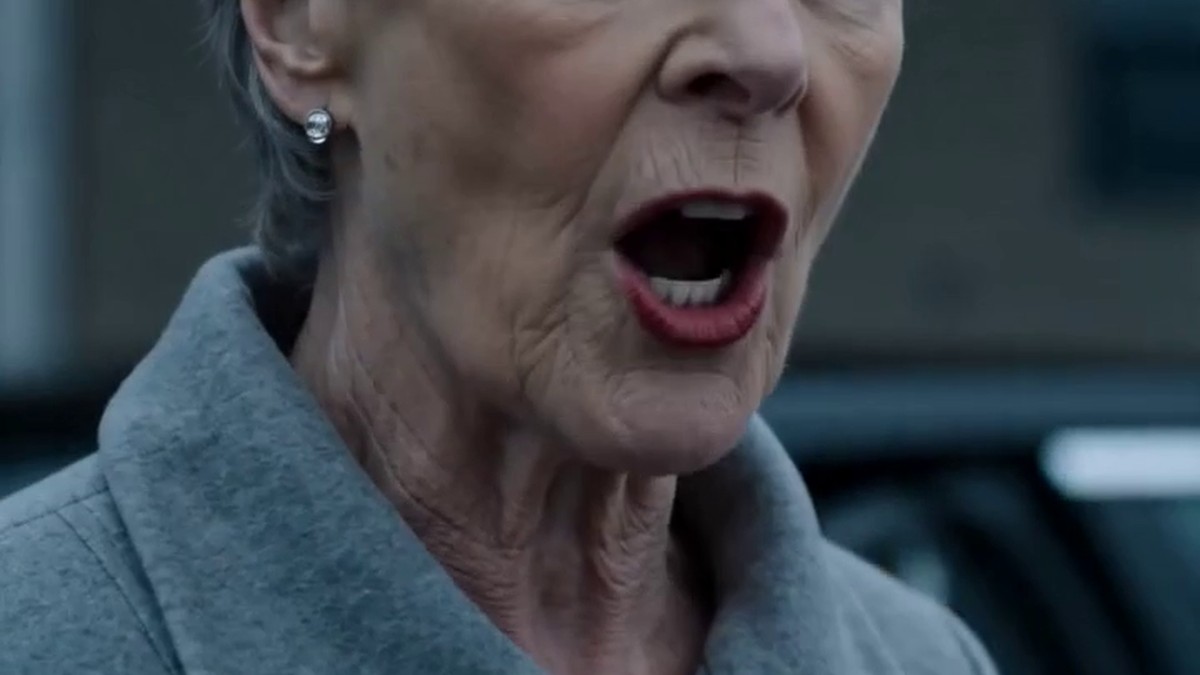
The rear door swung open, and my grandmother stepped out.
Evelyn Hart had no business standing on a cracked winter sidewalk outside a shelter. She belonged in glass-walled offices, restaurants with cloth napkins folded into swans, rooms that went half a decibel quieter the moment she entered. She looked at me. She looked at Laya. She looked at the sign. Something behind her eyes went hard so fast it sent a chill straight through me.
“Maya.” Her voice was the kind of calm that functions as a warning. “Why are you here?”
I gave her the answer exhausted women have been handing out since forever. “I’m fine. It’s temporary.”
Her gaze traveled down to Laya’s mismatched socks, then back up to my face. “Why aren’t you living in the house on Hawthorne Street?”
For a full second I was certain I had heard her wrong.
“My *what?*”
“The house,” she said again, unhurried. “On Hawthorne Street.”
My stomach dropped like something had been cut loose inside me. “What house?”
Laya pulled at my sleeve and tilted her face up with the enormous, luminous hope that only a six-year-old can generate at the sound of a single word. “Mom,” she breathed, “do we *have* a house?”
I couldn’t answer her. I couldn’t pull in enough air to form a sentence.
An hour later, the three of us were tucked into a diner booth with steam curling off Laya’s hot chocolate while my grandmother worked her phone with the clipped precision of someone who has already decided she’s angry — she’s simply choosing the right moment to show it. Words drifted across the table that had no business anywhere near my life. Property manager. Keys. Lease file. Rent history. Transfer records.
Money.
That was the exact moment my humiliation curdled into something colder. Something closer to fear.
Months before this, when my hours got slashed and childcare costs swallowed everything that remained, I moved in with my parents. Temporary, we all said. My mother called it *support.* My father called it a chance to catch my breath. What it actually became was a slow, grinding lesson in how cruelty can dress itself in concern and pass right through the front door. Quiet digs at my parenting. Complaints about the groceries Laya and I used. Regular reminders that they were tolerating the *inconvenience* of us.
Then one night I came home from a shift and found my boxes stacked in the hallway outside their apartment door. Laya was slumped in a chair with her coat still buttoned and her shoes untied, half-gone into sleep. My mother said it was time I learned to stand on my own. My father called it tough love.
Then they turned the deadbolt.
I burned through every dollar I had left on a motel room. After the motel came the shelter, because pride does not buy a second week under a real roof, and it absolutely does not get a six-year-old to school fed, clean, and wearing a smile she means.
In that diner booth, my grandmother called my mother on speaker. My mother’s voice came through bright as a sales pitch. *Oh, Maya’s doing just wonderfully. She’s all settled into the Hawthorne house. She loves it there. We just didn’t want to trouble you with every little detail.*
I sat perfectly still while Laya filled in a coloring page of cartoon stars and hummed something tuneless to herself.
My grandmother let my mother talk. Let her layer the lie with imaginary neighbors, invented routines, borrowed gratitude. Then she ended the call and held her eyes on the table for one long breath before she raised them to mine.
“That wasn’t a misunderstanding,” she said. “That was a plan.”
By then she had already learned enough to make my blood go cold. Eight months earlier, through her trust, she had purchased a small house on Hawthorne Street — for me and Laya. My parents were supposed to handle the paperwork, hand over the keys, help us move in, and keep the utilities and taxes straight until I got back on solid ground.
Instead, someone had quietly rewritten the ending.
Three days after the diner, my grandmother told me to put on the nicest dress I owned, arranged for Laya to spend the evening with a sitter, and drove me to a family dinner my mother had been orchestrating for weeks. She parked across the street, reached over and straightened my coat collar, and offered exactly four words.
“Walk in ahead of me.”
The room was everything I expected: low lighting, catered trays, polished silverware, and the particular brand of bright, hollow laughter people produce when they’re all performing for each other. My mother spotted me from the far side of the room and stopped cold, her wine glass suspended halfway to her lips. My father’s expression clenched like a fist, fast enough that — for just a moment — it was almost satisfying.
I had never once seen either of them look frightened before.
Then my grandmother came through the door behind me, with a lawyer at her shoulder carrying a slim folder and a laptop bag.
That was when the whole room shifted.
She made her way to two aunts, exchanged a nod with an uncle, then turned to face my mother the way you’d turn to correct a minor factual error — unhurried, unblinking, completely sure of herself. “Before we sit down to eat,” she said, “I’d like to address something you told me.”
Nobody reached for a drink after that.
The lawyer set the laptop on a sideboard along the wall. A small projector hummed to life. My mother’s hand began to shake. My father took one step forward and then went completely still, realizing he had no idea yet how deep the digging had gone.
No one else in that room did either.
But I knew one thing with absolute certainty.
For the first time in months, I was not the person backed into a corner.
And when that first document blazed onto the screen, my parents looked exactly like two people watching solid ground open up beneath their feet.
The first document was a deed.
Hawthorne Street. The address printed in clean black type looked almost casual up there on the wall, the way dangerous things sometimes do. My grandmother’s trust name at the top. Intended beneficiary listed below. My name. Laya’s name as dependent minor.
My mother made a sound somewhere between a laugh and a cough. “That’s hardly — there’s an explanation for all of this, Mother.”
“I know there is,” my grandmother said. “That’s why we’re here.”
The lawyer — a trim man in his fifties named Gerald Kwan who had the specific stillness of someone who has watched families detonate in enclosed spaces before — advanced to the next document without being asked. A lease agreement, dated eight months ago. My name on one line. A signature on another that was not mine, that had never been mine, written in my mother’s careful, looping hand.
The room was completely silent now. The catered trays steamed quietly on the table. Nobody was going to eat tonight.
My father took another half-step forward and stopped himself again. His jaw was working like he was chewing something he couldn’t swallow. He looked at the screen, then at Gerald, then at the slim folder still mostly closed under Gerald’s arm, calculating how much more was in there. His face gave him away entirely.
There was more.
“The property manager,” my grandmother said, turning toward the room now, speaking to the aunts and the uncle and the cousins who had gone granite-still at their chairs, “was paid out of my trust account. Eight months of property taxes. Eight months of utilities. Eight months of maintenance reserve.” She paused. “The receipts were submitted to me by my son-in-law as proof of support.” She glanced at my father. “Proof that Maya and Laya were being taken care of.”
One of my aunts, my mother’s younger sister Sandra, set her glass down on the tablecloth with a sound like a small gavel.
My mother turned on a pivot. “Sandra, don’t you dare — ”
“I haven’t said a word,” Sandra said.
“You were about to.”
“Diana.” My grandmother’s voice carried no heat at all. That was the thing about Evelyn Hart — she did not need temperature to be dangerous. “You will not redirect this.”
My mother turned back. She had drawn herself up to her full height, which was considerable. I had spent my whole childhood watching that posture mean something. Tonight, watching it from this side of the room, I noticed for the first time how much work it required. How much of her energy went into holding the architecture together.
“I was protecting her,” my mother said. “Maya has never been equipped to manage — ”
“She was sleeping in a shelter,” my grandmother said. “With her daughter. Three weeks before winter.”
The word *shelter* in that room, spoken by Evelyn Hart in that voice, landed like something thrown hard through glass.
My mother’s chest rose. “That was her choice. She refused every offer of — ”
“You stacked her belongings in a hallway,” my grandmother said. “You locked the door. Laya was six years old and still in her coat.” She let that sit for a count of three. “I’ve spoken to the building supervisor. The neighbor across the hall. The night manager at the motel on Fifth where Maya used her last two hundred and forty dollars.” Another beat. “Gerald.”
Gerald advanced the slide.
Phone records. A grid of calls and timestamps, highlighted in yellow. My mother’s number to the property management company. My mother’s number to the utilities provider. My mother’s number to my grandmother’s personal assistant, weekly, with brief cheerful updates about how settled and grateful Maya was in her wonderful new house.
My father said, “This is being taken completely out of context.”
It was the first thing he had said, and the quality of it — thin, reaching, badly constructed — told me everything about how unprepared he actually was. He had assumed, I realized, that the evidence would be softer. That my grandmother would arrive with suspicion and leave with her family intact. He had counted on her wanting the neat version too much to bear the real one.
He had been wrong about Evelyn Hart his entire adult life.
“Then give me the context,” she said, and looked at him the way she might look at a contract clause she had already decided to strike.
He opened his mouth.
He closed it.
My mother said, “We intended to tell her. When she was more stable. When she could appreciate — ”
“Where are the keys?” I said.
It came out quiet. I hadn’t planned it. The room shifted toward me, and I felt the weight of it — every set of eyes — and I did not look away from my mother. My whole body was vibrating at some frequency below sound.
“The house keys,” I said. “Where are they.”
My mother’s gaze moved across my face like she was looking for the girl who used to fold herself small enough to stop taking up space. I watched her not find her.
“In my kitchen drawer,” she said finally. Her voice had changed. Not softened. Deflated. Like something structural had given way inside it.
“You had them for eight months,” I said.
She didn’t answer.
“Laya asked me every single night if we were going to be okay.” The vibration had moved up into my throat now and I let it be there. I was done performing steadiness. “Every night. I told her yes. I had no idea if it was true. I told her yes anyway because I had nothing else to give her. And you had a key in your kitchen drawer.”
My father said, “Maya — ”
“Don’t,” Sandra said, and her voice was flat and final and nobody argued with it.
My grandmother walked to the sideboard, picked up the slim folder Gerald had set there, and carried it across the room to my mother. She held it out.
“Deed reassignment,” she said. “Already drawn. You’ll sign it tonight, and you’ll release the keys, and you will arrange with Gerald’s office before the end of this week to settle the difference between what was spent on your behalf and what was intended for my granddaughter.” She held her eyes on my mother’s face without blinking. “Or I will deal with this in a way that does not involve a family dinner.”
The implication required no diagram.
My mother took the folder. Her hands were steady. She was a woman who had spent decades being the person in the room who decided things, and even now, cornered and documented, she held herself like someone who would eventually find the angle. I knew that woman. I had spent my whole life trying to get her to look at me with something warmer than assessment.
Standing there watching her open the folder, I understood — really, finally, molecularly understood — that she was never going to. Not because of anything in me. Because of something missing in her that I had been trying to fill from the wrong side of the wall.
She signed.
My father signed after her, pressing too hard on the pen, saying nothing.
Gerald collected the folder and gave me a single professional nod that somehow contained a great deal of human warmth.
My grandmother touched my arm. Just briefly. Her hand was thin and cool and absolutely certain.
“Come,” she said. “I’ll drive you to get Laya.”
—
We picked her up from the sitter just after nine. She came to the door in her pajamas, rumpled and warm-smelling, and launched herself at my knees with the full-body commitment that six-year-olds bring to everything.
“Did you have a good dinner?” she asked my grandmother solemnly.
“Productive,” my grandmother said, and seemed genuinely amused by Laya for the first time I’d ever witnessed.
In the car, Laya pressed her face against the window and watched the streetlights go past. After a few minutes she said, without turning: “Mom. Are we going to the house?”
I looked at my grandmother.
My grandmother looked at the road.
“Tomorrow,” I said. “We go see it tomorrow.”
“Is it nice?”
I didn’t know. I had never seen it. I had no idea what color the walls were, whether the kitchen got morning light, if there was a yard, if the floors were the kind Laya could slide across in her socks.
“I think so,” I said.
“I think so too,” Laya said, with the absolute confidence of someone who has decided, and pulled her feet up onto the seat and fell asleep against my arm before we crossed two more blocks.
—
The key was on my kitchen counter by ten the next morning. A neighbor I hadn’t met yet waved from across the street. The front door swung open onto hardwood floors and winter light and a small backyard with a single oak tree still holding a handful of stubborn brown leaves.
Laya walked in ahead of me, turned a full slow circle in the empty living room, looked up at the ceiling and then back down at me.
“It echoes,” she said.
“We’ll fix that.”
She nodded, very seriously. Then she dropped her backpack, ran the full length of the hallway in her socks, and slid.
She made it almost to the kitchen, arms out, grinning so hard I could feel it from fifteen feet away.
I sat down on the bare floor in the middle of the empty room, and I let her hear me laugh.