Cedar Rapids. Our hallway. Dad’s face the color of a stop sign, and Serena on the stairs crying in that careful, practiced way she had — like she’d run the scene in her head a dozen times before curtain.
The charge: one missing gold bracelet.
“I didn’t take it,” I said.
He pointed at the front door. Finger straight, jaw set. “Get out. We believe your sister.”
Mom said nothing. She’d already gone through my room before I even walked in the door. That silence — that *pre-decided* silence — cut deeper than anything he shouted.
Ten minutes. That’s how long it took to reduce me to a duffel bag, a backpack, and sixty-three dollars pressed between the pages of my geometry textbook.
The porch light buzzed above my head. The smell of pot roast still drifted through the door behind me. I dialed Aunt Diane.
She drove four hours from Madison in a salt-streaked Subaru with a thick brown file sitting on the passenger seat under a crumpled gas receipt.
She didn’t ask whether I’d done it.
She said, “Are you cold?”
That was the night I got a new home. The file came with her — court papers, school forms, screenshots, every piece of wreckage my parents assumed the years would quietly bury.
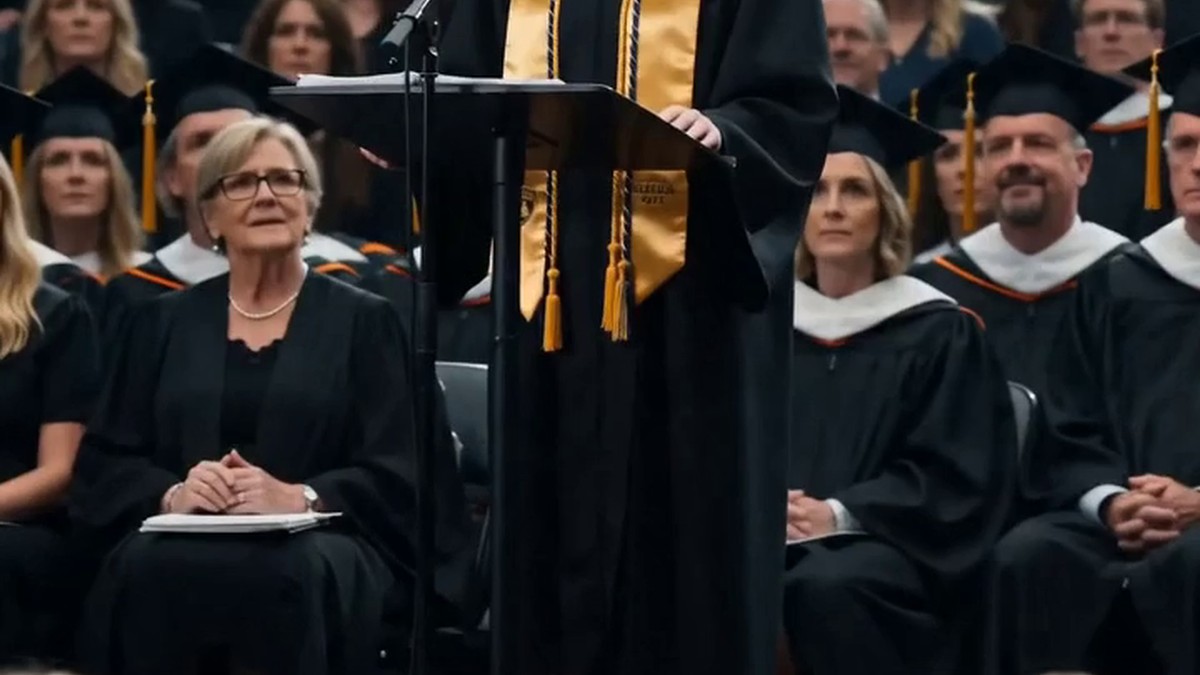
Seven years later, I stood at the front of a university arena in a black gown and gold honor cords, looking down at the first row.
Dad was already angling for photos, smile wide and easy.
Serena was clapping. Enthusiastic. Like someone who’d never detonated anything.
And in Row C, Aunt Diane sat with that same brown file balanced across her knees.
I opened my speech the way they expected me to.
Then I said that once, a fifteen-year-old girl was put out on the street for a bracelet she never touched.
The room went quiet all at once — the particular quiet of two thousand people holding their breath.
Dad’s smile vanished.
Mom turned toward Diane. Diane was already rising to her feet.
I wrapped both hands around the podium and leaned into the microphone.
“Please stand up, Diane Harper.” I let the words land. “My real mother.”
Mom’s hands began to tremble.
Diane opened the file.
The folder was thick. Worn at the corners. The kind of document that has been opened and closed a hundred times in private moments — at kitchen tables at two in the morning, in parking lots before hard phone calls, in the front seat of a salt-streaked Subaru on a four-hour drive toward a girl standing alone on a porch.
Diane didn’t read from it. She didn’t have to.
She simply held it open so the first row could see.
—
I’d written the speech three times.
The first version was what they expected — gratitude, grace, a few careful tears, the kind of story where struggle becomes scenery and everyone goes home feeling good. I deleted it the same night I wrote it.
The second version was angrier. Too much. It wanted to burn the room down, and I understood that impulse, but burning rooms down was never the point.
The third version — the one I was reading now — was the truth. Just the truth. Specific and plain and impossible to look away from.
“I was fifteen,” I said into the microphone. “I had sixty-three dollars and a geometry textbook. I had no plan and no explanation that anyone was willing to hear.”
The arena was still. You could hear the ventilation system working overhead.
“I also had one phone number I hadn’t used in two years because I was afraid she’d say she was busy. Or that she’d ask if I was sure I hadn’t taken it.”
I paused.
“She didn’t ask that. She asked if I was cold.”
In Row C, Diane pressed two fingers to her mouth. Her shoulders were back. She was not the kind of woman who collapsed in public, but I could see what it cost her to stay straight.
—
Down in the first row, my father had gone very still.
He was a man who occupied space confidently — always had — the kind of man who adjusted his collar before cameras and knew how to angle his jaw. Right now he looked like someone had cut his strings. The smile was gone. In its place was something I recognized from the night he pointed at the front door: the expression of a man who has already decided the story and cannot process that the story has changed.
Serena sat beside him.
She was not clapping anymore.
I looked at her directly. I’d decided, writing the third version, that I would do that. That I wouldn’t look away or soften it by looking somewhere safer.
She met my eyes for about four seconds. Then she looked at her lap.
That told me everything the bracelet itself had never needed to confirm.
—
“For seven years,” I said, “I called what happened to me a complication. A rough patch. I was good at elegant euphemisms. It turned out they were useful academically — you can build a very clean argument when you’ve had years of practice deciding which parts of a story to leave out.”
A ripple of uncomfortable laughter moved through the rows behind the first.
“But I don’t want to leave parts out anymore.”
I looked down at the pages I’d printed, then set them aside.
“Diane Harper drove four hours at nine o’clock on a Tuesday night because a fifteen-year-old called her. She had a court file on her passenger seat because she’d been building a case for years — quietly, carefully — against the possibility that something like that night might happen. She didn’t tell me about the file for a long time. She didn’t want me to feel like a project. She wanted me to feel like a kid.”
My voice caught there. Just briefly.
“It took me longer than it should have to let that work.”
—
My mother stood up.
I hadn’t expected that.
She was in the third seat of the first row, and she stood the way people stand when they’ve been sitting somewhere too long and the body finally overrides the mind — abrupt, unsteady, one hand braced against my father’s shoulder.
He grabbed her arm. She shook him off.
She was looking at Diane.
Diane was still standing in Row C, file open, watching my mother the way you watch a weather system you’ve been tracking for years.
The two thousand people in that arena were watching my mother walk up the aisle.
I stayed at the podium. I kept my hands wrapped around it the way I’d decided I would — steady, present, not stepping back.
She stopped about six feet from the stage.
“Sandra.” Diane’s voice was calm and low but it carried. The microphones caught the edge of it.
My mother’s name — spoken that plainly, without armor — seemed to do something to her. Her face broke open in a way I had never once seen in thirty years of living inside the same walls as that face.
“I knew,” she said. Not to the room. To Diane. To me. Her voice was barely above a whisper but the arena was so quiet it didn’t matter. “I knew before she came home that night. Serena showed me where it was. I’d already found it.”
The breath Serena drew was audible two rows back.
My father said her name — *Sandra* — low and warning, like he still believed the situation could be managed.
She ignored him.
“I let it happen anyway.” She was crying now — not Serena’s practiced, curtain-ready tears, but the ugly, graceless kind that doesn’t care how it looks. “I don’t know why. I’ve been — I’ve tried to understand why, for seven years, and I —”
“Sandra.” Diane’s voice again. Firm but not unkind. “Not now. Not here.”
And the strange thing — the thing I hadn’t planned for, that I hadn’t written into any version of the speech — was that my mother listened. She nodded once, like someone being helped down from a ledge, and she sat in the aisle step because her legs wouldn’t carry her back to her seat.
The arena breathed.
—
I looked back down at the podium.
There were more pages. A few good lines I’d worked hard on. A closing paragraph that had seemed, three nights ago, like the right way to end.
I left them.
“I came here seven years ago with sixty-three dollars,” I said. “I leave today with a degree in social work and the knowledge that one person asking *are you cold* at the right moment can rewrite everything that comes after.”
I turned toward Diane.
“Thank you for the file. Thank you for the four-hour drive. Thank you for never once asking me to perform gratitude before I was ready to feel it.”
I stepped back from the microphone.
The applause started in the middle of the arena and worked its way out — not the polite, scattered kind, but the kind that builds from something real, from two thousand strangers who recognized something they knew.
—
Afterward, in the side corridor behind the stage, Diane found me first.
She still had the file. She handed it to me.
“It’s yours,” she said. “Always was.”
I held it against my chest. It was lighter than I remembered, or maybe I was stronger. Probably both.
My mother appeared at the corridor entrance twenty minutes later, without my father. I didn’t know where he’d gone and I found, for the first time, that I didn’t particularly need to.
She stopped at the threshold. Asked with her eyes if she was allowed in.
I didn’t wave her forward. But I didn’t turn away.
“I’m not ready,” I said. “I want to be honest about that.”
She nodded. “Okay.”
“But I’m not done, either.” I looked at her — really looked, the way I’d avoided for twenty-two years of living inside the noise of what I needed her to be. She was just a person. A person who had made a choice on a Tuesday night and spent seven years unable to explain it, even to herself. “I just need it to be honest. Whatever it is.”
She said, “Okay,” again. Smaller this time. Like a door opening one inch instead of slamming.
It wasn’t forgiveness. It wasn’t resolution. It was a door open one inch, and for now that was enough.
—
The porch light over my parents’ house had buzzed on a Tuesday night seven years ago, and I had stood under it with sixty-three dollars and nowhere to go.
I drove home with Diane that evening down the same highway she’d taken to come get me, in the same Subaru now worn past salt-streaks into something almost comfortable.
The file sat in my lap. My honor cords were draped over the back seat.
Halfway home she turned the radio on low.
Neither of us talked for a long stretch, and in that silence — the *chosen* kind, the warm kind, the kind that doesn’t need to fill itself — I understood what home had always been.
It was this. A woman who asked if you were cold. A car heading somewhere safe.
The highway unrolled ahead of us into the dark.
We drove into it together.