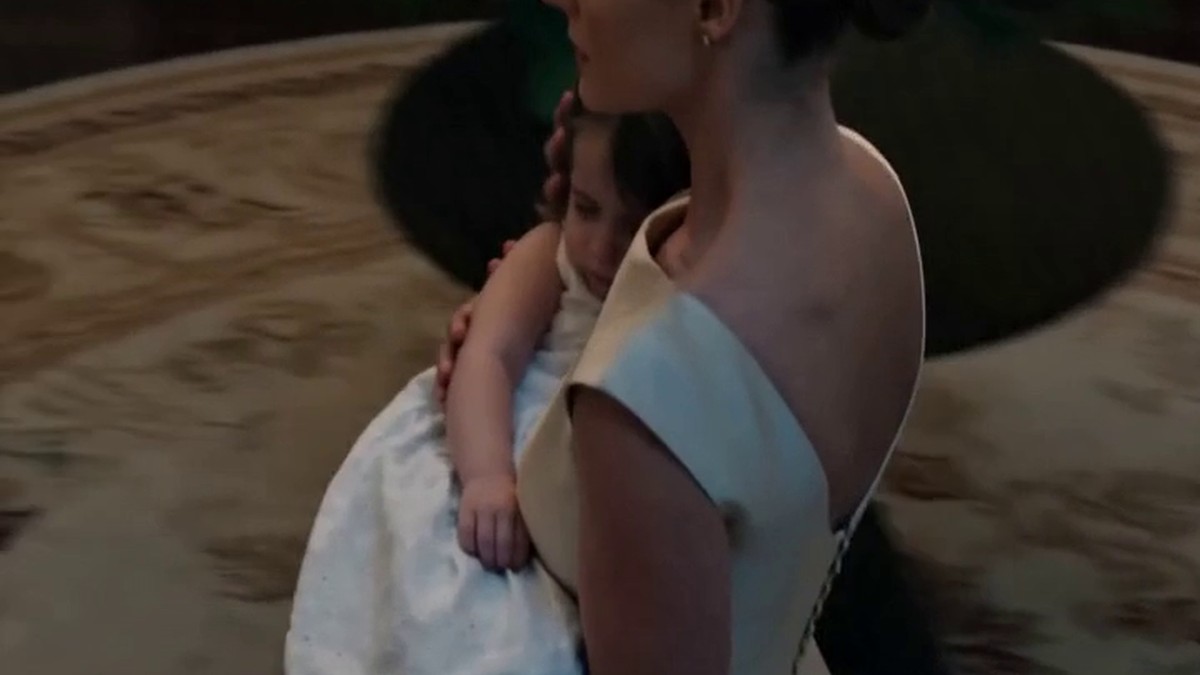
I looked down at Sabina.
Four years old, folded into my chest like something broken, her cheeks scorched red, her hair plastered in damp curls at her temples. She could barely hold her head up.
“Mommy,” she breathed. “I’m tired.”
That was enough.
Downstairs, the house performed flawlessly. Jazz drifted through the marble corridor. Crystal rang against crystal in the dining room. Caterers glided past in single file, trays lifted, chins level, and my mother-in-law’s guests arrived in a slow procession, surrendering their coats to the staff as though the whole evening had been choreographed by God himself.
Meanwhile my daughter’s fingers had gone limp around mine.
I gathered her medical bag, her coat, my keys.
I was six steps down the staircase when Beatrix appeared in the hall below me.
Wine-colored silk. Pearls that caught the chandelier like small white fires. She looked at me first, then at the coat draped over my arm, then at Sabina — the way you look at something that has ruined the symmetry of a room.
“Where exactly are you going?” she asked.
“Urgent care.”
Her eyes sharpened. “The guests are here.”
“My daughter is sick.”
“She has a fever. Give her something for it, and stop making this family look ridiculous.”
The house didn’t go silent. The music kept moving. Laughter rolled out from somewhere near the bar. A server pushed through the kitchen door sideways, tray balanced overhead. But something inside me went perfectly, completely still.
I recognized that tone. I had been hearing it for years — at charity galas, at Sunday brunches, at family birthday dinners where Beatrix once corrected the position of my own silverware in my own dining room. She always spoke to me like I was a guest who had overstayed a provisional welcome.
I stepped around her.
She stepped with me.
“Vivian.” Her voice dropped to something intimate and cold. “Do not embarrass yourself in front of people who matter.”
I looked at my daughter’s face pressed into the curve of my neck.
“She matters.”
Thatcher came out of the study at that precise moment, working a cufflink with the unhurried ease of a man who believed time would wait for him. Black dinner jacket. Hair perfect. Jaw already tight.
He glanced at Sabina. Then at his mother. Then at me.
“Vivian,” he said. “Not tonight.”
I waited for something to shift in his expression. Worry. Softness. Anything.
Nothing came.
“Her fever is too high,” I said. “I’m taking her in.”
He dropped his voice the way men do when they want control without volume. “My uncle brought investors tonight. This dinner is important.”
“So is your daughter.”
The muscle in his jaw flickered. “Don’t do that. Give her medicine, put her to bed upstairs. We’ll check on her after dinner.”
*After dinner.*
Those two words landed somewhere between my ribs and didn’t move.
I almost didn’t recognize the man in front of me.
Behind him, Beatrix had folded her arms, the pearls at her throat rising and falling with quiet, satisfied patience. She wasn’t watching this the way a grandmother would. She was watching it the way an employer watches a subordinate to see whether they’ll finally remember the hierarchy.
I reached for Sabina’s coat.
Thatcher moved in front of the door.
“Don’t make a scene,” he said again. Same tone. Same word. Like repetition was its own kind of authority.
Sabina shifted against me and made a sound so small it barely qualified as sound at all.
It rearranged something permanent inside me.
Five years. Five years of careful maintenance in that house. Smiling when Beatrix introduced me at parties as “Thatcher’s wife” and let my profession dissolve into the air. Going quiet when guests credited my husband for a life he had never paid for. Watching his family host dinners beneath my roof, speaking around me as though the walls themselves had more lineage than I did.
I had called it keeping the peace.
I had told myself Sabina needed a whole family. That not every wound required a response. That patience was a kind of grace.
But standing at my own front door, holding my sick child, while my husband positioned his body between me and the exit to protect a dinner party — I finally understood what all that quiet had actually cost.
I let my eyes travel the length of the hall. The imported rug. The oil painting above the console table. The fresh flowers Beatrix had ordered without asking anyone. The staff schedule clipped neatly beside the kitchen entrance.
Every single thing in that house had my name behind it.
Not Thatcher’s. Mine.
I had purchased that mansion before his family ever began calling it *our estate*. My company paid for the gut renovation. My accounts covered the staff, the property taxes, the emergency repairs, the parties, the wardrobe, the wine cellar, the monthly transfers Thatcher drew on like proof of his own accomplishment.
And here, in my own house, I was being asked to request permission to take my child to a doctor.
“Move,” I said.
Thatcher blinked. Genuinely blinked — like the word had arrived in the wrong language.
He was fluent in my patience. In my measured explanations and careful concessions, all the small surrenders I had made so he could keep his dignity assembled and presentable. He had no vocabulary for one flat word with no softening clause attached.
“Vivian,” he said, with warning in it.
“No.” I held his gaze. “You don’t get to use that voice with me tonight.”
Beatrix produced a short, dry laugh. “Listen to yourself.”
I turned to her.
For the first time in five years, I did not adjust my face for that woman. I did not round my edges or lower my eyes or find somewhere neutral to rest my expression.
“You should go check on your guests,” I said. “They’re about to hear that dinner’s been pushed.”
The laugh vanished.
Thatcher stared at me as though I had revealed a fluency he never knew I had.
I walked past him.
He didn’t stop me.
Outside, the driveway lanterns made gold pools on the wet stone. A valet took one look at Sabina’s face and went for my car without a word. I buckled her into the back seat, tucked her coat around her like armor, and heard the front door open at the top of the steps.
Thatcher stood in the light.
“You leave right now,” he called after me, “don’t expect to walk back in like none of this happened.”
I looked at him across the roof of the car. Steady. Unblinking.
“That’s exactly what I’m counting on.”
I drove away.
The clinic was all fluorescent light and plain walls, and when the nurse took one look at Sabina and moved — quickly, purposefully, without performance — I felt something loosen behind my sternum that I hadn’t realized had been locked for years.
No pearls. No investors. No salmon.
Just people who understood that a child’s—
fever was the only thing in the room that mattered.
They brought her back within twenty minutes. Strep, the PA said. Classic presentation. We caught it early enough. She’d need antibiotics, rest, fluids. She’d be uncomfortable for a couple of days and then fine — fully fine, he said, in the cheerful, matterof-fact tone of someone who delivers relief professionally and still means it every time.
I sat on the edge of the exam table beside her and held her hand while the nurse went over dosing instructions, and Sabina looked up at me with those glazed, fever-tired eyes and said, “Are we going back to the loud house?”
I smoothed the damp hair away from her forehead.
“No, baby,” I said. “We’re not.”
She closed her eyes and seemed satisfied with that, in the way children are satisfied when they’ve asked the only question that actually counts.
—
I drove to my sister Elena’s apartment on the east side. It was past ten by then and I hadn’t called ahead, but Elena opened the door in thirty seconds flat — barefoot, reading glasses pushed up into her hair, a paperback still hinged open in one hand — and took one look at Sabina asleep against my shoulder and held the door wider without saying a word.
She made up the guest room. She filled a glass with water and left it on the nightstand. She found a children’s thermometer in her bathroom cabinet and handed it to me like she’d been keeping it there in case I eventually needed it, which, knowing Elena, she probably had.
I got Sabina settled. First dose of antibiotics from the pharmacy bag. Fever reducer. Cool cloth on her forehead. Her breathing deepened and evened out and the red in her cheeks began to soften to something closer to sleep than suffering.
I stood in the doorway and watched her chest rise and fall.
Elena appeared at my elbow with two cups of tea.
“Come,” she said softly.
We sat at her kitchen table. The city moved quietly outside the window — distant sirens, a delivery truck reversing somewhere, the ordinary nighttime machinery of a place that didn’t know or care what had just ended.
“Tell me,” Elena said.
So I did.
She listened the way she always listened — without interrupting, without performing shock, without the ambient noise of her own opinion crowding in before I’d finished. When I was done she wrapped both hands around her mug and looked at the table for a moment.
“How long have you known?” she asked.
“That it was over?”
She nodded.
I thought about it honestly. “A while. I just kept — filing it away. Telling myself it wasn’t as bad as it felt.”
“And tonight.”
“Tonight I stopped filing.”
Elena looked up. Her eyes were steady and a little sad, not for me specifically but in the way of someone who has watched something preventable go on for too long. “What do you need?”
“I need a lawyer,” I said. “Monday morning.”
She reached across the table and covered my hand with hers. “I know one.”
—
Thatcher called at 11:47. I watched his name light up the screen and let it go to voicemail.
He called again at 12:03. Again at 12:31.
At 12:44 he sent a text.
*We need to talk about what happened tonight. I said some things. Come home and we’ll talk it through.*
Come home. As though home were a place I had been confused about the location of.
At 1:09 Beatrix called. I hadn’t even known she had my number saved. I let that one go too, and felt something almost like amusement at the image of her in that wine-colored silk, sitting in the evacuated dining room, the salmon finally plated for no one, the investors long since packed into their cars, trying to reconstruct the evening’s authority through a phone screen at one in the morning.
I turned the ringer off. I finished my tea. I slept on Elena’s couch under a blanket that smelled like cedar and borrowed safety.
—
In the morning Sabina woke up asking for apple juice and cartoons, which I took as a reliable sign that she was going to be perfectly fine. She was still warm but the manic brightness had come back into her eyes, and she ate half a piece of toast and declared Elena’s apartment “cozy” in the tone of a small person who gives interior design verdicts with full authority.
Elena took her for cartoons and I stepped onto the balcony with my phone.
Thatcher had sent three more texts overnight. The arc of them was familiar. First the softened version of an apology — *I know you were worried, I get that* — then the pivot to grievance — *but the way you handled it was not okay* — then the appeal to practicality — *we have things to discuss, there are logistics here, call me.*
I read all three. I didn’t respond to any of them.
What I did instead was call my attorney. Not the family attorney. Mine. The one I’d retained four years ago to structure my company’s holdings in a way that was, as she had put it at the time with the precision of someone who’d seen every variety of marital disaster, cleanly separate from any future complication.
She answered on the second ring, which told me she’d already been expecting this call for longer than I had.
—
Three weeks later I sat across a conference table from Thatcher and his lawyer and mine, in a room with a view of the river and the kind of silence that has been professionally manufactured for exactly this kind of occasion.
Thatcher had aged slightly since the night on the steps. There was something diminished about the ease he normally wore on his face. He hadn’t expected, I think, that I would be so methodical. He’d anticipated tears, or pleading, or a long renegotiation period during which he could reassemble his footing. He was fluent in my patience, as I’d understood at last — and this was something else entirely.
He looked at me once before the lawyers started talking. A long, searching look, like he was trying to locate the version of me that would help him out of this.
I met his gaze. I didn’t look away. But there was nothing in my face for him to hold onto.
The house, as the documents confirmed in dry legal language, had always been mine. The accounts. The property. The equity in every surface his family had called their estate. Thatcher’s attorney raised two objections. Mine answered them in three sentences each. The room moved forward.
It took two hours.
When it was done, Thatcher stood and buttoned his jacket — that automatic, reflex gesture of composure — and then seemed to realize he wasn’t sure what the next move was supposed to be. He looked at me one more time.
“Vivian.” His voice was quieter than I’d ever heard it. Stripped of the dinner-party register, the warning register, the register of a man who believed tone was the same thing as authority. Just a voice. Tired and a little lost. “Was there anything I could have done?”
It was the first honest question he’d asked me in years. Maybe the first one he’d ever asked.
I thought about Sabina’s fingers going limp around mine. The sound she made — that sound too small to be a sound — that had rearranged something permanent inside me. I thought about five years of careful maintenance and all the small surrenders stacked up like a debt I’d been paying without understanding the interest rate.
“That night,” I said. “If you had moved.”
He held that for a moment.
Then he nodded, once, the way people nod at things they know they cannot argue, and walked out.
—
The house sold in the spring.
I didn’t need it. I bought something smaller — a renovation project, three blocks from Elena, with a garden that got afternoon light and needed work, which was exactly what I wanted. Something to put my hands into. Something that would become what I made it, rather than what I’d inherited.
Sabina helped me pick the paint for her room. She chose a yellow so insistently bright it practically argued with you, and she stood in the middle of the drop-clothed floor with a brush in her hand, deeply serious about the business of covering the old color completely.
“Is this our house?” she asked.
“Yes,” I said.
“Just ours?”
“Just ours.”
She considered this. Dipped the brush. Applied a stripe of yellow to the wall with the full conviction of someone laying claim.
“Good,” she said.
Outside, the afternoon came through the uncurtained window and fell across the floor in a long clean rectangle. No chandelier. No staff. No salmon waiting to be plated for people who had never once asked my daughter’s name.
Just light. Just the smell of fresh paint. Just the two of us, making something new out of what had always been there.
That was enough.
That had always been enough.