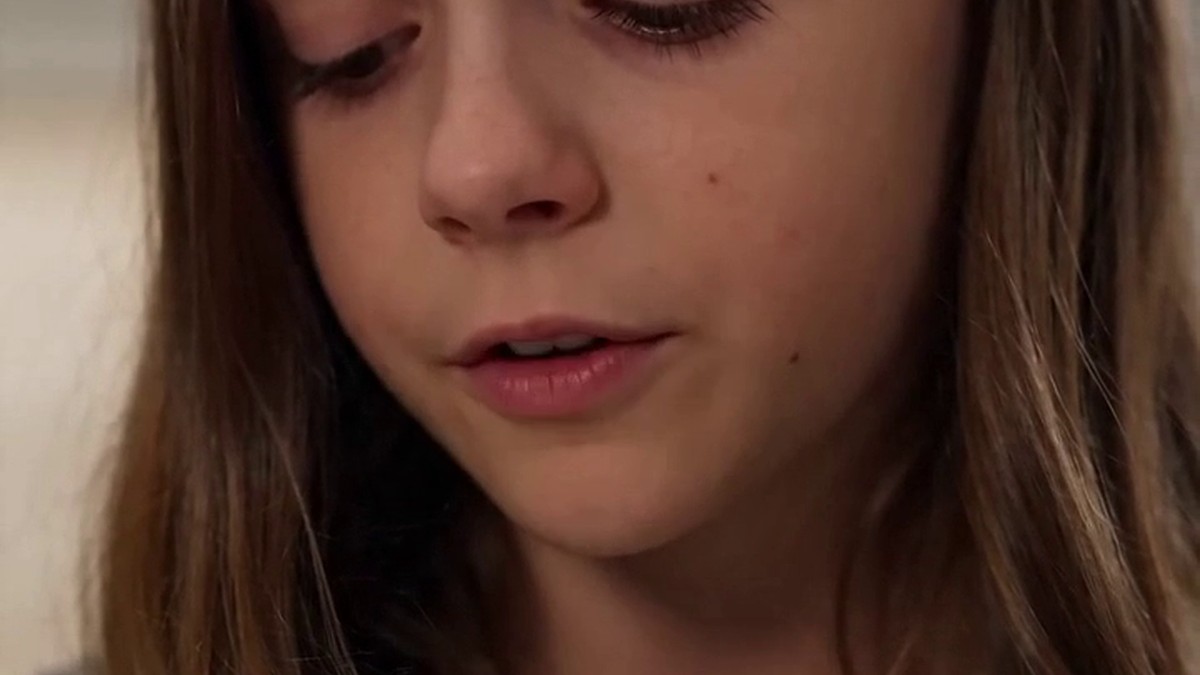
Michael walked in and stopped dead.
He reached over and turned off the faucet. Then he crouched down beside her.
“Lily… why are you in here washing dishes while everyone else is opening presents?”
The little girl hesitated. Her eyes drifted toward the living room, warm and glowing with Christmas light.
Then she squeezed the sponge tight in both hands and said, barely above a whisper:
“Grandma said the photo was only for the real grandchildren.”
The air in that kitchen shifted in an instant.
Michael didn’t move. Didn’t breathe.
Out in the living room, the laughter began to die — slowly, then all at once.
Eleanor, standing beside the Christmas tree, went completely still the moment those words reached her. The smile drained from her face like color from a wound.
For the first time all night, no one had a single thing to say.
Michael walked out of the kitchen. Lily followed close behind.
And the moment the two of them stepped through that doorway into the light —
the festive illusion shattered, and every person in that room was left staring at a truth none of them could pretend away.
The fire in the hearth kept crackling. It was the only sound in the room.
Michael didn’t raise his voice. He didn’t have to.
He simply walked to the center of that living room — past the gleaming tree, past the tangle of ribbons and torn wrapping paper, past the faces of his brothers and their wives, all of them suddenly finding something to study on the floor — and he stopped in front of Eleanor.
His mother.
She was seventy-three years old and had never once, in all those years, looked small to him.
She looked small now.
“Mom.” His voice was quiet. Steady in the way that a bridge is steady before it gives. “Tell me I heard that wrong.”
Eleanor opened her mouth. Closed it. Her fingers found the strand of pearls at her throat, the way they always did when she was buying time.
“Michael, it was just the family photo — there are arrangements, and traditions, and I didn’t think —”
“She was washing dishes, Mom.”
The sentence landed like a stone dropped into still water, and the ripples moved through every person in that room.
His brother David shifted his weight. His sister-in-law Carol reached for her wine glass and then thought better of it. The children — the *real* grandchildren, Eleanor’s word still radioactive in the air — had gone absolutely silent, sensing, with the animal instinct of kids, that whatever this was, it was not for them.
Lily stood just inside the doorway, still holding the damp sponge. She hadn’t put it down. Michael noticed that. It broke something open in his chest.
“She was seven years old,” he said, “washing dishes on Christmas Eve, because she was told she didn’t belong in a family photo.”
Eleanor drew herself up. He knew that posture. The Queen straightening her spine.
“She is not your biological —”
“She is my daughter.”
The word *daughter* hit the room like a flat palm on a table. Final. Non-negotiable.
“I adopted her fourteen months ago.” Michael turned slowly, making eye contact with each face in the room — David, Carol, his aunt Ruth rigid in the wingback chair, the cousins staring from the staircase. “There is a legal document. There is a judge’s signature. There is a little girl who has been through more in seven years than any of us will ever know, and she came into this house tonight believing she was coming to meet her family.”
No one moved.
“And instead someone handed her a sponge.”
Carol set her wine glass down with a small, precise click. She stood up. Crossed the room. And she crouched in front of Lily exactly the way Michael had crouched in the kitchen — eye level, unhurried, all the performance of the evening gone from her face.
“Hey,” Carol said softly. “I’m your Aunt Carol. I’ve been wanting to meet you.”
Lily blinked. She looked up at Michael. He gave her a small nod.
Carol gently took the sponge out of Lily’s hands, stood, and set it on the mantle — right next to a framed photo of the family. The old family. The one without Lily in it.
Carol looked at that photo for a moment. Then she turned it face down.
—
Eleanor didn’t speak for a long time after that. She sat down in the armchair near the window — not the grand wingback she normally claimed, the one that might as well have had *Matriarch* embroidered on the cushion — but the smaller one. The one near the frost-edged glass.
Michael sat across from her. Not to fight. The fight, he realized, was already over. It had ended the moment Carol set down that sponge, the moment David’s oldest boy, thirteen and suddenly very serious, walked over and asked Lily if she wanted to come see the train set in the back room. The moment Lily looked up, uncertain, and the boy said, *”It’s okay, I’ll show you — it does this thing with the smoke, it’s pretty cool”* — and she went.
The room had rearranged itself around a new truth. That was the thing about children. They were faster than adults at that.
What was left was this: Michael and Eleanor, and the fire, and forty years of love shaped in ways that had sometimes been tender and sometimes been tyrannical, and the distance between them that had grown, over this one evening, into something that would need real work to cross.
“She reminded me of someone,” Eleanor said finally. Her voice was different now. The queen was gone. What was left was a tired woman in December. “The way she looked at everything when she walked in. Like she was memorizing it. In case it disappeared.”
Michael waited.
“Your father used to look at things that way. When we were young and we had nothing.” She turned from the window. “I didn’t handle it well. I saw it in her and I —” She stopped. Pressed her lips together. “I don’t know what I did. I only know it was wrong.”
“You’re going to need to tell her that,” Michael said. “Not me. Her.”
Eleanor nodded. Once. Slowly.
“I know.”
—
He found them in the back room — Lily on her stomach on the floor, chin in her hands, watching the little locomotive haul itself through a papier-mâché mountain tunnel, the artificial smoke curling up in thin white threads. His nephew was lying beside her, explaining the mechanics with the intense authority of a thirteen-year-old who knows exactly one thing very well.
Michael leaned against the doorframe and watched his daughter’s face.
She was smiling. Not the careful, watchful smile she used when she wasn’t sure of her welcome. The other one. The one he’d spent fourteen months trying to coax out, the one that belonged to a kid who had simply forgotten, for a moment, to be afraid.
He heard footsteps behind him.
Eleanor stopped at his shoulder. They stood together in the doorway, and Michael didn’t move aside, and she didn’t ask him to.
After a moment, she stepped forward into the room.
“Lily,” she said.
The little girl looked up. The careful smile came back — automatic, protective.
Eleanor sat down on the floor. Michael watched his seventy-three-year-old mother lower herself onto the hardwood with all the slow dignity of someone doing a difficult and necessary thing, and he felt something shift in his chest that he did not yet have a name for.
“I owe you an apology,” Eleanor said. “I said something tonight that was unkind and untrue. You are a real grandchild. You are *my* grandchild.” She paused. “I’m sorry it took me until now to say it out loud.”
Lily studied her for a long moment. Seven years old and already an expert in the architecture of adult sincerity, in what was real and what was performance. Michael held his breath.
Then Lily pointed at the train.
“It makes smoke,” she told Eleanor, her voice careful but not closed. “Watch.”
Eleanor watched.
The locomotive rounded the bend, and the little white curl rose up into the warm air of the room, and Michael’s nephew narrated in a low serious voice, and Eleanor said *”Oh, would you look at that”* in a tone that was genuine — genuinely surprised, genuinely delighted — and Lily glanced sideways at her grandmother and then back at the train.
Not forgiving yet. But not leaving, either.
Which was, Michael thought, all you could ask for on the first night of anything.
—
Later, after the children were asleep in various corners of the house — Lily in the guest room, finally, under three blankets and a quilt that had belonged to Michael’s grandmother — he stood in the kitchen doing the dishes himself.
Carol came in and picked up a towel without being asked.
They worked in silence for a while.
“Your mom,” Carol said finally.
“Yeah.”
“She’s a piece of work.”
“Yeah.”
Carol dried a glass and held it up to the light. “She sat on that floor for forty minutes.”
“I know.”
“Her knees are terrible.”
“I know.”
Carol set the glass down. “She’s trying.”
“I know that too,” Michael said. He handed her another glass. “Doesn’t fix it. But it’s a start.”
Outside, the snow had finally come — late, and quiet, settling over the lawn and the bare oak trees and the long driveway, covering the sharp edges of everything in soft and temporary white.
Michael looked out the window above the sink.
He thought about a little girl memorizing a room in case it disappeared.
He thought: *she won’t have to do that anymore*.
He didn’t say it out loud. Some things you hold in your chest awhile before they’re ready to be words.
He just dried his hands, turned off the light, and went to check on his daughter.





