Customers screamed.
The manager stepped back.
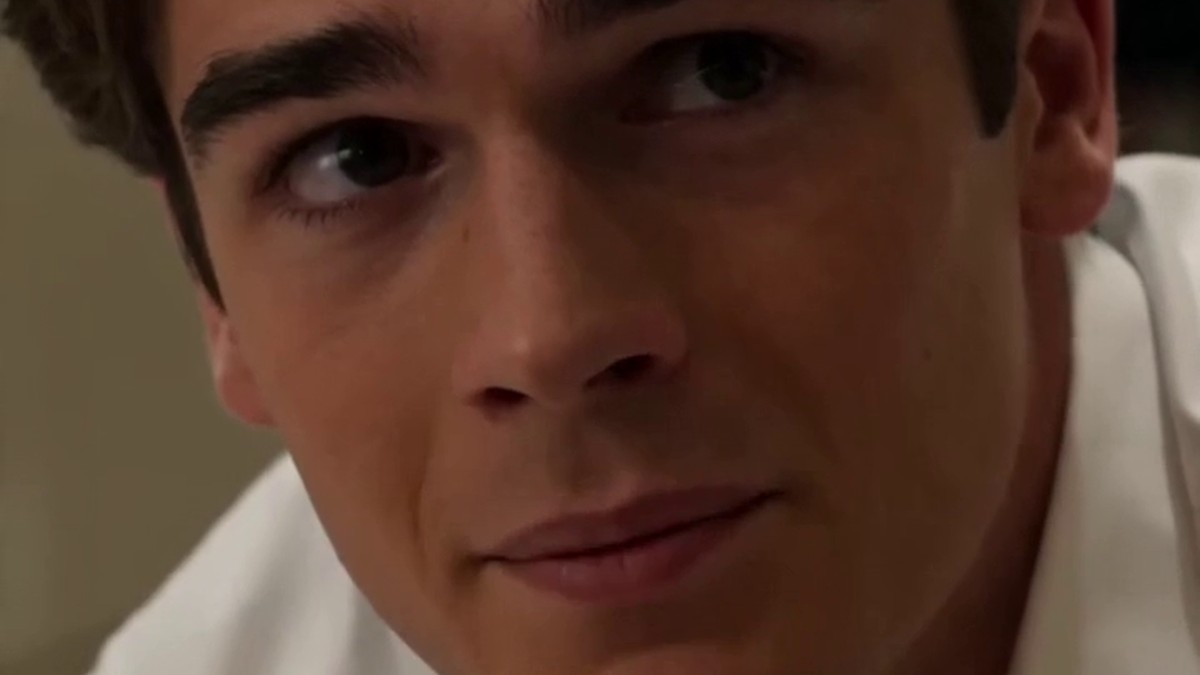
But a young employee in a blue uniform lunged forward and caught the old woman before she hit the floor.
The pearls from her broken necklace scattered across the polished marble.
Nobody moved.
Nobody wanted to kneel down.
Nobody except him.
One by one, he picked them up. Carefully. All of them.
Then something strange happened.
One of the pearls split open in his palm.
And from inside it fell a tiny gold key.
The manager went white.
“No… that’s not possible…”
The young man looked up.
“What does this mean?”
The old woman stared at the key for a long moment.
Then she smiled. For the first time.
A quiet smile.
Dangerously quiet.
“That’s the key to the private salon.”
The entire jewelry store fell silent.
The manager began to shake.
Because that room had been locked for over twenty years.
And only one person had the right to open it.
The old woman reached out slowly and took the key.
She looked at the young employee.
And asked:
“What’s your name?”
“Mateo.”
She gave a single nod.
Then she pointed toward the massive reinforced door at the far end of the boutique.
“Come with me, Mateo.”
The manager lurched forward in desperation.
“You can’t do this!”
But the old woman was already sliding the key into the lock.
And when the mechanism clicked—
every last drop of color drained from the manager’s face.
Because she knew exactly what had been hidden behind that door.
—
The door swung open on silent hinges.
Twenty years of sealed air breathed out — cool and still and faintly sweet, like the inside of a cedar chest where someone had pressed flowers between the pages of an old letter.
Mateo hesitated at the threshold.
The old woman did not.
She wheeled herself through without a glance back, as though she had rehearsed this moment ten thousand times in the dark of a room he’d never see.
He followed.
—
The private salon was not what he expected.
No diamonds under glass. No velvet pedestals. No spotlights angled to make greed look like beauty.
It was an office. Or it had been. A long mahogany desk. Two chairs. A painting on the far wall — a harbor at dusk, the water the color of a bruise. And on the desk, untouched, a single leather-bound ledger.
The dust on everything was architectural. Two decades thick.
The old woman stopped in the center of the room and said nothing for a moment. Just looked.
Mateo stayed near the door, the tiny gold key still warm in his mind — the way it had fallen from that hollow pearl, the way the manager’s face had collapsed like a demolished building.
“Close it,” she said.
He closed the door.
The manager’s muffled voice came through the reinforced steel — urgent, climbing toward something ugly — and then the mechanism sealed and there was only silence.
—
“Sit down, Mateo.”
He pulled one of the chairs out and sat. She positioned herself across the desk from him, and for the first time he really looked at her.
Late eighties, maybe. Spine bent by time but not broken. Eyes the pale grey of deep water. And something behind them — not fragility. Not at all. The opposite of fragility.
“You don’t know who I am,” she said.
“No, ma’am.”
“The manager does.” She set the key on the desk between them. “His name is Ferran. He’s been running this store for nineteen years. He was hired the year after I left.”
Mateo looked at the ledger.
She noticed.
“Go ahead.”
He opened it.
The handwriting was small and precise, column after column of entries. Names, dates, amounts. Transactions that went back decades. But as he turned the pages toward the middle, the entries changed. The handwriting changed. Numbers that didn’t belong beside the names they were attached to. Transfers to accounts listed only by code.
He looked up.
“Someone was stealing,” he said.
“Someone has been stealing,” she corrected. “For nineteen years. From the estate. From the foundation. From the clients who trusted this store with pieces worth more than most people earn in a lifetime.” She folded her hands in her lap. “And Ferran knew. Ferran enabled it. Because Ferran was afraid of the man who gave the orders.”
“What man?”
She was quiet for exactly three seconds.
“My son.”
—
Mateo said nothing.
Outside the door, Ferran had stopped shouting. That was worse, somehow. The silence from the other side felt like a held breath — or a drawn weapon.
“My husband built this store,” the old woman continued. “He built it for fifty years. Every piece of glass, every stone, every relationship with every client — it was his life’s work. When he died, he left it to me. But I was old, and I was tired, and my son told me he would manage it.” A pause. “I believed him.”
“How long before you knew?”
“Longer than I should have.” Something moved across her face — not quite shame. More like the particular pain of a woman who had loved too much in the wrong direction. “I suspected for years. But suspicion isn’t proof. And he was my son.”
She reached across the desk and turned to a specific page in the ledger. Near the back. A list of names — maybe forty of them.
“These are the clients who were defrauded. Their pieces were appraised at one value, insured at another, and the difference funneled out through a series of accounts Ferran managed. The clients never knew. The insurance companies never looked closely enough.” She touched the page. “This ledger is proof of everything.”
Mateo stared at it.
“How did it end up in here?”
“Because I put it here.” The first flicker of something fierce behind those grey eyes. “Twenty years ago, when I first found it, I was not yet sure what I was dealing with. I hid it in this room. I locked the room. I hid the key.” A dry, precise pause. “In a pearl.”
Mateo looked at his hand, as though he could still feel the weight of it.
“But how did I—” He stopped. “It split open on its own.”
“Not on its own.” She folded her hands again, deliberate as a closing book. “I had that pearl prepared. A jeweler I trusted — no one connected to this store — hollowed it and set the seam with a wax compound that would fail under sustained hand pressure. Body heat. The squeeze of a closed fist.” She looked at him steadily. “I needed someone to find it who would actually hold it. Actually close their hand around it. Most people who pick up a spilled pearl pinch it between two fingers and drop it into a dish. They don’t cup it. They don’t carry it like it matters.” She paused. “You held every one of them that way.”
Mateo sat with that for a moment.
“And your son—”
“Never found it. He thought I had lost my mind, or lost the key, or simply forgotten. He was happy to let me believe that.” She almost smiled again. “He underestimated how long I was willing to wait.”
—
The sound from outside the door was different now.
Footsteps. More than one person. A low, deliberate voice giving instructions.
Mateo stood.
“We need to—”
“No.” She was calm in a way that stopped him cold. “We stay. I made a phone call this morning before I came here. I told you I hadn’t been in this store in twenty years. I told you that. I did not tell you I had been planning today for considerably longer.”
Three hard knocks.
Not Ferran’s knocking. Official. Practiced.
“Ma’am?” A woman’s voice. Steady. “This is Detective Rivera. We’re ready when you are.”
The old woman exhaled — just slightly, just enough for Mateo to catch it.
For the first time, he saw how much it had cost her to carry this. Not just today. Twenty years of carrying it — the ledger locked away, the pearl worn against her throat on a chain, the phone call made and remade in her mind ten thousand times before she finally dialed it this morning.
She picked up the ledger.
She picked up the key.
And then she looked at Mateo with those pale, deep-water eyes.
“You picked up every pearl,” she said quietly. “Every single one. Most people don’t bother with the ones that roll under the shelves.”
He didn’t know what to say to that.
“I notice things like that,” she said. “I always have.”
—
When she opened the door, Ferran was standing ten feet back, flanked by two detectives in plainclothes. His face had moved through white and landed somewhere greenish and desperate. Beside him, gripping his own wrist like a man trying to keep himself from running, stood a younger version of the old woman’s bone structure — the same jaw, the same grey in the eyes, but everything else wrong. Harder. Cornered.
Her son.
He had come.
Of course he had come. Ferran must have called him the moment the key went into the lock.
The old woman wheeled herself through the doorway and stopped in the open space of the boutique floor. The glass cases glittered around them. A few customers remained near the walls, frozen, watching in the particular way people watch things they know they’ll be describing for years.
Her son stared at the ledger in her hands.
The color left him like water leaving a bath.
“Mamá—”
“Don’t.” One word. Quiet as the click of that lock. “I’m not doing this for me, Gabriel. I want you to understand that.” She held the ledger out toward Detective Rivera without looking away from him. “I’m doing it for every name in that book.”
Gabriel took one step toward her.
The detective moved first.
—
Mateo watched it from the side — the handcuffs, the formal language of rights being read, Ferran folding at the knees slightly as the second detective guided him toward the door. The boutique had the hushed, ringing quality of aftermath.
He watched the old woman’s face while her son was walked past her.
Gabriel said her name once more. Just once.
She didn’t look away from him. She didn’t look away and she didn’t speak and she didn’t cry. She simply let him see her. Fully. Whatever that cost her — and Mateo understood, looking at her in that moment, that it cost everything — she paid it without flinching.
Then he was gone.
The door closed.
—
The store was quiet for a long time.
Eventually one of the remaining customers slipped out. Then another. Then the last.
Mateo realized he was still standing in the middle of the floor in his blue uniform with his name tag slightly crooked, the way it always went by midday, and no idea what to do with his hands.
The old woman turned her chair to face him.
“You’ll lose this job,” she said. It wasn’t cruel. Just factual. “Ferran will see to that before the day is out, whatever happens to him afterward. That’s the kind of man he is.”
Mateo nodded slowly. He’d already understood that the moment she opened the salon door and he chose to follow her through it. Some doors, once you walk through them, close behind you.
“I own this store,” she said.
He blinked.
“I have always owned this store. What my son held was a management agreement, not a title.” She tilted her head slightly. “I’ll need someone trustworthy here while things are restructured. Someone who pays attention. Someone who kneels down for the things that matter.” A pause. “The position pays considerably better than whatever they’re giving you now.”
Mateo looked around the empty boutique — the light through the front windows, the scattered gleam of the glass cases, the faint scuff marks on the marble where her wheelchair had moved.
He thought about saying yes immediately. It would have been easy. The offer was generous, and he had rent due and a mother he called every night and a uniform that would stop fitting him as soon as Ferran filed whatever paperwork Ferran intended to file.
But he thought about the room behind them. The dust. The ledger. What twenty years of careful waiting looked like up close. And he understood that a woman who had prepared a hollow pearl and worn it around her neck for two decades was not someone who respected a fast answer.
“I don’t know anything about jewelry,” he said honestly.
“Neither did my husband when he started.” She turned toward the front door. “He learned.”
Mateo was quiet for another moment. Then he nodded — not the quick nod of someone eager to please, but the slower one of someone who has weighed a thing and found it worth the weight.
“All right,” he said.
—
Later, when he tried to reconstruct how the day had gone — when he tried to explain it to his mother on the phone that night, sitting on the edge of his bed with his uniform still on — the part he kept coming back to wasn’t the key, or the ledger, or the moment the handcuffs clicked.
It was the pearls.
The way they’d scattered across the marble and everyone had looked away.
The way one of them had been hollow all along.
And how you’d never know — how you could never possibly know — which one, until you picked it up.