The old woman held her tight.
Weeping.
The way you weep when something stolen from you is finally, impossibly returned.
Then Sofia raised her eyes.
“Did my mom really love me?”
Silence swallowed the entire mansion whole.
The grandmother closed her eyes.
A single tear traced a slow line down her cheek.
“Your mother loved you more than her own breath.”
Sofia swallowed hard.
“Then why… why did she never come back for me?”
The old woman drew a long, unsteady breath.
And when she spoke, her voice was already broken in two:
“Because she died keeping you safe.”
Sofia’s face went perfectly still.
But that wasn’t the worst of it.
The woman turned and pointed — directly, deliberately — at Eduardo and Vivian.
“The night my daughter fled this house, she was carrying documents. Proof of who had been trying to steal everything our family had ever built.”
Eduardo went white.
“Don’t listen to her!”
But the old woman had already produced an envelope.
Sealed.
Ancient. Yellowed at every edge by the weight of years.
“Your mother left this for you.”
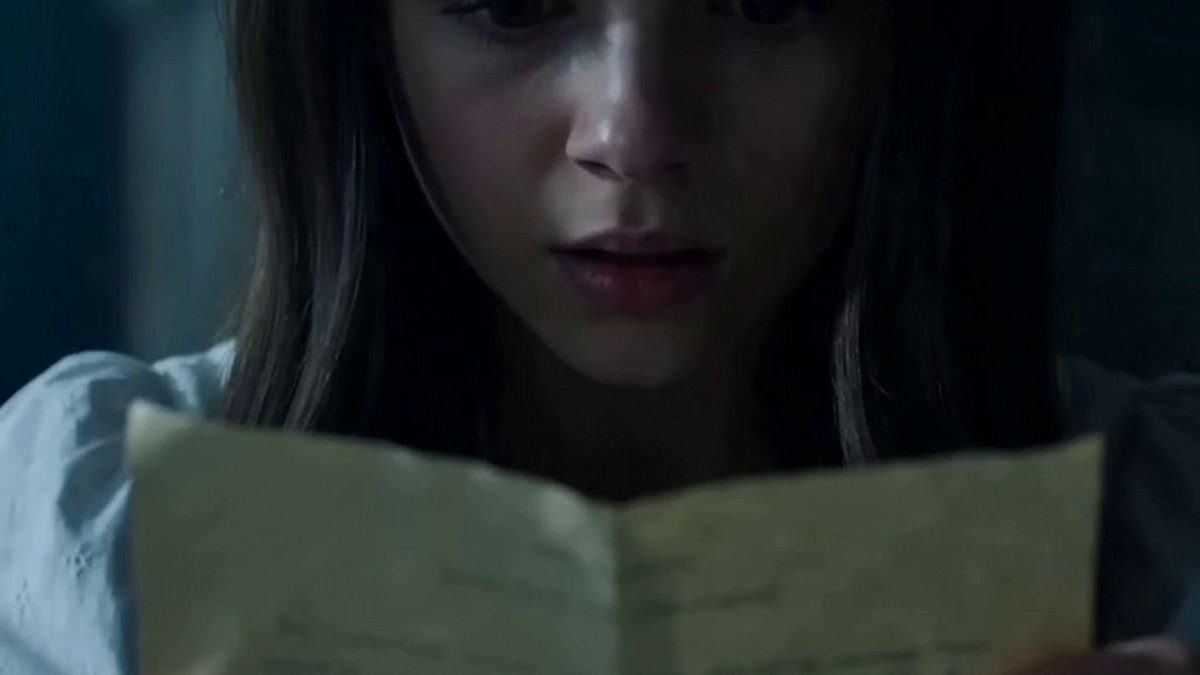
Sofia’s hands shook as she tore it open.
Inside was a photograph.
And a letter.
She had barely reached the end of the first line when the color drained completely from her face.
Because the letter began with words that landed like a blade:
*”If you are reading this, it means the people who tried to destroy our family are still standing close to you…”*
Sofia’s fingers went numb.
The letter trembled in her grip — not from her hands, but from somewhere deeper. From the place in her chest where grief and fury were suddenly discovering each other for the very first time.
She read it again. That first line. The blade falling clean.
*”If you are reading this, it means the people who tried to destroy our family are still standing close to you…”*
She looked up.
Eduardo was already moving toward the door.
“Stop.”
Sofia’s voice came out low. Quiet. The kind of quiet that doesn’t negotiate.
He stopped.
Not because of her voice. Because Marcos — the old woman’s driver, who had been standing motionless near the doorway the entire time, built like a man who had survived things no one ever discussed — had stepped sideways and filled the entire frame.
Eduardo turned back around. He made his face into something reasonable, something practiced.
“Sofia.” He spread his hands open. “Whatever is in that letter — whatever this woman has told you — you have to understand. She’s elderly. She’s been alone for years. Grief does things—”
“She named you.”
The room held its breath.
Sofia lowered the letter and looked at him the way you look at someone you are finally, irreversibly *seeing*.
“The letter names you, Eduardo. By name.” She glanced at Vivian. “Both of you.”
Vivian laughed. It was a short, surgical sound — the laugh of a woman who had spent decades making other people doubt what they knew.
“Darling.” She moved two steps closer, her heels precise against the marble. “Your mother wrote that letter when she was terrified and irrational. Running from shadows. She was—”
“She was running from *you.*”
Sofia’s grandmother had risen to her feet. Slowly, heavily, like a woman who had been waiting years to stand up straight.
“My daughter ran the night Vivian told Eduardo about the offshore accounts. The night they made their play to dissolve the company foundations and take everything liquid.” The old woman’s voice didn’t shake anymore. It had gone somewhere past shaking. “She had copies of the wire transfers. The forged signatures. All of it.”
“That is *slander.*” Eduardo’s reasonable face was starting to crack at the edges.
“It is *evidence.*” The grandmother pointed to the envelope still in Sofia’s hands. “There is a second document folded inside the photograph. Your mother was thorough. She got that from me.”
Sofia’s hands moved before she’d decided to move them.
She reached into the envelope again.
Behind the photograph — a young woman laughing at a garden table, dark eyes identical to Sofia’s own — there was another page. Folded into quarters. The paper so old it sighed when she opened it.
Columns of numbers. Account references. Dates.
And at the bottom, two signatures.
Sofia recognized one instantly.
Eduardo’s handwriting was the same as it had always been. She had seen it on her birthday cards for twenty years.
The room tilted.
“You were there,” she said. “You were *there* when she ran. You knew she had this.”
Something shifted behind Eduardo’s eyes. The reasonable face fell completely away, and what was underneath it was older and colder and entirely without apology.
“What I knew,” he said carefully, “was that your mother made a very unfortunate choice. On a very dark road. In very bad weather.”
The silence that followed was absolute.
Sofia’s grandmother made a sound — low, animal, the sound of a wound reopened after twenty years of scar tissue.
“You said it was an accident.”
“It *was* an accident.” Eduardo adjusted his cuffs. “A tragic one. But the road was wet, and Elena always drove too fast when she was upset.” He looked at Sofia then — and there it was, finally exposed, the thing he had always been: “The real tragedy is that it left a little girl without a mother. We did everything we could to raise that child as our own.”
“As your *cover,*” Sofia said.
The word landed.
Vivian moved first.
She reached into her jacket — a movement that was fast and practiced and revealed exactly what kind of woman she had always been underneath the cashmere and the careful smiles — and produced a phone, not a weapon, but her face made it feel like the same thing.
“I’m calling our attorneys. This conversation is over. Whatever fantasies this woman has constructed—”
“The documents have already been sent.”
Everyone turned.
Marcos spoke for the first time. His voice was unhurried. He held up his own phone, screen facing outward.
“The senhora asked me to scan and transmit everything two days ago. When she knew Sofia was finally coming home.” He looked at Eduardo without expression. “The files went to three separate recipients. A journalist. A judge. And the federal financial crimes unit.” A small pause. “An hour ago.”
Vivian’s phone hand dropped six inches.
Eduardo stood very still.
For a moment he looked — not frightened, not yet — but *calculating.* Running the numbers the way men like him always did. Exits. Options. Leverage remaining.
Sofia watched him do it.
And she felt something she hadn’t expected to feel.
Not triumph. Not even relief.
Something heavier than both.
“I called you *Dad,*” she said quietly. “For twenty years.”
Eduardo looked at her. And in his face, buried deep beneath everything else, there was something that might — in another man, in a different life — have been shame.
“We gave you everything,” he said. “A real home. Education. Opportunity. Whatever your mother’s *documents* claim—”
“You killed her.”
“We did *not—*”
“You don’t have to hold the wheel.” Sofia’s voice broke slightly, then steadied. “You just have to make sure someone frightened enough is driving on a dark road at night.”
Eduardo’s jaw tightened.
He looked away first.
And in that small, quiet surrender — not dramatic, not cinematic, just a man who couldn’t hold a girl’s gaze — Sofia had her answer. The only one she was ever going to get from him directly.
Vivian set her phone down on the side table. Slowly. With the precise, careful movement of someone recalibrating in real time.
“We’ll need to contact the attorneys regardless,” she said to Eduardo, her voice stripped of performance entirely. Just logistics. Just damage control. As if Sofia had already ceased to matter. As if she were furniture being rearranged around a problem.
Sofia had grown up watching Vivian do that to people.
She had never realized she was watching it being done to *her.*
Marcos stepped aside from the doorway — but only to let two uniformed officers through.
The old woman had been thorough in more ways than one.
—
The officers were quiet and professional. There were forms. There were words exchanged in measured tones. Eduardo said nothing — he had become, in the space of minutes, a man conserving himself entirely for his legal team. Vivian asked once, sharply, whether she was being *detained* or merely questioned, and the answer made her face go a particular shade of white that Sofia had never seen on it before.
They were escorted out through the same door they’d walked in through.
No dramatic exit. No last words.
Just the sound of expensive shoes on marble, and then a car door, and then nothing.
—
Sofia stood at the tall window overlooking the garden.
The sun was going down. The light was the color of old photographs.
Her grandmother came to stand beside her. She didn’t speak right away. She had the patience of someone who had waited this long and knew that the important things didn’t need to be rushed.
After a long moment, Sofia lifted the photograph again.
Her mother. Laughing at a garden table.
Dark eyes. Her eyes.
“Was she happy?” Sofia asked. “Before all of it.”
“Terribly happy,” the old woman said. “The irritating kind. The kind that fills a room.”
Sofia almost smiled.
“She sounds like someone I would have liked.”
“You would have fought constantly,” her grandmother said, with absolute certainty. “You are exactly alike.”
Sofia pressed the photograph against her chest.
Outside, the garden was going amber and gold, and somewhere in the old trees at the far end of the property, birds were making the kind of noise that means a day is ending and the night is safe.
She had come here looking for a bracelet.
For proof that she had belonged somewhere, to someone, before the life she’d been handed.
What she had found was heavier than that, and harder, and shot through with a grief she was going to be living with for a long time.
But underneath the grief — running beneath it like a current beneath cold water — was something solid.
A name.
A face in a photograph.
A woman who had driven through the dark to keep something safe, and had.
*”Your mother loved you more than her own breath.”*
Sofia exhaled slowly.
For the first time in her life, she believed it.
Her grandmother’s hand found hers — dry and warm and certain — and held on.
And the garden light kept falling, gold and slow, over everything.