It wasn’t a large photo. Just a small frame, worn soft at the corners, holding the image of a smiling woman who was no longer alive to protect her. But to Elena, that photograph was the last living proof of a promise.
Her mother had made her swear to believe it, right before she died — that her fifteenth birthday would not pass quietly into nothing.
*”Even if I’m not there, you’ll have your night, my girl,”* she had whispered once, her fingers moving gently through Elena’s hair.
Elena had carried those words like a heartbeat for years.
So when she walked into the living room that evening and found the decoration box sitting sealed on the table — and Victoria standing over it, dressed in black, her face carved into something cold and her voice dripping with contempt — Elena felt something inside her begin to crack open.
“There will be no quinceañera,” Victoria said flatly.
Elena looked up. Her eyes were already burning.
“But Dad said Mom left money for it…”
Victoria’s jaw tightened. She moved one step closer.
“Your mother has no authority in this house anymore.”
The words landed harder than a slap.
Elena pressed the photograph against her chest. She tried to speak, but her voice barely made it out of her throat.
“I just wanted… I only wanted to keep what she dreamed for me…”
Victoria let out a short, humorless laugh.
“Dreams don’t pay for parties. And in this house, I decide what happens.”
The tears came then — streaming down Elena’s face with nothing left to hold them back. She wasn’t crying just over a party. She was crying because this night wasn’t simply her birthday. It was the last thread connecting her to her mother. The last promise still breathing. And Victoria was crushing it with a calm that made it somehow worse.
Then a voice came from the hallway.
“What did you just say?”
Arturo stood in the doorway.
His white shirt sleeves were rolled to the elbows, like he’d stepped away from his desk mid-thought. But the moment he took in his daughter’s tear-streaked face and Victoria standing over her like a verdict, something shifted entirely behind his eyes.
Elena turned toward him the way someone turns toward air when they’ve been suffocating.
“Dad…”
Victoria lost a shade of color.
“Arturo, it’s not what it looks like.”
But he was already moving into the room.
He looked at the photo in his daughter’s hands. Then the sealed decoration box. Then Victoria’s hardened expression.
“Why is she crying?”
Elena opened her mouth, but Victoria cut across her.
“Because she refuses to understand that we cannot throw away money on some pointless celebration.”
Arturo went still.
“What do you mean we can’t?”
Victoria looked somewhere past him.
“There’s no money for it.”
Elena shook her head, crying harder now.
“Mom left it paid… I heard you say so yourself… you both said it…”
Arturo’s brow furrowed. He walked to the table and rested his hand on the sealed box. Beneath it sat an envelope.
He picked it up.
Victoria’s face changed the instant she saw it in his hand.
Arturo opened the envelope slowly.
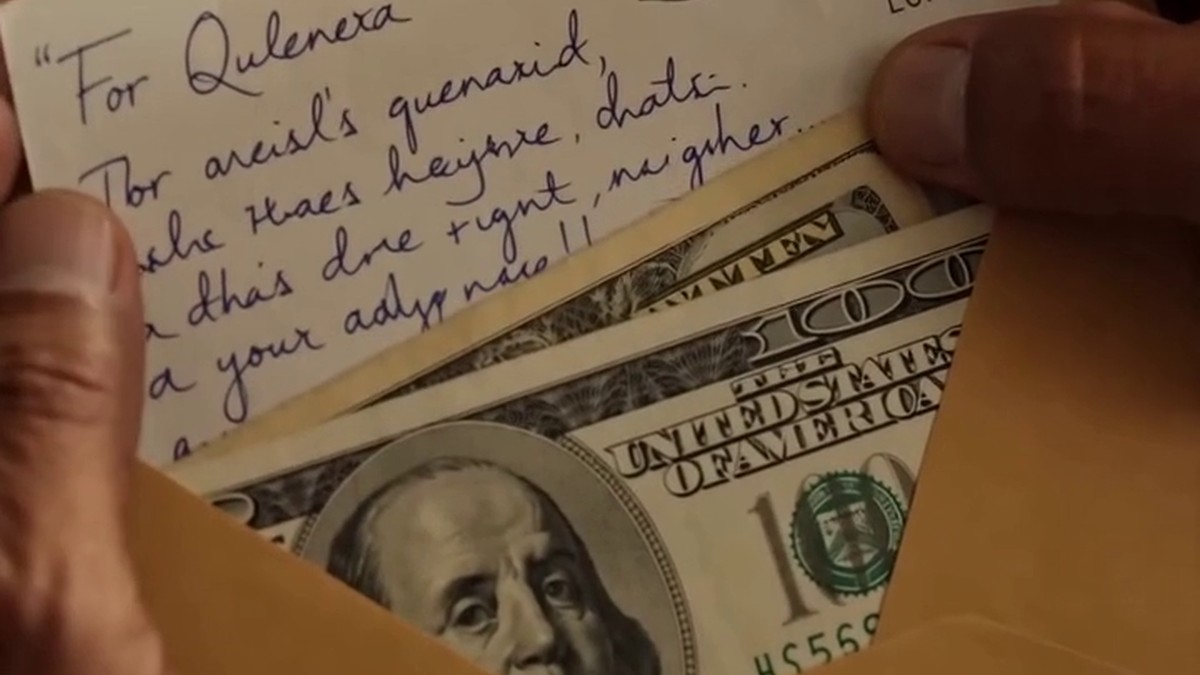
Inside: cash, receipts, and a letter written in his late wife’s handwriting.
The room seemed to forget how to breathe.
Arturo read the first line and his jaw locked.
*”For Elena’s quinceañera. If anyone ever tries to take this night from her, give her this letter and tell her that her mother thought of everything.”*
Elena pressed her hand over her mouth.
Victoria stepped backward.
Arturo raised his eyes, something white-hot and controlled burning behind them.
“That money was for my daughter.”
But the worst of it hadn’t come yet.
Because buried inside the same envelope was another folded piece of paper. Smaller. Older. Arturo opened it — and the color drained from his face as though someone had pulled a plug.
This had nothing to do with the party.
It was a confession.
And as Arturo read what his wife had uncovered before she died, he looked at Victoria the way you look at a stranger wearing someone else’s face.
His wife had left more than money behind.
She had left the truth.
And it was the kind of truth that doesn’t just end a lie — it demolishes everything built on top of it.
The paper trembled in Arturo’s hands.
Not from weakness. From the effort of holding very, very still.
Elena watched her father’s face the way you watch a sky that’s about to break open — knowing something is coming, not knowing how bad. The tears on her cheeks had gone cold. She wasn’t crying anymore. She was just standing there, one hand pressed against her mother’s photograph, waiting.
Victoria hadn’t moved. But her stillness had changed quality. It was no longer the stillness of a woman in control. It was the stillness of someone who has been caught in the open with nowhere to run.
Arturo set the second paper down on the table.
Slowly. Deliberately. The way you set down a weapon you’re deciding whether or not to use.
“Sit down, Victoria.”
It wasn’t a request.
Victoria’s chin lifted half an inch. Old reflex. Armor.
“Arturo, whatever your wife wrote in that letter—”
“*Sit. Down.*”
The second time landed differently. It filled the room. Elena had never heard her father use that register before — that low, ground-level quiet that was somehow louder than shouting. It was the voice of a man who had just watched the floor fall away beneath everything he thought he knew, and was choosing to remain standing anyway.
Victoria sat.
Elena looked at her father. “Dad. What does it say?”
Arturo picked the paper back up. His eyes moved across it again, slower this time, as though he was hoping the words might rearrange themselves into something more forgivable. They didn’t.
He looked at Victoria.
“The account,” he said. “The savings account. The one you told me we drained paying off the property taxes two years ago.”
Victoria’s jaw shifted.
“That account was—”
“Was what?” His voice stayed flat. Controlled. But his knuckles around the paper were white. “Because according to what my wife wrote here, she checked. She checked because something didn’t feel right to her. And she found the transfer records.” He paused. “She found your sister’s name on the receiving end of forty-three thousand dollars.”
The room went airless.
Elena’s hand dropped from her mouth.
Victoria’s composure held for exactly three more seconds. Then something gave way behind her eyes — not guilt, not quite, but the specific look of a person recalculating.
“Your wife was sick,” Victoria said carefully. “She was on medication. She was confused about what she saw—”
“She was dying.” Arturo’s voice cracked on the word, just once, like a fault line. Then it sealed back over. “She was dying, and instead of resting, she spent the last weeks of her life making sure Elena would have her party. Making sure there was money no one could touch. Making sure she wrote down what she’d found.” He set the paper down again. “She documented everything, Victoria. Dates. Account numbers. Her sister’s contact information. She gave this to our family lawyer with instructions to place it in the decoration box if anything ever happened to the quinceañera fund.”
Elena felt something move through her chest. Huge and wordless.
Her mother had known. Her mother, lying in that hospital bed with tubes in her arm and her voice going thin, had known that this moment might come. Had prepared for it. Had built a trap out of love and left it sealed and waiting, because she understood something about the woman her husband had brought into their home that no one else had been willing to see.
“Mama,” Elena whispered. To the photograph. To no one. To the air.
Victoria stood up. Her chair scraped hard against the tile.
“I will not sit here and be accused based on the paranoid writings of a woman who was—”
“Get out.”
Two words. No weight to them at all, except the absolute weight of finality.
Victoria went very still.
“Arturo.”
“Get out of my house tonight. Right now. With whatever you can carry.” He wasn’t shouting. That was the thing. He wasn’t shouting and he wasn’t crying and he wasn’t trembling. He was standing beside his daughter in the room where his dead wife had outsmarted everyone, and he was completely, terribly calm. “My lawyer has a copy of everything in that envelope. I’ll be calling him in the morning.”
“You’re making a mistake—”
“I made the mistake.” His voice broke slightly on that, then steadied. “I made it when I stopped paying attention. When I told myself everything was fine because it was easier than looking.” He shook his head. “Elena’s mother was paying attention. She paid attention right up until she couldn’t anymore. The least I can do is finish what she started.”
Victoria’s eyes moved to Elena. One last calculation, sharp and assessing, looking for a lever, for softness, for some angle left to work.
She found nothing useful.
Elena looked back at her steadily. She wasn’t afraid anymore. She was fifteen years old and her face was still blotched from crying and she was holding a small, worn photograph against her chest, and she was not afraid.
Victoria picked up her bag from the armchair by the door. She walked out without another word. The front door closed behind her with a quiet click that somehow felt louder than a slam.
The house breathed.
Arturo stood there for a long moment, staring at the closed door. Then he turned around, and whatever controlled thing he’d been maintaining began, very slowly, to come apart at the edges.
Elena crossed the room and put her arms around him.
He held on.
They stayed like that for a while — father and daughter, in the middle of the room where everything had just collapsed and somehow also come clear. Outside, a car engine started. Headlights swung across the front window and disappeared down the street.
When Arturo finally pulled back, his eyes were red. He looked at the photograph in Elena’s hand.
“She really did think of everything,” he said.
Elena nodded. She couldn’t quite trust her voice yet.
He reached out and touched the corner of the frame gently, the way you touch something you’re afraid of disturbing. Then he picked up the sealed decoration box from the table and held it out to her.
“I think,” he said quietly, “we have a party to plan.”
Elena looked at the box. Then at her father. Then she laughed — a short, broken, completely real sound that surprised both of them.
She took the box.
—
The quinceañera happened on a Saturday, three weeks later.
The decorations were white and gold. There were flowers on every table — her mother’s favorite, pale yellow roses — and the cake was exactly the kind her mother had described once, late at night, in the careful voice of someone building a dream out loud: four tiers, sugar flowers along each layer, a small figure on top in a blue dress.
Elena danced.
She danced in a room full of people who had loved her mother and now loved her, and she wore a dress that made her feel, for the first time in a long time, like someone was watching over her shoulder in the best possible way. Like the evening had been held in reserve all this time, sealed and waiting, kept safe by a woman who refused to leave her daughter without a night to remember.
At one point, between songs, Elena slipped away to the edge of the room. She pressed her back against the cool wall and took one quiet breath.
She looked down at the small photograph she’d slipped into the side of her dress. She’d borrowed a safety pin from her aunt to make sure it didn’t fall.
*You thought of everything, Mama,* she thought.
She could almost feel her mother’s fingers moving through her hair.
*Almost.*
She squared her shoulders, pushed off the wall, and walked back into the light.