White flowers everywhere. A live band. Cameras catching every angle. And a bride who drifted through the reception hall like she already owned the walls around her.
Then, just before the toast, a pregnant woman stepped through the entrance.
She wore a plain dress, flat shoes, and held a manila folder pressed tight against her chest. Her face was drained of color — but her eyes held steady. No fear. None at all.
“I need to speak with Sebastian,” she said.
Every head in the room turned.
The bride let out a sharp laugh.
“Another desperate ex-girlfriend? God, how embarrassing for you.”
The woman drew a slow breath.
“My name is Clara. And that man asked me to marry him — before any of this.”
Sebastian went pale.
Valeria glanced down at Clara’s belly and smiled the way people smile when they want to wound.
“You show up today, with that story, looking like that? Sweetheart. Did you really think pregnancy was going to make us believe you?”
The guests murmured among themselves.
Clara took one step forward.
“I didn’t come here for anyone’s belief. I came here to say what’s true.”
Valeria snatched the folder from her hands and dropped it on the floor.
“The truth is you’re standing in my home, at my wedding, in front of my husband-to-be. Walk out the door before I have you removed.”
Clara looked around slowly. The chandeliers. The oil paintings. The grand marble staircase that curved toward the second floor like a question.
“Your home,” she said quietly.
Valeria lifted her chin. “That’s right. Mine.”
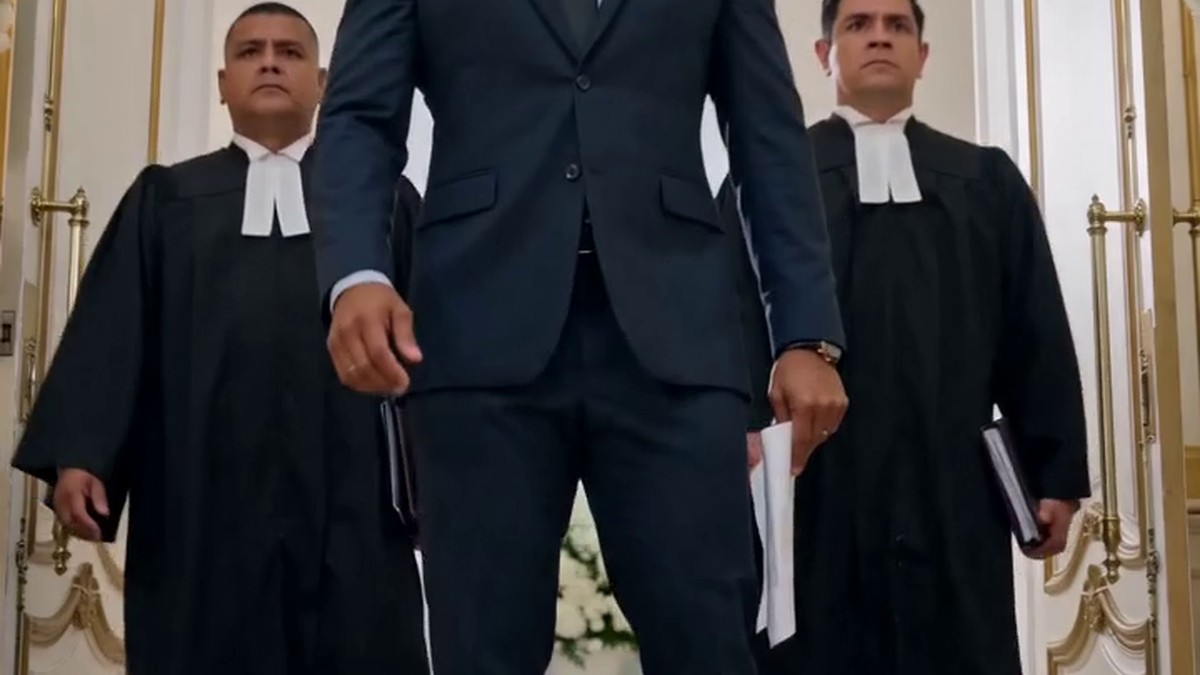
At that moment, a lawyer walked into the hall. Two notaries followed close behind.
“Forgive the interruption, Ms. Valeria,” the lawyer said. “But this property does not belong to you. It doesn’t belong to Mr. Sebastian either.”
The music stopped.
Sebastian moved toward Clara. “We can settle this somewhere private—”
“No.” Her voice didn’t waver. “You’ve kept me hidden long enough.”
The lawyer raised a document above the crowd.
“The estate, the family business, and all primary accounts are the legal property of Clara Montes — recognized heir of the late Don Arturo Beltrán, acknowledged in writing before his death.”
Valeria stood completely still.
“That’s not possible.”
Clara reached down and picked up her folder. She pulled out an old photograph and held it up without a word. A little girl. An elderly man. His hand on her shoulder, her face turned up toward his.
“Don Arturo was my father,” she said. “They buried that fact for years — long enough to keep the bloodline money out of my hands and inside theirs.”
Silence swallowed the room.
Sebastian looked at the floor.
He had known.
He had known everything — and still he’d tried to marry into Valeria’s fortune, locking down wealth that had never once belonged to him.
Clara rested her hand on her stomach.
“I came so my child wouldn’t enter this world the way I did. Hidden. Erased. Like an inconvenience.”
Valeria stepped back. Her jaw was tight, her hands trembling — not from grief, but from fury at watching something she thought she’d secured begin to dissolve.
And just when she thought the worst of it was over, the lawyer cleared his throat and read the final clause of the will.
Any party found to have denied Clara’s identity or that of her child — through document, declaration, or deliberate act — would be stripped of all inheritance rights, immediately and permanently.
Sebastian had signed exactly that denial.
Seven days ago.
The paper made a sound as the lawyer folded it back. A small sound. Barely anything. But in that silence it hit like a door slamming shut on an empty house.
Sebastian’s hand moved to his collar.
Old habit. The kind men develop when they need a moment they haven’t earned.
“Clara.” His voice dropped low, reaching for intimacy like it was still a tool he could use. “Whatever you think happened—”
“Don’t.” She didn’t even look at him. “I know exactly what happened. I was there.”
Valeria found her footing first. That was her gift — the ability to pivot on catastrophe like it was just another surface to walk across. She turned to the guests with a smile that had been pre-loaded for emergencies.
“This is a legal matter,” she announced. “It’ll be handled by the appropriate parties, through the appropriate channels. Tonight is still a celebration—”
“Whose celebration?” someone asked from the back.
The question floated forward through the crowd. No one claimed it. No one needed to.
Valeria’s smile held for three more seconds. Then it didn’t.
She crossed the floor in four quick steps and stopped directly in front of Clara. Close enough that the distance between them became its own kind of statement.
“You want to do this here,” Valeria said, her voice low and stripped of performance. “In front of everyone.”
“You made it public the moment you dropped my folder on the floor.”
“That folder is unverified. Your story is unverified. You are—”
“Recognized.” Clara didn’t raise her voice. She didn’t have to. “In writing. Before witnesses. Before a notary. Before God, if that helps you understand how permanent it is.”
One of the notaries stepped forward without being asked. She placed a second sealed document on the nearest table — the kind of quiet, deliberate action that contains more force than anything shouted.
Valeria stared at it.
“Sebastian.” She said his name like a command.
He was still standing by the foot of the marble staircase. Still touching his collar. He looked like a man trying to remember the version of himself that would know what to do right now, and finding the shelf empty.
“Sebastian. Say something.”
He looked up. First at Valeria. Then at Clara.
What passed across his face in that moment was not remorse. It wasn’t guilt. It was the particular expression of someone watching their math stop working — every calculation they’d made on the assumption that certain things stayed buried, and the ground shifting anyway.
“I didn’t know the clause was—”
“The clause,” Valeria said, very quietly. “That’s what you’re leading with.”
“I didn’t know the *specific language*—”
“You signed it. Last Tuesday. In my father’s office.” Her voice had gone flat. The performance was completely gone now. “You told me it was a formality. A clean severance from any prior claims. You said she would take the money and disappear.”
A breath moved through the room.
Clara stood still. She’d heard this before — not word for word, but she’d heard the shape of it. The way she had been planned around. Managed. Accounted for like a variable in someone else’s equation.
She looked at Sebastian for the first time since she’d said his name.
“How much?” she asked.
He frowned. “Clara—”
“How much were you going to receive? From her family. For marrying her and making sure the Beltrán estate stayed consolidated on their side.”
Sebastian said nothing.
That was its own answer.
Valeria made a sound that might have been a laugh if it hadn’t broken apart before it finished. She turned and picked up the sealed document from the table. She looked at it for a moment — the notary stamp, the official language, the weight of it — and set it back down without opening it.
“My father,” she said, to no one in particular. “He knew about the clause.”
“He drafted it,” the lawyer said, not unkindly.
“He told me this was contained.” Her voice was measured now. Careful. The voice of someone deciding, in real time, what to salvage. “He told me the documentation was insufficient. That she had no provable chain—”
“The chain was proven fourteen months ago,” the lawyer said. “The delay was procedural. The outcome was not in question.”
Valeria set her glass down on the table beside the document. She straightened the hem of her dress. She looked, briefly, like a woman who was about to say something that would matter.
Then she looked at Clara.
And Clara looked back.
Whatever Valeria saw there — the steadiness, the utter absence of triumph, the hand resting flat against her belly like a woman protecting something that had nothing to do with any of them — it stopped her.
She didn’t speak.
She walked to the entrance of the hall, lifted her coat from the attendant’s arm, and left.
No scene. No declaration. Just the sound of heels on marble going quiet as the doors swung shut behind her.
—
The guests didn’t know what to do with silence, so they started filling it. A few moved toward the exit. A few reached for their phones. The band exchanged looks over their instruments, then began, very softly, packing up.
Sebastian crossed the floor.
Clara watched him come.
He stopped a few feet away — far enough to signal that he wasn’t trying to reach her, close enough to be understood as not retreating entirely.
“I told myself it was better this way,” he said. “For you. For the child. That the money through Valeria’s family would be cleaner. Less complicated.”
“You told yourself a lot of things.”
“I know.”
“You told me my father never knew about me. You said you’d looked into it. You said there was no record, no acknowledgment, nothing to pursue.” She paused. “You said it so gently. I almost believed you cared about whether it was true.”
Sebastian pressed his lips together.
“I want to be part of the child’s life,” he said.
“I know you do.” Clara picked up her folder. She tucked the photograph back inside. “That’s a conversation for a different room, on a different day, with attorneys present and a judge’s name on the calendar.” She looked at him directly. “It is not a conversation you get to have at your wedding.”
She walked to the door without looking back at the chandeliers, or the oil paintings, or the grand marble staircase curving upward like something that had once looked like power and now just looked like architecture.
—
Outside, the evening had gone cool.
Clara sat on the wide front steps for a moment, alone, her folder in her lap.
The lawyer appeared behind her. He didn’t sit down. He stood a respectful distance back and waited.
“The probate process,” he said, when she looked up. “It begins Monday. I want you to understand — the estate is substantial. There may be attempts to—”
“I know,” she said. “There will be appeals. Delays. People who signed things they’ll suddenly claim they misunderstood.” She exhaled. “There always are.”
“Yes.” A pause. “Are you prepared for that?”
Clara looked out at the lit driveway. A car was pulling away — Valeria’s, probably. Moving fast, the way things do when they’ve been cornered into honesty.
“I came here tonight because I needed them to know they couldn’t erase this,” she said. “The child. Me. My father’s name attached to mine.” She rested her hand on her stomach again. “I didn’t come for the estate. I came so my daughter — or my son — would never have to come somewhere like this and say what I just said. Never have to stand in the middle of someone else’s celebration and prove they exist.”
The lawyer nodded once. The way people do when something has been said that doesn’t need a response.
He left her with the quiet.
Across the garden, behind the tall hedges, the sound of the city moved on the way it always did. Indifferent. Constant. Unbothered by the specific weight of what had just been resolved inside that hall.
Clara sat with the night for one more minute.
Then she stood, smoothed her dress, and walked down the steps toward the car she’d hired for exactly this possibility — the possibility that she would actually get here, say everything, and need a way home after.
She had planned for a lot of things.
She had planned to be turned away at the door. She had planned for laughter. She had planned to be called a liar in a room full of witnesses and have to stand there anyway, holding her folder, holding her ground, holding everything.
She had not let herself plan for what winning would feel like.
Now she was finding out.
It felt quiet. It felt like taking a breath after a long time of not being sure you were allowed to. It felt like the first thing that belonged entirely to her — not given, not negotiated, not something she’d have to fight to keep after she’d already fought to hold.
Just hers.
The car door closed behind her.
The white flowers were still on the tables inside. The band was gone. The chandeliers were still burning.
But the house was already, in the only way that mattered, someone else’s inheritance.