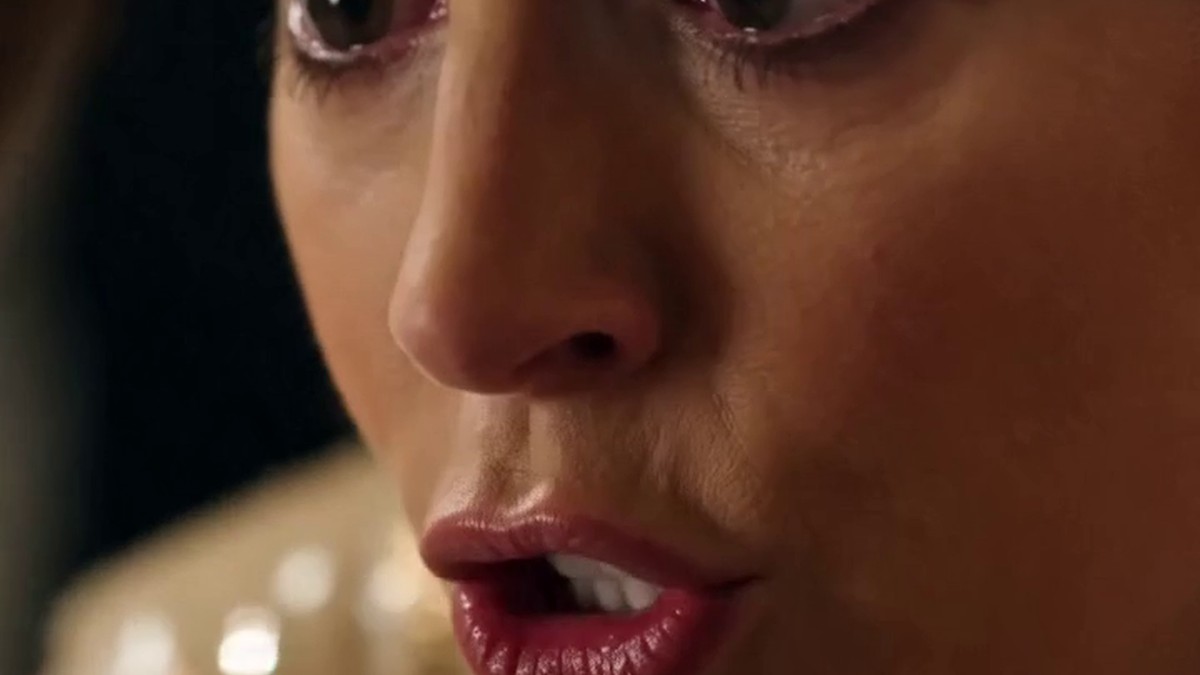
The child dropped to his knees to pick it up.
“I’m sorry… I was hungry.”
The guests barely glanced his way.
But one woman — draped in a stunning gold gown — went absolutely still.
Something had slipped from the boy’s pocket when he fell.
An old photograph.
She picked it up without thinking.
And the moment she looked at it, every drop of color drained from her face.
It was a photo of her.
Years younger.
Cradling a newborn baby.
“Where did you get this?” Her voice came out barely above a whisper.
The boy pulled the photograph tight against his chest.
“My mom gave it to me.”
“What’s her name?”
“Lena.”
The woman’s breath caught in her throat.
*Lena.*
The name of the nurse who had vanished the very same day her baby was declared dead. Eight years ago now.
Her hands were shaking.
“Where is she? Where’s your mother now?”
The boy’s eyes filled with tears.
“She died two weeks ago.”
The entire entryway fell silent.
Then the boy reached into his pocket and pulled out a crumpled envelope.
“Before she died, she told me to find you.”
The woman unfolded it slowly.
Read the first line.
And felt the whole world grind to a halt.
Because the letter opened with words that should have been impossible:
**”Forgive me… I know who took your son that night.”**
—
The orchestra had already begun its first tentative notes somewhere beyond the gilded doors. Somewhere, a bride was waiting. Somewhere, two hundred guests were adjusting their cuffs and checking their lipstick and caring about nothing beyond the next glass of champagne.
None of that existed anymore.
Vivienne Ashworth — bride’s aunt, former magazine editor, woman who had spent eight years building a life on top of a grave — stood in the marble entryway of the Grand Bellhaven Hotel and felt the floor dissolve beneath her heels.
She read the line again.
*Forgive me… I know who took your son that night.*
Her son.
The baby the doctors had handed her in a blue-wrapped bundle at 11:47 p.m. on a February evening. The baby whose heartbeat she had counted against her palm for forty-one weeks. The baby who had been placed in the hospital nursery at midnight — standard procedure, the nurses had said, you need rest — and was declared gone by morning.
Sudden infant death, the certificate read.
She had buried an empty grief for eight years because they never let her see the body. *Too traumatic*, the attending physician had said. *Trust us. You don’t want that image.*
She had trusted them.
She looked at the boy.
He was eight years old — she knew it the moment she thought it, felt it land with the specific weight of a fact her body had been holding in reserve. Eight years ago in February. Eight years to this very season. Thin the way children are thin when meals are uncertain — not sickly, but careful, like a small animal that had learned to take up less space. His shoes were clean despite everything else about him being dusty and road-worn. Someone had taught him to keep his shoes clean.
His eyes were dark. Long-lashed.
The same shape as hers.
She pressed the thought down before it could detonate.
“What’s your name?” she asked.
“Marcus.”
Her breath left her body in a slow, controlled stream.
Marcus. The name she had whispered to her stomach in the last weeks of her pregnancy, alone in her apartment, before she had told anyone else. A name she had never spoken aloud after the funeral. A name that existed in exactly one place — the journal she had burned in her fireplace the winter after.
“Who told you to look for me here?” she asked. “At this hotel. Today.”
Marcus pulled the envelope back and turned it over. On the back, in handwriting she didn’t recognize — shaky, end-of-life handwriting — was an address. Below it, a date. Below that:
*She’ll be wearing gold.*
Vivienne’s knees nearly gave.
She reached out and gripped the edge of the marble check-in desk.
The concierge started toward her. She stopped him with one raised finger, eyes never leaving the boy.
A cold thought moved through her — *how did she know?* — and then, just as quickly, the answer arranged itself. The wedding announcement had been in two local papers and the hotel’s social calendar. Lena had followed her. Of course she had. Eight years of watching from a distance, carrying her secret, and in the end she had done her homework with the thoroughness of a dying woman who needed to get one last thing exactly right. The gold dress was a coincidence — the kind of terrible, shivering coincidence that feels like the universe confirming something. Or maybe Lena had simply known her well enough, once, to guess.
Either way, it was the detail that cracked Vivienne open.
“There’s more in the envelope,” Marcus said quietly. “She said don’t read it in front of people. She said find somewhere private.”
—
The hotel’s back garden was empty. November cold kept the roses in their last brittle dignity. Vivienne sat on a stone bench, Marcus beside her — close but not touching, like a child who had learned that touching strangers didn’t always end well.
She unfolded the rest of the letter.
Lena Marsh’s handwriting started shaky and grew steadier as it went, as though the act of confession had returned something to her hands.
*I was twenty-three. I needed money for my mother’s surgery. They told me it would be simple — just take the baby before the morning rounds, say he passed in the night, hand him to the couple waiting in the parking garage. They said the mother was too young, too unstable. They said the baby would have a better life. They gave me forty thousand dollars and a story to memorize.*
*I told myself it was true. For a long time, I told myself that.*
*The couple’s name was Gerald and Patricia Holt. They lived in Dunmore at the time. I don’t know where they are now. But I kept Marcus when Patricia Holt died of cancer four years ago and Gerald Holt said he couldn’t manage a child alone. He left Marcus with me like luggage at a train station.*
*I loved him. I want you to know that. However wrong everything was — I loved him like my own.*
*But he isn’t mine. And you deserved to know he’s alive.*
*The doctor who arranged it was named Carver. Richard Carver. He’s still practicing. He still has your file. I found the wedding announcement three weeks ago and I’ve been watching long enough to know your habits, your taste, the color you always reach for. I’m sorry it took me dying to find my courage.*
*— Lena*
Vivienne read the letter twice. Then she folded it with the precision of someone who needed to keep their hands occupied or they would shake apart.
Richard Carver.
She knew that name.
She had seen it three weeks ago, printed on a program at the hospital gala she had attended. *Chief of Neonatology. Twenty-two years of service. Community Excellence Award.*
He was inside this hotel right now.
The wedding they were all here for — her niece’s wedding — had been partly funded by a donation from the Carver Family Foundation. She had shaken his hand in the lobby two hours ago. He had called her *Vivienne, lovely as ever* and moved on.
The cold of the stone bench had gone all the way into her bones.
She looked at Marcus.
He was watching her the way children watch adults in crisis — carefully, ready to become invisible if necessary.
“Are you okay?” he asked. The question was so straightforward, so entirely undefended, that it almost broke her.
“Not yet,” she said. “But I’m going to be.”
She took out her phone.
—
Detective Sandra Royce was off-duty and at a birthday dinner eleven blocks away when Vivienne called. She had worked Vivienne’s original case — the infant death report that had always made her uncomfortable, the file she had flagged twice for review and been told twice to close. Both times she had closed it with the private conviction that she was closing it wrong, that one day something would come loose and she would need to move fast. She had been waiting, without quite admitting it to herself, for exactly this kind of call. She answered on the second ring.
By the time Vivienne finished speaking, Detective Royce was already pulling on her coat.
“Don’t confront him,” Royce said. “I mean it. Go back inside, stay visible, don’t let him leave. I’ll be there in fifteen minutes.”
“He’s going to give a toast,” Vivienne said, “in about twenty minutes. He’s seated at the head table.”
“Then you have twenty minutes. Keep it together. Do not tip him.”
Vivienne hung up.
She looked at Marcus.
“I need you to stay here,” she said. “Right here on this bench. There’s a waiter near the garden door — I’m going to ask him to bring you something to eat. Real food. You’ll stay put?”
Marcus looked at her steadily. “Are you going to get in trouble?”
“No,” she said. And then, because he was eight years old and had already been lied to enough: “Possibly a little. But the good kind.”
—
The ballroom was all candlelight and white orchids and the kind of music that cost more per hour than most people earned in a week. Two hundred guests in their finest, suspended in the amber of celebration, entirely unaware.
Vivienne moved through them like water.
She found her seat. She smiled at the woman on her left. She accepted a glass of champagne she did not drink. She kept Richard Carver in her peripheral vision — silver-haired, distinguished, laughing at something the man beside him had said — and she felt a cold, clarifying fury settle into her like a second skeleton.
Eight years.
Eight years of a grave she had tended in her mind every single day.
Eight years of a weight she had never fully put down because something in her had always known — the way the body knows things the mind is not yet ready to receive — that the story didn’t fit.
She held herself still.
Twelve minutes.
Then ten.
Then the best man tapped his glass and stood, and Richard Carver straightened in his chair, ready to perform his own toast next, and the doors at the back of the ballroom opened.
Detective Sandra Royce walked in with two uniformed officers.
The music stopped.
Royce moved directly and without hesitation toward the head table. She had the particular walk of someone who had stopped caring about the temperature of a room. Vivienne watched Carver’s expression process the approach — confusion first, then recognition, then something that was not quite fear but was its immediate neighbor.
He started to rise.
“Dr. Carver,” Royce said, loud enough for the nearest tables to hear. “I’d ask you to stay seated.”
“What on earth is—”
“Richard Alan Carver. I have a warrant for your arrest on charges of fraud, falsification of medical records, and criminal conspiracy in connection with the unlawful transfer of a minor.” She paused. “That’s the short list.”
The room had gone the specific silence of two hundred people trying to process the same impossible thing at once.
Carver’s face moved through several expressions in rapid succession and landed on something hard and calculated. “This is absurd. Whatever this is, it can wait until—”
“It waited eight years,” Vivienne said.
Her voice was steady. She hadn’t planned to speak. But she was standing now, her chair pushed back, her gold gown catching the candlelight, and every eye in the room had turned to her. She let them look. She had spent eight years shrinking around the grief of this. She was done shrinking.
“You told me my son died,” she said. “You signed the certificate. You looked me in the eye at the follow-up appointment and told me these things happen and there was nothing anyone could have done.” Her voice didn’t waver. “You sold him.”
The word landed in the room like a stone in still water.
Carver’s jaw tightened. “I don’t know what you’ve been told, but—”
“There’s a letter,” Vivienne said. “From Lena Marsh. She kept records, Richard. Nurses do that when they’re afraid. Dates, amounts, names. She kept all of it.”
She watched the calculation in his eyes run its course and fail.
The officers were on either side of him now.
Detective Royce met Vivienne’s eyes across the table and gave her the smallest nod.
—
The garden was dark and cold and entirely quiet by the time Vivienne walked back out to the stone bench.
Marcus was still there.
Beside him sat a plate — bread, sliced turkey, a small bowl of soup that had gone lukewarm. He had eaten most of it. He was holding the photograph again, the one of Vivienne and the newborn, turning it over and over in his hands with the careful repetition of someone who had memorized an object and kept returning to it anyway.
He looked up when he heard her heels on the stone path.
“Did you get in trouble?” he asked.
“A little,” she said. She sat beside him. “The good kind.”
He studied her face with those dark, long-lashed eyes.
“Are you really her?” he asked. “The woman in the picture?”
Vivienne looked at the photograph. The young woman in it — twenty-four, terrified, radiant — was barely recognizable to her now. But the baby in her arms was unmistakable. The particular way the newborn’s fist was curled against her chest.
The way his head fit exactly in the curve of her palm.
“Yes,” she said. Her voice broke on it, just slightly. “I am.”
Marcus was quiet for a moment.
“My mom — Lena — she used to tell me I came from someone who loved me very much.” He said it carefully, like he was handling something fragile. “I didn’t totally believe her. Because if that was true, I thought — how come?”
Vivienne felt the full weight of eight years press against the back of her eyes.
“Because someone took you,” she said. “Not because you weren’t wanted.” She turned to face him fully. “You were the most wanted thing in the world.”
He looked at her for a long time. The kind of looking that children do when they are deciding whether or not to trust something their instincts are already inclined toward.
Then Marcus leaned — just slightly, just a few degrees — against her arm.
She didn’t move. Didn’t pull him closer, didn’t pull away. Just let him be there.
The November garden held them both in its cold, dark quiet.
Inside, the wedding continued. Music drifted through the gilded doors. Someone laughed. A champagne cork found the ceiling.
Out here, something much older than a wedding was being put right.
Vivienne looked up at the sky — the particular city sky that is never fully dark, always lit from below by ten thousand lives in motion — and she let herself, for the first time in eight years, breathe all the way in.
He was alive.
He was right here.
And whatever came next — the lawyers and the courts and the slow, grinding machinery of official truth — could come. She would walk into all of it. She would walk into fire if that was what was required.
But tonight, on a cold stone bench, with a boy who kept his shoes clean and asked if she was okay before asking anything for himself, Vivienne Ashworth put down the weight she had been carrying since February, eight years ago.
She did not put it down gently.
She let it fall.