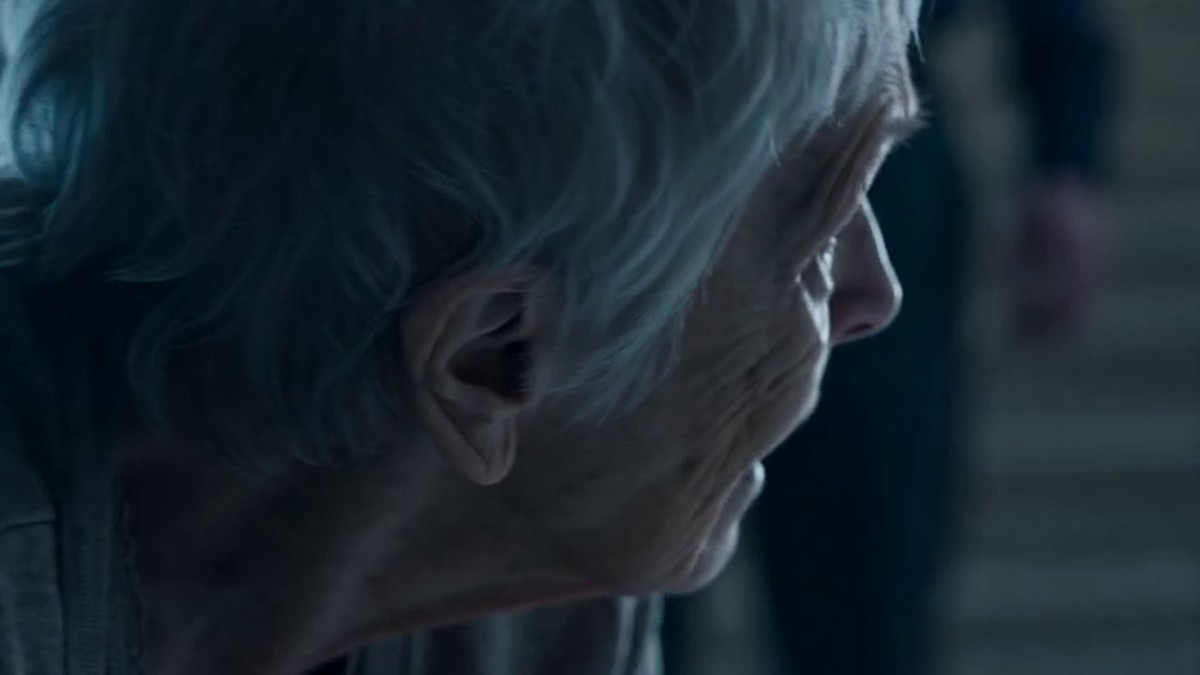
She was nearly eighty years old. Her back curved like a question mark, her knees ached deep in the bone — and still she dragged that cloth across the gleaming entryway of the family home, as if she had to keep earning her right to breathe the air inside it.
Then a sharp heel clicked down.
Right on top of the section she’d just cleaned.
The old woman looked up.
Standing over her was her son’s fiancée — draped in expensive silk, wearing a smile cold enough to frost glass.
“Do it again,” the young woman said.
The old woman’s breath caught.
“I just finished it…”
The fiancée tilted her head, performing confusion like an actress who’d rehearsed the role too many times.
“Are you actually talking back to me?”
Near the staircase, the old woman’s son stood frozen. His face had gone the color of ash. He watched every second of it and said absolutely nothing.
A low laugh slipped from the young woman’s lips.
“You’d better start getting used to this. The moment I marry your son, this house belongs to me. And you?” She let the pause hang. “You’ll just be an old servant taking up space.”
The old woman’s hands tightened around the cloth until her knuckles whitened.
“I lived in this house long before you ever learned his name.”
The fiancée leaned down slowly, bringing her face close — almost intimate, almost gentle.
“Then maybe it’s time you learned to ask permission to stay.”
The silence that followed hurt worse than anything she’d said out loud.
The old woman turned her eyes to her son.
“Say something.”
He looked at the floor.
That was his answer.
Then the front door burst open — hard, like a punctuation mark at the end of a very long sentence.
A man in a dark suit stepped inside, a sealed folder tucked under his arm. His eyes swept the room. He took in the old woman, still on her knees. He took in the fiancée, still standing over her.
And then he spoke.
“I think everyone in this room needs to hear what this document says.”
The fiancée straightened. Something shifted in her expression — not quite fear, not yet, but the first hairline crack in the performance.
“Who are you?” she asked. The cold smile stayed, but it was working harder now.
The man in the dark suit didn’t answer immediately. He crossed the entryway — stepping carefully around the old woman, offering her a slight, deliberate nod, the kind of nod you give someone you respect — and set the sealed folder on the hall table as if placing a verdict on a bench.
“My name is Daniel Marsh,” he said. “I’m an attorney. And I represent the estate of Viktor Hale.”
The old woman’s breath caught for the second time in five minutes, but this time for a different reason entirely.
Viktor. Her husband. Dead three years now and still, apparently, speaking.
Her son finally moved. He came down the last two stairs, arms crossed tight against his chest. “What estate? Everything was settled. We went through all of it after Dad died.”
Daniel Marsh opened the folder.
“Not everything,” he said quietly.
—
The document was eighteen pages long.
It took Daniel Marsh seven minutes to read the relevant sections aloud. Seven minutes during which the fiancée — her name was Celeste, though somehow the old woman had always struggled to use it — stood absolutely still in the middle of the entry hall, the expensive silk doing nothing to disguise the fact that she had stopped breathing normally.
The old woman had pulled herself up from the floor. No one had offered her a hand. She’d done it herself, slowly, with one palm pressed to the wall, her knees screaming, her spine unfolding degree by degree. She stood now by the doorway to the kitchen, her damp cloth still in her hand, and she listened.
The house — this house, with its marble floors and its high ceilings and the scratch on the banister her daughter had made at age six with a toy car, back when the whole family still lived under this roof — did not belong to her son.
It had never belonged to her son.
Viktor, it turned out, had been a careful man. A quiet man. A man who said very little but noticed everything, and who had spent the last year of his life watching his son change in ways that troubled him deeply. He had watched the son he raised grow soft in the wrong places and hard in the wrong ones. He had watched him choose comfort over courage, again and again and again.
And so Viktor had drawn up a second document. A private trust. Witnessed and filed two months before he died.
The house, and everything in it, belonged to his wife.
To her. To the old woman on her knees.
Not to the son. Not — not ever — to whoever the son might one day marry.
“There’s a clause,” Daniel Marsh said, turning to the last page. “Your husband was specific. The property cannot be transferred, sold, or occupied by any party without the consent of the primary beneficiary.” He looked at the old woman directly. “That’s you, Mrs. Hale. Any decisions about who lives here, who doesn’t, who stays and on what terms — those decisions are yours alone to make.”
The room held its breath.
Celeste recovered first. That was the thing about her — she was fast. She turned to the son with her eyes already recalculating.
“Marcus.” Her voice had dropped to something soft and private, the register she used when she wanted to seem vulnerable. “You knew about this?”
Marcus’s face cycled through three expressions in two seconds. “No. I swear I — no.”
“You’re going to let this stand?” The softness evaporated. “Some dusty piece of paper your dead father wrote? Over me?”
Marcus opened his mouth.
And here is where the story could have gone the way it usually goes — the son capitulating, the mother watching it happen, the document becoming a battlefield that courts would pick apart for years.
But the old woman spoke first.
“Marcus.”
Her voice was not loud. It didn’t need to be. It was the voice that had called him in from the yard at dusk when he was seven. The voice that had sat beside his bed when he had his fever at nine. The voice that had, three years ago, held itself together at a graveside so he wouldn’t have to watch his mother fall apart.
He turned to look at her.
“I’m not going to use this against you,” she said. She held up the cloth, almost absently, then set it down on the hall table beside the folder. Two things side by side: the document that gave her power, and the rag she’d been using when she had none. “That’s not why Viktor did this. You know that.”
Marcus’s jaw tightened. Something was happening behind his eyes, some slow and terrible reckoning.
“He did it,” the old woman continued, “because he wanted you to have a witness. To what you chose. To who you became when no one was holding you accountable.”
Celeste laughed — a sharp, disbelieving sound. “Oh, that’s wonderful. A deathbed guilt trip. Very theatrical.”
“You stepped on a floor I’d just cleaned,” the old woman said, turning to her, “and told me to do it again. In my own home.” A pause. “I don’t think I need Viktor’s document to know what kind of person that makes you.”
“You can’t—”
“I can.” The old woman’s voice didn’t rise. It just became very, very clear. “I can ask you to leave. Right now. And I am.”
The silence that followed was a different kind of silence than before. Not the silence of shame, the way it had been when Marcus looked at the floor instead of speaking. This was the silence of a room that had just shifted on its axis and everyone in it was finding their footing.
Celeste looked at Marcus.
Marcus looked at his mother.
Something moved across his face — grief, maybe. Or the beginning of it. The first cold water of understanding what it actually costs to stand by and watch.
“She’s right,” he said. His voice was rough. “You should go.”
Celeste stared at him for a long moment. Then the silk rustled, her heel clicked against the marble one final time, and the door closed behind her — not slammed, which would have given the moment too much drama. Just shut. Final. Like a chapter ending without ceremony.
—
For a while, neither of them spoke.
Daniel Marsh quietly gathered his papers. He set a business card on the table, nodded to the old woman again, and showed himself out with the discreet efficiency of a man who understood that some moments belong only to the people inside them.
The old woman walked to the window. Outside, she could see the garden Viktor had planted — the roses he’d fussed over every spring, the stone path he’d laid himself on a hot Saturday fifteen years ago, cursing under his breath while she brought him water.
“Mom.”
She didn’t turn right away.
“I’m sorry.” Marcus’s voice broke on the second word. Not cleanly — it splintered, the way things do when they’ve been held together too long and finally let go.
She turned then.
He looked older, suddenly, than he had an hour ago. Not in the way she’d aged — earned, over decades, through everything that had happened and survived. He looked older the way people do when they first see themselves clearly and don’t love what they find.
She crossed the room to him.
She did not tell him it was fine, because it wasn’t. She did not tell him she forgave him instantly, because forgiveness is not a faucet you turn. She took his face in her two hands — rough hands, aching hands, hands that had scrubbed this floor and buried a husband and raised this particular stubborn, complicated man — and she held him the way she’d held him when he was small and frightened and didn’t yet know how to be brave.
“Your father knew you could do better,” she said. “So do I.”
He put his arms around her and they stood in the entryway of the house, on the marble floor she had cleaned on her hands and knees that morning, in the particular quiet of two people who still have time, if they choose to use it.
Outside, the afternoon light came through the windows and fell across the banister, and for a moment, the whole house felt like what it had always been, underneath everything.
Hers. And his. And his father’s still, in the way that love leaves its handprints on the walls of places long after the hands are gone.
She would not ask permission to stay.
She never had.