"You don't touch something you could never afford."
The words landed in the quiet of the jewelry store like an open-handed slap.
Several customers turned immediately.
A man near the entrance lowered his phone.
Even the fiancé went completely still.
The young saleswoman held the ring with trembling hands. Color flooded her face in an instant, but she didn't fire back. She didn't flinch, didn't raise her voice.
She just looked at the wealthy woman and said, barely above a whisper:
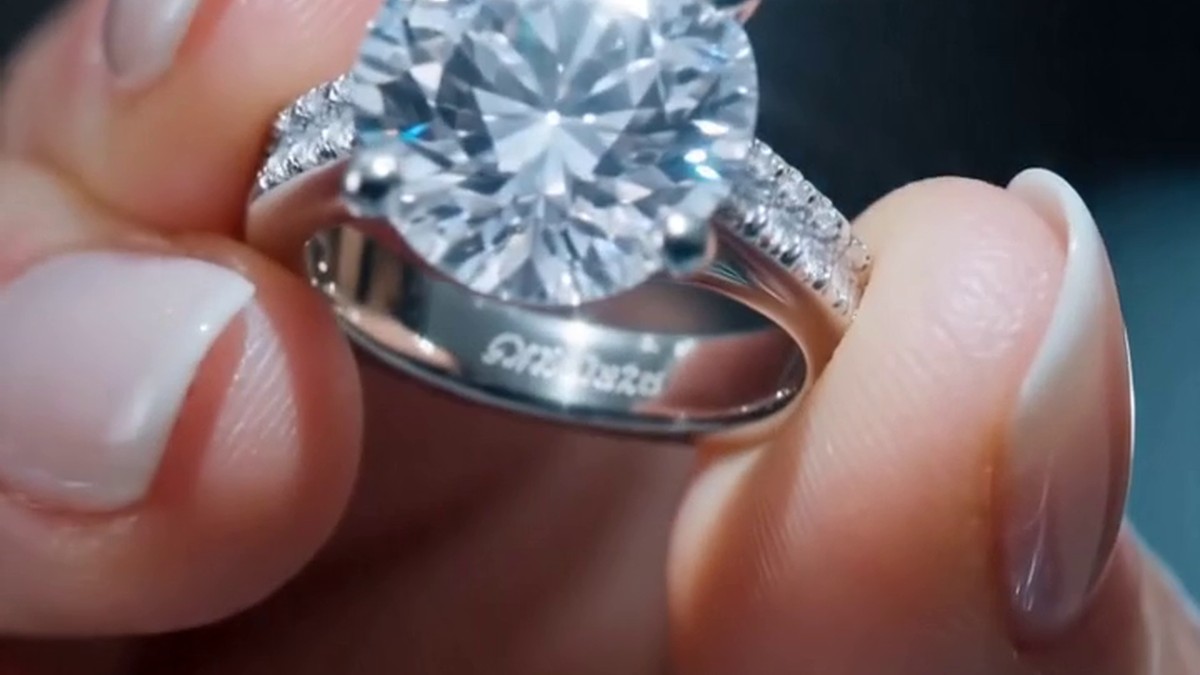
"Look at the inside."
The woman let out a short, cold laugh.
"Excuse me?"
"Look at the inside."
Annoyed now, she turned the ring between her fingers. The boutique's white lights caught the diamond as the moment seemed to slow down all on its own.
Then her expression shifted.
First — contempt.
Then — confusion.
And finally — something that looked a lot like fear.
"What is this date supposed to mean…?"
The saleswoman swallowed hard.
"That's the day this ring was sold for the very first time."
The whole room got heavy.
The fiancé looked like he'd forgotten how to breathe.
An older jeweler stepped out from behind the counter and took the ring carefully, deliberately. He studied the engraving for a few seconds that stretched on far too long.
Then the color drained from his face.
Customers started whispering to each other.
For the first time since she'd walked through the door, the wealthy woman turned and looked directly at her fiancé.
And before she could shape a single word, the saleswoman whispered:
"Ask him why he promised that no other woman would ever wear my ring."
The silence that followed didn't just fill the boutique.
It broke it.
The wealthy woman's mouth opened.
Closed.
Opened again.
Her name was Diane. Diane Hartwell-Crosse, whose picture had appeared in three charity galas last season, whose engagement ring budget had been announced over brunch to a table of twelve. She was not a woman who stood in silence. She was not a woman who lost the thread.
But she'd lost it now.
Her fiancé — Marcus — had gone the color of old wax. He was forty-one, broad-shouldered, the kind of man who filled a room without trying. Right now he was trying very hard to disappear into the wallpaper.
"Marcus." Her voice came out strange. Stripped down. "Look at me."
He did. Briefly. Then his eyes cut to the saleswoman.
Her name tag read *Claire*.
She hadn't moved. She still stood on her side of the glass counter, both hands flat against the surface now, fingertips pressing white. She wasn't performing composure. She was clinging to it. There was a difference, and everyone in that room could feel it.
—
Three hours earlier, Claire had been having an ordinary Tuesday.
She'd opened the boutique at nine, brewed a single cup of coffee she never finished, and spent the morning cleaning the display cases with the quiet focus of someone who finds dignity in small tasks done well. She'd worked at Aldren & Sons for twenty-six months. She knew every piece in every case. She knew their weights, their histories, their previous owners.
She knew the ring the moment Diane Hartwell-Crosse pointed to it.
Because she'd sold it herself. Fourteen months ago. On a Thursday afternoon in October, when the light came through the west window just like this and her hands hadn't trembled at all because she had been so completely, entirely certain.
She'd placed it on her own finger first — just for a second, just to feel it. A habit the older jeweler, Mr. Aldren, had gently discouraged. *You fall in love with them*, he'd warned her. *And then someone buys them away.*
She'd laughed at him then.
She wasn't laughing now.
—
"Marcus." Diane's voice had found its edge again. Sharp. Controlled. The voice of a woman recalibrating. "Tell me right now that this is some kind of —"
"It's not." Claire said it quietly.
Diane's head turned. Slow. Deliberate. The kind of turn that usually preceded devastation.
"I was not speaking to you."
"No." Claire met her gaze. "But I'm speaking to you."
The older jeweler — Mr. Aldren, seventy-two years old, forty of them behind this same counter — set the ring down on a velvet tray with the care of a man handling evidence. Because that's what it was now.
"The engraving," he said, his voice low and unhurried, "reads *October 14th*. And below the date —" he paused, adjusting his glasses, "— there are two initials. *C* and *M*."
Claire.
And Marcus.
A woman near the far display case pressed her hand to her mouth.
Diane looked at the ring. Then at Marcus. Then at Claire, really looked at her — the way she hadn't bothered to look before, when she'd been just a salesgirl in a blue apron, something decorative and dismissible.
Now she was looking.
And something rearranged itself behind her eyes.
"How long," Diane said. Not to Marcus. To Claire. "How long were you with him?"
Claire's jaw tightened. She hadn't expected that question. She'd been bracing for anger, for dismissal, for the wealthy woman to simply sweep the ring off the counter and demand to see a manager.
She hadn't expected to be asked.
"Twenty-six months," she said. "He proposed on a Tuesday. He told me Tuesdays were underrated."
A sound came out of Marcus. Not a word. Not quite.
Diane turned to look at him and the look was surgical.
"She still works here," Diane said slowly, as if she were following a thought to its conclusion in real time. "She still works in the same store where you bought her ring." She picked up the velvet tray, studied the diamond, set it down again. "The ring you told me you'd had *custom designed*."
"Diane —"
"For *me*."
The word landed the way the first one had — like something physical.
Marcus ran a hand through his hair. His jaw worked. In another life, in another context, he might have talked his way through this. He was good at that. Claire knew exactly how good he was at that. She had believed every word for twenty-six months and hadn't doubted a single one until the Tuesday he didn't show, and the Wednesday he texted, and the Thursday she came to work and understood, with the specific and terrible clarity of someone who knows jewelry, exactly what had happened.
In the weeks after Marcus stopped returning her calls, he had come into the store when she wasn't working — Mr. Aldren had told her this later, quietly, without editorializing — and formally returned the ring. Processed it as a standard consignment return. Said he no longer needed it. Said it was a clean break. Mr. Aldren had accepted it without asking questions, because that was his policy, and because Marcus had paid the restocking fee without flinching, and because nothing about the transaction had seemed extraordinary at the time. The ring had gone back into the case. Someone had cleaned the glass above it. The store had opened the next morning exactly as it always did.
What no one had known — what Marcus himself may not have known — was that the engraving on the inside of the band was small enough, and set deeply enough, that it hadn't made it onto the resale tag. The ring had sat in the case for five months. And then Marcus had come back in, pointed to it through the glass, and said he'd like to see the round-cut solitaire in the second row. He had bought it again, for a different woman, without ever turning it over to read what was already there.
The irony wasn't lost on Mr. Aldren. He hadn't said a word.
"He told me you'd had it custom designed," Diane said again, flatly.
"I made a mistake," Marcus said.
The room didn't move.
"I made a mistake," he said again, and this time it wasn't clear who he was talking to.
"Which one?" Claire asked.
The question was quiet. It wasn't cruel. It was the most honest thing anyone had said in that boutique all morning, and it fell into the silence and stayed there.
Marcus looked at her. Really looked at her, the way Diane had a moment ago. The way people look when it's too late to look away.
"Claire —"
"Don't." She said it without heat. "You don't need to."
And she meant it. She understood, standing behind that counter with the velvet tray between them, that she didn't need the answer. She'd been waiting — without knowing she was waiting — for fourteen months. She'd come to work every day in this store, she'd cleaned these cases, she'd sold other people's rings for other people's proposals, and somewhere underneath all of it she'd been waiting for the moment the story made sense.
It made sense now.
Not because it was fair. Not because it resolved into something clean and satisfying. But because she could finally see the whole shape of it.
—
Diane picked up the ring.
She held it between two fingers, the diamond catching light, and she looked at it for a long moment.
Then she placed it back on the tray. Gently. Almost carefully.
"I don't want it," she said.
Marcus blinked. "Diane —"
"I said I don't want it." Her voice was steady. Remarkably steady. She picked up her handbag from the counter's edge, smoothed the front of her coat, and looked at Marcus with an expression that wasn't anger and wasn't grief. It was something older than both. *Disappointment with its mind already made up.*
"I'm going to need you to find your own way home," she said. "And I'm going to need some time before you call."
She walked to the door.
At the threshold she paused — not dramatically, not for effect, just the natural hesitation of a woman crossing from one version of her life into another.
She looked back at Claire.
"For what it's worth," Diane said, "I'm sorry he did that to you."
Then she walked out.
The door eased shut behind her.
The little bell above it chimed once.
—
The customers drifted. Quietly, almost apologetically, the way people leave a church after something unexpected happens in the middle of the sermon. The man near the entrance pocketed his phone. The woman by the far case moved away without buying anything.
Mr. Aldren picked up the ring, turned it once in his fingers, and set it back in its original place in the case.
Marcus stood alone on his side of the glass.
He opened his mouth.
"Claire, I —"
"I can help you find something else," she said. "If you're still looking."
It wasn't an invitation. It wasn't forgiveness. It was just — the job. The same job she'd done every day. She was good at it. She would keep being good at it.
He understood. She could see that he understood. And for one unguarded second his face showed something that might have been the truest thing about him — not the charm, not the smoothness, but the plain and ordinary shame of a man who had known better and chosen worse.
He left without buying anything.
—
The boutique settled back into its quiet.
Mr. Aldren came to stand beside her. He didn't say anything for a while. That was one of the things she valued most about him.
Then: "You all right?"
Claire looked down at the ring in its case. At the diamond. At the date engraved inside a band that had once belonged to a future she'd believed in completely.
"I think so," she said.
And the strange thing — the thing that surprised her — was that she meant it.
She reached beneath the counter for her polishing cloth and began, slowly and carefully, to clean the glass.
The afternoon light came through the west window.
The boutique held its breath for just a moment longer.
Then it exhaled.
And the day went on.