White roses crowned every table. Crystal chandeliers spilled warm light across the faces of California’s finest, and Juliette Mercer smiled the way a woman smiles when she believes the entire world is finally, irrevocably hers.
Then the doors opened.
The Grand Bel Air Ballroom fell silent. Not gradually — all at once, like a held breath.
Two sheriff’s deputies came through first, moving with the kind of unhurried calm that drains the air from a room. And between them walked a woman.
Dressed in black.
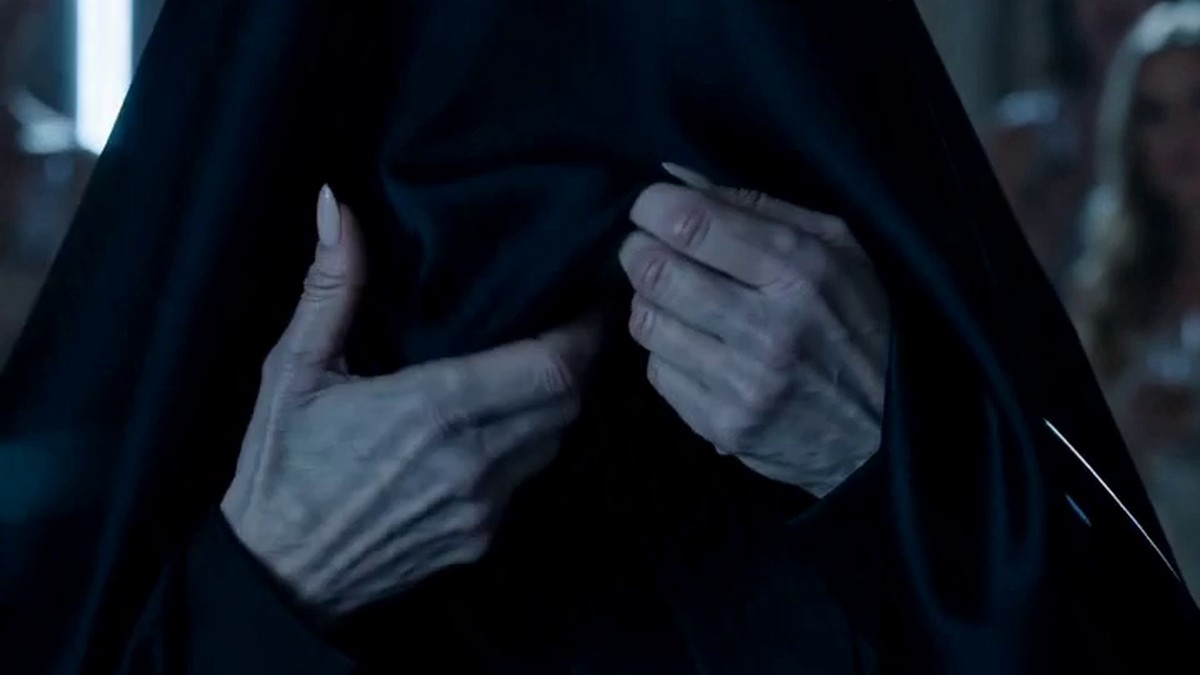
Her face partially hidden beneath bandages, wrapped tight under a dark veil. Long gloves covered her hands. Each step she took across the marble floor seemed to carry something buried — something that had been underground for years and had no business being here tonight.
Juliette stopped smiling.
Nathan’s brow creased.
“Who is she?” he whispered.
No one answered.
The woman moved slowly down the aisle of white roses. Some guests stepped back. Others raised their phones, uncertain whether they were witnessing an interruption or a threat.
Douglas Mercer — Juliette’s father — rose from his seat.
The color left his face.
There was something about the way she carried herself. Something in the angle of her shoulders, the deliberate weight of every step.
Something that should not have been possible.
Juliette tightened her grip on the champagne flute until her knuckles whitened.
“This is a private event,” she said, forcing steel into her voice. “You need to leave.”
The woman said nothing.
One of the deputies lifted a folder stamped with official seals from the Superior Court of California.
“We’re here by order of the court.”
The silence that followed had texture. Weight.
The woman stopped directly in front of Juliette. For a long moment neither of them moved. Neither spoke.
Then, with hands that trembled, the stranger reached up — slowly, deliberately — and began to remove her veil.
The bandages shifted.
A scar caught the candlelight.
Juliette stepped back.
“No…”
And when the woman’s face was fully revealed, the champagne flute slipped from Juliette’s fingers and shattered against the marble floor.
Because that woman was not a stranger.
She was the sister everyone believed was dead.
The crystal scattered across the marble in slow, terrible pieces.
Nathan caught Juliette’s arm before she stumbled. His grip was instinct — the protective reflex of a man who still believed he understood the woman he was marrying. He didn’t. Not yet.
“Jules.” His voice was careful. “Jules, look at me.”
But Juliette wasn’t looking at him.
She was staring at the dead.
—
Her name was Cecile Mercer.
Twenty-nine years old. Three years younger than Juliette. She had her mother’s cheekbones and her father’s silence — that particular Mercer silence that lived behind the eyes, calculating, patient, capable of holding a wound for years without once letting it show on the surface.
She had been gone for seven years.
The official story — the story Douglas had told at the memorial, the story printed in the obituary, the story Juliette had told so many times she had stopped knowing whether she believed it — was a car accident on Highway 1. Night fog. A guardrail that didn’t hold. A body never fully recovered from the water below.
Everyone had cried.
Douglas had bought a headstone.
Juliette had worn black for exactly three weeks, then quietly moved into the master suite of the family estate.
Now Cecile stood in the candlelight, and the scar along her jawline — ragged, silver-white, the kind of scar that comes from something deliberate rather than accidental — caught the warmth of the chandeliers like a brand.
She looked at her father first.
Douglas Mercer had not sat back down. He stood perfectly still beside his table, his face the color of old ash, his hands flat against the white linen as if the tablecloth were the only solid thing left in the world.
“Hello, Dad,” Cecile said.
Her voice was quieter than Juliette expected. Rougher. The voice of someone who had learned to speak carefully after a long time of not speaking at all.
The room held its breath.
“This is insane,” Juliette said. Her composure was returning, assembling itself piece by piece the way it always did — that Mercer armor, built young and worn constantly. “Whatever this is, whatever you’ve been paid to do—”
“I haven’t been paid anything.” Cecile turned to look at her sister for the first time. Fully. Without flinching. “I’ve been recovering.”
“From what?”
“From what you did.”
The words landed in the silence like stones dropped into still water.
Nathan’s hand loosened from Juliette’s arm.
—
The deputy with the folder — a woman, mid-forties, the kind of calm that comes from years of delivering news that dismantles lives — stepped forward.
“Mr. Mercer.” She addressed Douglas directly. “We have a court order requiring your immediate presence for questioning in relation to the civil suit filed by Cecile Anne Mercer. The suit concerns the fraudulent filing of a death certificate, the improper transfer of assets from the Mercer family trust, and conspiracy to commit—”
“That’s enough.” Douglas’s voice came back, low and controlled. “I need to call my attorney.”
“You’ll have that opportunity, sir. But you need to come with us now.”
“I’m not going anywhere.” He straightened. Adjusted his jacket. Sixty-three years old and still capable of filling a room with sheer force of authority — the practiced gravity of a man who had been building things and buying things and making things disappear for four decades. “Not tonight. Not from my daughter’s wedding.”
Cecile made a sound that wasn’t quite a laugh.
“Your daughter’s wedding,” she repeated. “That’s still what you’re worried about. The optics.”
“Cecile—”
“Seven years.” The roughness in her voice sharpened. Not anger — something colder. The temperature of absolute certainty. “I had three surgeries. I learned to walk again. I spent two years in a facility in Phoenix because the doctors said my nervous system needed time and the alternative was a wheelchair and I was twenty-two years old and not willing to accept that.” She paused. “I had no money, Dad. Because you had declared me dead. Because my accounts were frozen. Because Juliette had already filed the paperwork to transfer my portion of the trust to herself.”
The room had stopped pretending not to listen.
Nathan had stepped back from Juliette by several inches without appearing to notice he’d done it.
“You can’t believe this,” Juliette said, turning to him. Her voice had found its register again — warm, reasonable, the voice she used in boardrooms and charity galas and every space where she needed people to choose her version of reality over someone else’s. “Nathan. Look at me. You know me.”
“I thought I did,” he said.
Not cruel. Just honest.
Juliette’s composure cracked along a very thin line.
—
Douglas moved first.
Not toward the deputies. Toward Cecile.
He crossed the marble floor with the same unhurried authority he’d carried into courtrooms and contract negotiations for forty years, and for a moment — one terrible, suspended moment — it was unclear what he intended to do when he reached her.
He stopped two feet away.
Up close, the damage in his face was visible. The guilt that power had been papering over for seven years. The way a man looks when the thing he buried has walked back into the light and he realizes, finally, that the ground was never as deep as he thought.
“I thought it was the only way,” he said. Quietly. Only for her.
“To protect what?”
“The company. The family name. Your mother had just died. If people had found out what happened on that road—”
“What happened on that road was that someone ran me off it.” Cecile’s voice didn’t shake. “And you knew that. And you chose the story that was easier for you.”
The word *someone* hung in the air.
Every head in the room turned toward Juliette.
She stood perfectly still. Nathan’s abandoned champagne flute on the table behind her. White roses framing her like a painting of everything she’d constructed. Beautiful. Expensive. Hollow at the center.
“You have no proof,” she said.
“I have the other driver,” Cecile said. “He spent six years believing I was dead. When he found out I wasn’t—” She let it sit. “People make different choices when they realize the statute of limitations isn’t what they thought it was.”
The deputy had been watching this exchange with the patience of someone who had given people enough rope before. She stepped forward now.
“Ms. Juliette Mercer, there’s a second order here for you as well.”
The folder opened again.
Juliette read the top page.
Something moved across her face that had no name — not fear exactly, not the performance of innocence she might have reached for in another moment. Something underneath all of it. Something that looked, briefly, almost like relief. Like a woman who has been holding a lie so long that being caught is the only exit she could ever find.
It lasted half a second.
Then the armor came back up.
“I’ll need my phone,” she said. “I need to call Richard Holt.”
“You can make that call at the courthouse, ma’am.”
Nathan picked up his jacket from the chair where he’d draped it an hour ago, full of anticipation and champagne and the easy confidence of a man who believed he was beginning his life. He looked at Juliette for a long moment. Searching for something. Whatever he found — or didn’t find — settled something in his face.
He put the jacket over his arm.
He walked toward the exit.
Not dramatically. Not with a speech. Just a man making a decision about what kind of life he was willing to live, made quietly, in the ruins of a wedding hall.
Juliette watched him go.
She didn’t call after him.
—
Cecile sat down.
Not at the head table. Just at one of the round white-rose tables near the back, alone for a moment, her gloved hands flat in front of her. The chandeliers were still warm. The flowers still white. The room still full of California’s finest, most of whom were now very quietly and urgently texting.
One of the deputies brought her a glass of water.
She drank it.
After a while she became aware that someone had sat down across from her.
An older woman. One of the guests. Someone Cecile didn’t recognize. She had kind eyes and the particular bearing of a person who had seen enough of life to stop being surprised by its cruelties.
“Are you all right?” the woman asked.
Cecile thought about it.
Seven years. Three surgeries. The facility in Phoenix. The slow process of learning that you are still a person when everything that defined you — name, money, family, the assumption that the people who were supposed to love you would choose you over their own convenience — has been stripped away. The discovery that underneath all of that there is still something. Small, maybe. Stubborn. Alive.
“I’m going to be,” Cecile said.
And for the first time in seven years, she meant it.
—
Outside, the deputies guided Douglas and Juliette toward separate vehicles. The Bel Air night was warm and smelled of jasmine and the distant Pacific. The white roses through the glass doors looked, from the outside, like something out of a dream.
Douglas paused at the car door. Looked back at the ballroom.
He had built a life on the principle that things could be managed — that money and authority and the right story told at the right moment could hold any structure in place, no matter what was rotting at the foundation.
He understood now, standing in the warm California night with the jasmine and the deputies and the wreckage of the evening behind him, that he had been wrong.
Some things come back.
Some things, buried in the dark, press their way up through the soil, through the weight of years, through every deliberate silence.
Some things simply will not stay dead.
He got in the car.
The door closed.
And inside the Grand Bel Air Ballroom, Cecile Mercer sat in the candlelight, alive — undeniably, irrevocably alive — and let herself, at last, begin.