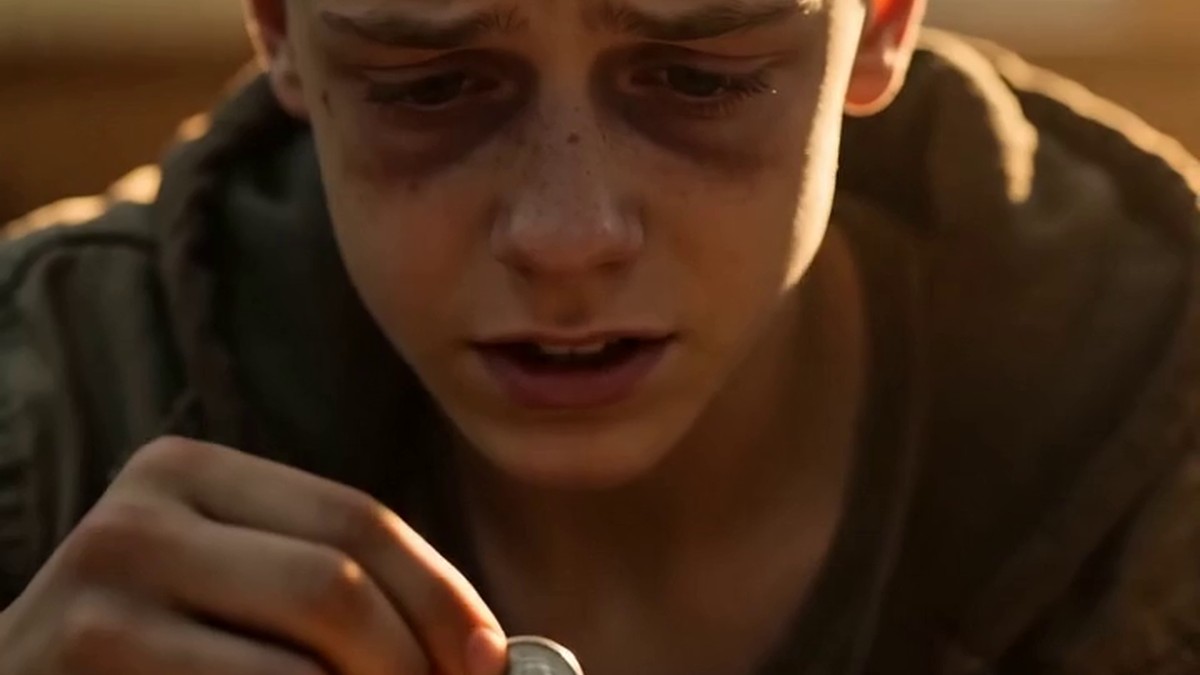
For most people, it was just another morning.
For Ethan — a ten-year-old boy who hadn’t eaten in nearly two days — it was agony.
His stomach twisted and growled as his eyes landed on an abandoned plate at an empty table.
Half a slice of toast.
A few bites of potato.
A strip of bacon.
His hand was already reaching for it when a voice cracked through the air like a whip.
— Just what do you think you’re doing?
The manager snatched the plate away and, in full view of every customer in the room, dumped the food into the trash.
The metal lid slammed shut.
The sound rang out across the whole restaurant.
Nobody moved.
Nobody said a word.
Ethan dropped his head, jaw clenched, fighting back tears that burned at the corners of his eyes.
Then a voice cut through the silence from the direction of the kitchen.
— That’s enough.
The chef stepped out, took one long look at the scene, and walked back through the kitchen door without a single word.
A few minutes later, he returned carrying the biggest breakfast Ethan had ever seen in his life.
Pancakes.
Eggs.
Sausages.
Fresh orange juice.
— Sit down and eat, — the chef said quietly.
Before Ethan turned to leave, he dug into his pocket and pulled out a worn silver coin.
It was the only thing he owned.
— It’s all I have.
The chef pressed it back into his palm.
— Keep it.
Ethan closed his fingers tightly around the coin.
Then he looked up.
— One day I’ll come back for you.
The chef smiled.
He assumed he’d never see the boy again.
But twenty years later, a black limousine rolled to a stop in front of the restaurant. And when a young self-made millionaire walked through the door and set a worn silver coin down on the counter, the chef’s hands began to shake — because he recognized that coin the moment he saw it.
The coin clinked softly against the worn formica countertop.
Such a small sound. Such an enormous weight.
Chef Raymond Kowalski — sixty-one years old, hair gone silver, hands scarred from forty years of hot pans and sharper knives — stared at that coin the way a man stares at something he buried long ago and never expected to see rise from the earth.
His throat closed.
The restaurant was full. The lunch rush. Plates clattering, cutlery ringing, the low warm roar of a dozen conversations rolling over each other. None of it reached him. The room had shrunk to the size of a counter, a coin, and the man standing on the other side of it.
Ethan Cole was thirty years old now. Broad shoulders filling out a charcoal suit that cost more than Raymond earned in a month. Dark eyes that hadn’t changed — still too serious, still carrying something heavy behind them that expensive clothes couldn’t quite cover.
— You remember me, — Ethan said. It wasn’t a question.
Raymond’s hand moved before his mind could stop it. His fingers reached out and touched the edge of the coin without picking it up. Like he needed to confirm it was real.
— I remember you, — he said. His voice came out rough. — Sit down, son.
—
Ethan sat at the same counter stool he’d collapsed into twenty years ago. He didn’t look around the restaurant. He kept his eyes on Raymond.
— I made a promise, — he said simply.
Raymond pulled out the stool across the counter and lowered himself onto it, ignoring the three tickets clipped up behind him, ignoring the line cook who stuck his head through the pass-through window and retreated without a word when he read the room.
— You didn’t owe me anything, — Raymond said.
— No. — Ethan picked up the coin. Turned it once between his fingers, the old habit. — You were the first person who didn’t treat me like I was less than nothing. You have any idea what that does to a ten-year-old kid?
Raymond looked at his own hands flat on the counter. Those scarred, used-up hands.
— What happened to you? — he asked quietly. — After that morning. Where did you go?
—
Ethan set the coin down again.
And then he talked.
He talked about the shelter that smelled of mildew and other people’s desperation. About the group home at eleven, the second one at thirteen, the third one after he put a bully through a drywall partition and nobody much cared whose fault it actually was. About sleeping in a car at sixteen belonging to a man he’d done lawn work for, not because the man offered — just because it was unlocked and it was January.
About finding a library. About discovering that silence and heat and unlimited books were free. About reading every business title on the shelf, not because he had a plan, but because those books described a world where outcomes could be controlled, where effort had a logical relationship to reward, where the rules were at least written down somewhere.
About his first job at seventeen — dishwasher in a hotel kitchen. About the chef there who watched him reorganize the storage room on his own initiative and moved him to prep. About saving. About a community college at night. About a small loan he shouldn’t have qualified for from a credit union whose loan officer was having either a very good day or a very reckless one.
About ten years of compounding small correct decisions.
About luck, which he named honestly and without false modesty.
Raymond listened to all of it without interrupting once.
When Ethan finished, the restaurant had quieted around them. The lunch rush had thinned without either of them noticing. A busboy moved silently between tables, not looking over, somehow understanding.
Raymond exhaled slowly.
— You came back to tell me that?
— I came back, — Ethan said, — because six weeks ago I found out you’re losing this place.
—
The silence that followed was a different kind than the one from twenty years ago.
That one had been shame and hunger and a metal lid slamming down.
This one was exposed.
Raymond’s jaw tightened. He looked away toward the window where afternoon light cut pale stripes across the floor.
— How do you know that? — His voice was flat now. Careful.
— I do my research before I walk into a room. — Ethan wasn’t apologizing for it. — Second mortgage called. Back taxes. The building sold to a development group that wants to put up condominiums. You’ve got ninety days, give or take.
Raymond said nothing.
— Where’s the manager? — Ethan asked. — The one who was here that morning.
A muscle moved in Raymond’s cheek. — Gone. Six years ago I bought him out. Took everything I had.
— But it wasn’t enough.
— It was never going to be enough. — Raymond’s voice came out harder than he intended. He pulled it back. — The neighborhood changed. Rents went up. I’m a cook, not a businessman. I kept thinking if the food was good enough—
He stopped.
Ethan nodded slowly. — If the food was good enough, the rest would follow.
— It doesn’t work like that.
— No, — Ethan agreed. — It doesn’t.
He reached into the inside pocket of his jacket and set a document on the counter beside the coin. Clean white paper. A red tab marking the signature line.
Raymond looked at it without touching it.
— What is that?
— Full purchase of the building. At current assessed value, not the developer’s number. — Ethan’s voice was even, businesslike, and underneath it something that was neither of those things. — Debt cleared. Renovation fund. A five-year operating agreement that keeps you as head chef and gives you thirty percent of any profit above baseline. Your name stays on the door.
Raymond stared at the document.
The afternoon light shifted. Somewhere in the kitchen, something on the stove hissed softly and someone turned it down.
— Ethan.
— It’s not charity, — Ethan said. — I’ve looked at the numbers. The kitchen has a real reputation. The location is actually better than you think with the new transit line. There’s a version of this that works.
— That’s not what I was going to say.
Ethan looked up.
Raymond’s eyes were wet. He wasn’t hiding it.
— I was going to say — — his voice broke once, cleanly, and he held the rest of it together — — I almost didn’t bring you that plate. You know that? I stood in that kitchen for two full minutes talking myself into it. Thinking it wasn’t my business. Thinking I’d get grief from the owner.
He looked at his hands again.
— Two minutes. I almost let you walk out of here.
Ethan was quiet for a long moment.
Then, carefully, he picked up the silver coin and held it out across the counter.
— You didn’t, though.
Raymond took the coin. His fingers closed around it the same way Ethan’s had, twenty years ago on a cold morning, outside a restaurant that smelled of bread and butter and things just out of reach.
His hand shook.
Just like Ethan had promised it would.
—
Raymond signed the document.
Not immediately — he took it home, read every page twice, called a lawyer friend from his parish who charged him nothing and told him the terms were more than fair. He slept on it the way a man sleeps on something that frightens him not because it’s bad but because it’s good and he isn’t sure he deserves it.
On the third morning he walked back in, sat at the counter, and signed.
Ethan wasn’t there. He’d left a number with the line cook.
Raymond called it.
— One condition, — he said, when Ethan picked up.
— Name it.
— You come in for breakfast. Actual breakfast, not a meeting. No phones. No documents.
A pause on the line.
— When?
— Saturday. Seven a.m. — Raymond looked around his kitchen. His kitchen. — I’ll make pancakes.
Another pause. Shorter.
— I’ll be there.
—
Saturday morning.
The restaurant smelled of fresh-baked bread, melted butter, and dark coffee.
Ethan Cole walked through the door at two minutes before seven in jeans and a plain dark shirt, the silver coin in his front pocket where it always was.
Raymond was already at the grill.
He didn’t say anything when Ethan sat down at the counter. Just set down a glass of fresh orange juice, the way you do for someone you’ve been expecting.
Pancakes.
Eggs.
Sausages.
The biggest breakfast Ethan had seen since the last time he sat in this exact spot.
He ate every bite.
And this time, nobody took it away.