“Today is your final deadline.”
Don Ernesto stood motionless in front of his little bakery. His hands were shaking. He knew he didn’t have the money. He knew he was about to lose the business he’d given his entire life to.
The two assistants behind the collector watched in silence. Not a word. Not a gesture. The air between them all had gone thick and still, like the moment before a storm breaks.
Then a black SUV rolled slowly to a stop at the curb.
Every head turned.
The door swung open.
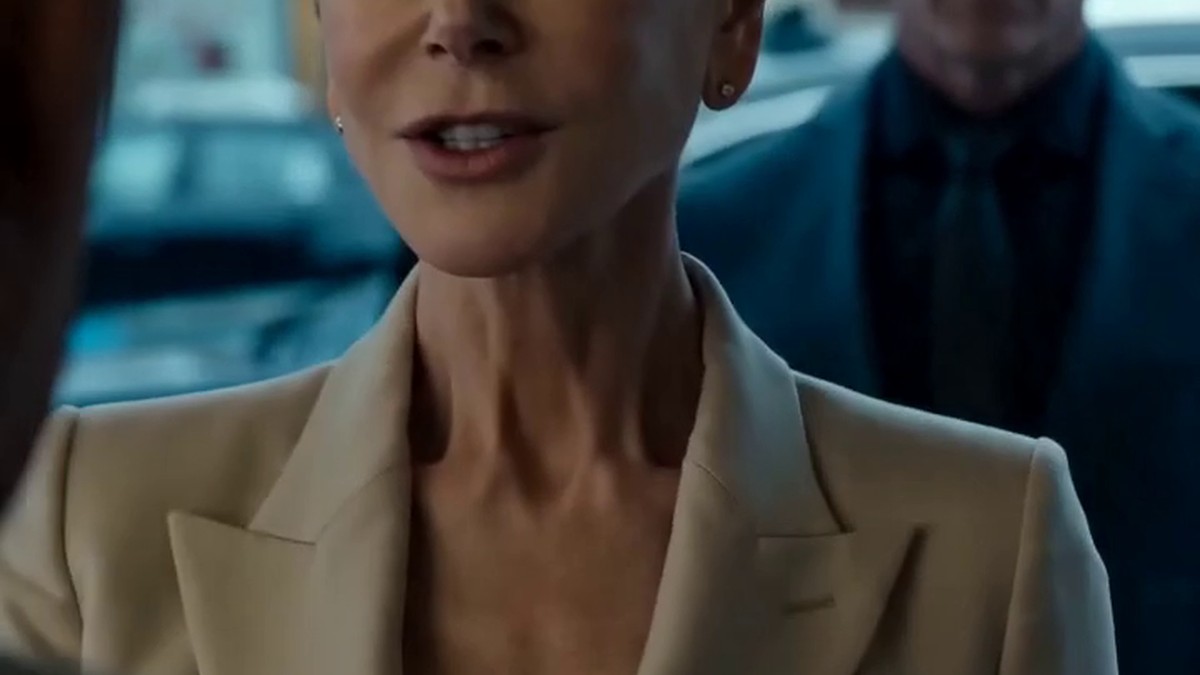
A woman stepped out — elegant, composed, dressed in a tailored beige suit. She walked straight toward the group with a quiet certainty that made everyone go silent without knowing why.
The collector narrowed his eyes.
“Who are you?”
She didn’t answer him. Not yet.
First, she looked at the old man. Long and steady. Then she reached into her bag — and pulled out an old paper napkin, yellowed and soft with age.
Don Ernesto saw it.
And something broke open across his face.
His eyes went wide. His hands trembled harder than before.
Because he knew that napkin. He had seen it exactly once in his entire life. Many years ago — when a small, hungry little girl had appeared on the doorstep of his bakery with nothing.
The woman slowly opened her hand, revealing the faded mark drawn on the paper.
And in that instant, the old man understood exactly who was standing in front of him.
No one else did. Not yet.
She folded her fingers back around the napkin gently, like it was something sacred. Then — and only then — she turned to face the collector.
“My name is Elena Voss,” she said. Her voice was level. No theater in it. Just weight. “I’m the majority stakeholder of Voss Capital Group. I believe you represent Meridian Lending Solutions.”
The collector blinked. Something shifted behind his eyes — not fear, not yet, but the first cold flicker of recalculation.
“That’s correct,” he said carefully.
“Meridian is a subsidiary.” She opened her bag again and produced a single folded document, clean white paper against her tan fingers. “Of my holding company. As of eleven days ago.” A beat. “It took my legal team nine of those days to find the clause in Meridian’s charter that made the acquisition clean. The other two were paperwork.”
Silence.
One of the assistants shifted his weight. The other stared at the pavement.
The collector looked down at the document. His jaw tightened. He looked back up at her, and this time the flat coldness in his eyes had cracks in it.
“This debt,” Elena continued, “is being restructured. Effective today. The terms Mr. Ernesto signed were predatory and, as my legal team has already submitted to the relevant offices this morning, almost certainly fraudulent.” She tilted her head. “You should check your messages.”
The collector’s hand moved slowly to his jacket pocket. He pulled out his phone. Read something on the screen.
He didn’t speak for a long moment.
Then, without a single word to Don Ernesto — without even looking at him — he snapped his folder shut a second time, tucked it under his arm, and gave Elena a nod so small it was almost nothing at all. Just a flicker of acknowledgment. The kind you give when you’ve lost and you know it and you’re calculating your next position before you even finish losing.
He turned and walked back toward the street. The two assistants followed. Their footsteps faded into the noise of the morning.
And then they were gone.
—
Don Ernesto hadn’t moved.
He was still standing in front of his bakery, both hands pressed flat against his chest now, as if trying to hold something inside. The morning light caught the silver in his hair. The flour dust still on his apron. The deep lines of a face that had been worrying quietly for months.
Elena walked to him.
She held out the napkin.
He took it with shaking hands. Turned it over. There was the mark — a small uneven star, drawn in child’s pencil, rubbed almost to nothing by decades of careful folding and unfolding. He had drawn it himself. A little game. A little joke he’d made for a skinny, frightened seven-year-old girl who had knocked on his back door on a November morning with no coat and no shoes and eyes that were too old for her face.
*If you’re ever lost,* he had told her, *and you show this to me, I will feed you. No matter what. No matter when.*
He’d given her bread. He’d given her soup. He’d sat with her for three hours that day because she had nowhere to go and he couldn’t bring himself to make her leave.
He never found out what happened to her.
That was thirty-one years ago.
—
“Elena,” he whispered. He tried the word like he wasn’t sure he had the right to use it. “You are — you were —”
“The girl from the back door.” She nodded. Her composure didn’t break, but something behind it went very soft. “November. You had just baked the sesame rolls. I could smell them from the alley.”
He made a sound — not quite a laugh, not quite a sob. Something in between that had no name.
“I looked for you,” he said. “After. I looked.”
“I know.” Her voice was quieter now. “My caseworker moved me to another district. I never got to come back.”
She reached out and covered his hands with hers. Both of them stood there holding the napkin together, this impossible small artifact that had survived foster homes and city offices and thirty-one years of distance and a little girl who had carried it across her entire life without ever losing it.
“I kept it,” she said, “because it was the first time anyone told me they would feed me no matter what.” She paused. “It was the first time I believed someone meant it.”
Don Ernesto was crying now, quietly and without embarrassment, the way old men cry when they’ve run out of reasons not to.
“You came back,” he said.
“I came back.”
—
Behind them, through the glass of the bakery door, the morning light fell across the wooden shelves and the cooling racks and the small handwritten chalkboard that had listed the same prices for years. The smell of bread was still in the air. It always was, here. It was the constant, the thing that had never changed no matter what tried to break it.
Elena looked at the building for a long moment.
“I’ve had this address for three years,” she said. “I kept telling myself I would come when I had something to offer. Not just — to show up empty-handed and say *hello, you fed me once, I never forgot.*” A small, wry pull at the corner of her mouth. “It took me a little longer to understand that sometimes you come back before you’re ready. Before you have everything arranged.”
“You came in time,” Don Ernesto said. His voice had steadied. “That is enough.”
She looked at him then — really looked — and for just a second the composed woman in the tailored suit was not quite there, and instead there was the echo of someone smaller, someone who had stood on this exact pavement in November cold and not known what would happen next.
Then she straightened slightly. Back to herself. Both versions of herself at once.
“The debt is cleared,” she said. “The restructuring is real — this isn’t a gift, the paperwork is clean. No one can challenge it.” A pause. “But I would like to come back. If that would be all right.”
Don Ernesto looked at her for a long moment. Then he reached out and patted her hand — twice, the way you do when words are too slow and hands are faster.
“Come Saturday,” he said. “I make the sesame rolls on Saturday.”
She smiled. It was a real one. It reached everything.
“I’ll be here,” she said.
And she meant it — the way he had meant it thirty-one years ago, standing at a back door with a pencil and a napkin and no idea that a promise that small could travel that far.