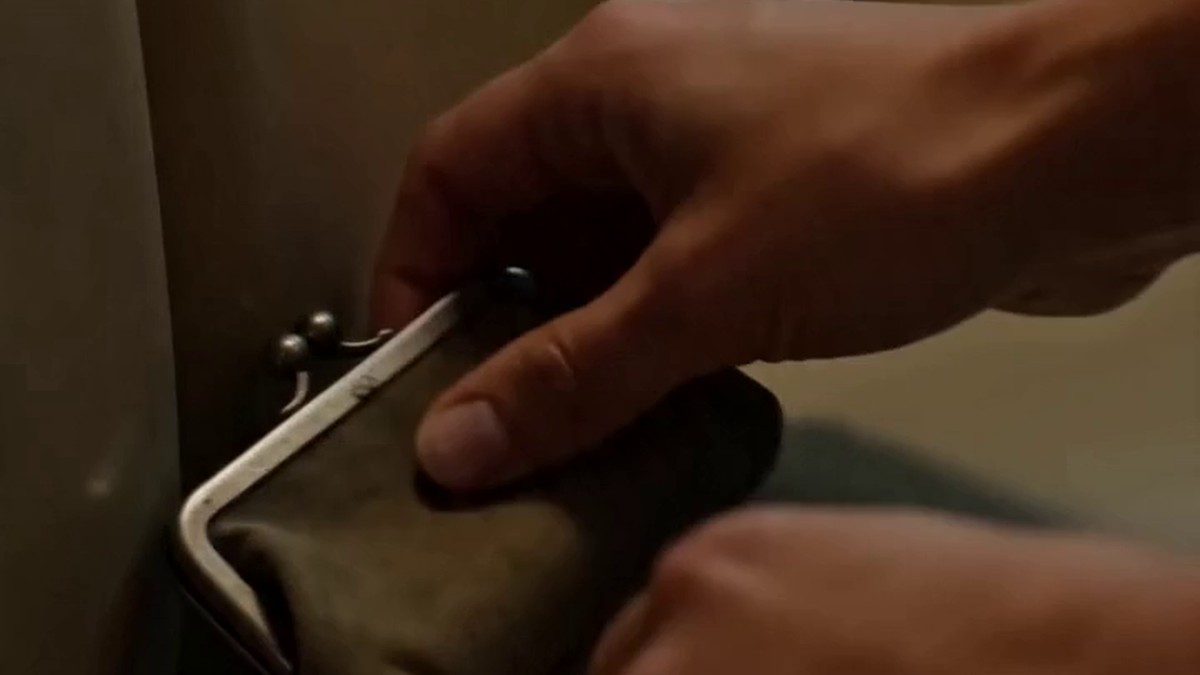
She didn’t ask for anything. Didn’t make a sound. She just appeared in the doorway, drenched through, one hand gripping a worn leather bag like it was the only solid thing left in the world. Water trailed off her coat and pooled on the linoleum. Her dark eyes found the nearest booth, then let it go — as if sitting down was something she needed to earn first.
Clara recognized that look.
Her grandmother used to say, “The ones no one bothers to notice have usually lived the most.” Clara had nodded back then without really hearing it. But that was before four years of a manager skimming her checks, before less than twenty dollars in her account, before she understood what it meant to feel invisible inside a room full of people. Now she heard it just fine.
“Ma’am?”
The woman’s shoulders jumped.
“Come on in. There’s a radiator near that booth — it’s warm.”
She crossed the floor slowly, each step deliberate, like her joints were negotiating with her bones. She settled into the cracked red vinyl and stared down at the table. Clara brought tea first. The woman looked at the rising steam for a long moment, then whispered something in Italian — quiet words that didn’t need translation. They carried the particular weight of apology.
Clara didn’t speak the language.
She spoke shame fluently, though.
She moved to the warmer. Lou had already told her to toss the tomato bisque before locking up — he had a strict policy against anything he called “yesterday’s soup.” Clara filled a bowl anyway. Cut the heel off a rye loaf. Set a pat of butter alongside it and carried everything to the booth without making it a production.
The woman reached immediately for her coin purse.
Clara rested a hand over her wrist. Just that. No words.
The first spoonful shook so badly that bisque sloshed onto the saucer. The woman went rigid with embarrassment. Clara turned away and began wiping down a table that was already spotless.
Behind her, she listened.
Spoon finding the bottom of the bowl. Bread pulled apart. The soft crack of a cracker sleeve. Then nothing.
When she turned back, the bowl was empty and some color had returned to the woman’s face. She pressed an open hand to her chest and spoke a few words — slowly, fully, the way people speak when they mean it as a prayer. Then she collected her bag and walked back out into the rain.
At the door, she turned around once.
What Clara saw in her face wasn’t simple gratitude. It was something older than that. Something that looked almost like being known.
“Tell me you didn’t do it again.”
Lou materialized from his office doorway, glasses dangling from one hand, wearing the expression he kept ready for exactly this.
“She was hungry,” Clara said.
“Clara. There are always hungry people.”
“You were about to dump that soup down the drain.”
He exhaled through his nose. “You’re thirty-two years old with twenty dollars to your name and you’re still giving things away.” He said it like a diagnosis.
He could say it because he knew exactly what was in her account. For four years, Lou had been quietly pulling money from her paychecks — repayment on a five-thousand-dollar advance he’d offered when her mother died. A gift that had slowly calcified into debt. A debt that had grown an interest rate Clara had never once agreed to. She’d trusted him back then the way you trust someone who hands you an umbrella in a storm.
That trust had cost her more than the money.
Lou went back to his office. Clara began clearing the booth.
That’s when she saw it.
The coin purse. Left behind on the bench seat.
She opened it hoping for a name, an address, anything. What she found instead was a photograph, folded along a crease so old that the paper had gone soft as cloth. Two young women stood behind a diner counter with their arms around each other, caught mid-laugh, like whoever held the camera had said something wonderful just before the shutter clicked.
One of the women was the old woman from the rain.
The other was Clara’s grandmother.
Clara stopped breathing.
She turned the photo over. Her fingers were trembling.
Three words, faded but legible, written in ink gone pale with age:
*Maple Street. Always.*
She looked up slowly at the sign mounted above the counter.
Alderton Street Diner.
That’s what it had been called since 1994.
Before that — for decades before that — it had gone by another name entirely.
Clara’s hands weren’t steady when she turned the photograph back over. She looked at the two women again. Her grandmother’s laugh, frozen mid-flight. The crease down the middle that someone had opened and closed so many times it had become the photograph’s spine.
Maple Street. Always.
She sat down in the booth.
This had been Maple Street Diner. That much she knew from fragments — old-timers who sometimes mentioned it in passing, a ghost of a name that Lou had painted over when he bought the building in ’94 and rebranded it with the street address like it was a filing cabinet. Clara had never thought much about what came before him.
Now she was thinking very hard.
She turned the coin purse over in her hands. Cracked brown leather, a brass clasp that had been pressed and released ten thousand times. Inside, beside the photograph: a bus transfer stamped that evening, a rosary with a missing bead, and a folded slip of paper. When Clara opened it, she found an address written in careful, slanting script. Not far. Fourteen blocks east, a residential hotel called the Brentworth that she passed twice a week on her way to the laundromat.
She didn’t deliberate.
She took off her apron, folded it over the back of the booth, and pulled on her coat.
—
“You’re not clocked out.” Lou’s voice came from behind her before she reached the door. He hadn’t gone back to his office after all — he’d been standing in the kitchen threshold, close enough to have heard the whole thing.
“I will be in a second.”
“You’re taking that purse somewhere.”
“It’s not mine.”
“Neither is your time right now.” He crossed the floor slowly, the way he always moved when he wanted to seem measured. Lou was fifty-eight and had the face of a man who had made a career out of being difficult to read. Reasonable enough that you never felt certain of the threat. “You walk out that door, Clara, we’re having a different conversation tomorrow morning.”
She turned around.
Maybe it was the photograph still warm in her hand. Maybe it was the look she’d seen on the old woman’s face — that look of being known — and how badly she had wanted someone to look at her that same way. Maybe it was four years of nodding, absorbing, making do. Whatever it was, something had shifted its weight inside her chest, and she felt the new balance of it plainly.
“The advance,” she said. “I want to see the paperwork.”
Lou’s expression didn’t change. That was how she knew she’d said something real.
“It’s late —”
“You’ve taken over eleven thousand dollars from my paychecks. I’ve never once seen a document with my signature on it that mentions interest.” She kept her voice level. “I want to see the original paperwork. The terms. What I agreed to.”
A pause. The refrigerator hummed. Rain tapped at the window.
“I kept you employed through a recession,” he said.
“I know. I was grateful.” She picked up the coin purse and put it in her coat pocket. “And I want the paperwork.”
He said nothing.
“Tomorrow morning,” she said. “I’ll be here at eight.”
She pushed through the door into the rain.
—
The Brentworth was a narrow building wedged between a pharmacy and a boarded-up watch repair shop, four stories of brick gone dark with weather. The lobby had a card table serving as a front desk and a fluorescent bulb that buzzed like a trapped fly. The man behind the card table looked at Clara the way people look at things that aren’t their problem yet.
She described the woman. Elderly, Italian, dark coat, rain-soaked, would have come in within the last half hour.
He shrugged.
She held up the coin purse.
His eyes moved to it and something shifted in his expression — not warmth, exactly, but recognition. He told her third floor, room seven, then looked back down at whatever he’d been reading.
The stairwell smelled of boiled vegetables and old carpet. Clara knocked on the door of room seven and waited.
Footsteps. A pause, the length of a held breath. Then the door opened.
The woman looked different without the rain pressing down on her. Smaller, somehow, but more present. She had changed into a gray cardigan and her white hair was loose. Her dark eyes traveled from Clara’s face to the coin purse and stopped there.
The sound she made was quiet and broken and utterly complete.
Clara held it out.
The woman took it with both hands — the way you take back something you’d already grieved. She clutched it to her chest and looked at Clara, and Clara watched her read something in her face. Something she must have been puzzling over since the diner. A resemblance. A ghost of a resemblance. The particular shape of a jawline coming back around after fifty years.
“*Nora’s girl?*” she said. Her accent was thick. The English came slowly, assembled with effort. “*Nora Alderton’s—*”
“Her granddaughter,” Clara said. “Clara.”
The woman’s hand came up and covered her mouth.
Her name was Rosaria. She had lived in the same apartment building three blocks from the diner for forty years and had spent the last six of them trying to build up the nerve to walk inside a building that had changed its name and its face and its owner but still stood on the corner where it always had. She and Nora had worked it together in the seventies — had built it together, in the real sense of the word, had spent their earnings on the lease deposit and painted the booths themselves and fed half the neighborhood on credit during the winter of ’78 when the mill layoffs came.
Then Nora had gotten sick. Then Rosaria had gotten old.
Then a man named Lou Alderton — Clara’s great-uncle, a name Clara had heard exactly twice in her life and always with the tight-lipped brevity reserved for family failures — had shown up with paperwork of his own when Nora was too ill to fight it, and the diner had changed hands before Rosaria could find a lawyer.
Clara sat on the edge of the narrow bed in Rosaria’s room and listened to all of it.
The room was spare and very clean. On the dresser: a framed photograph of a man Clara assumed was a husband, a small crucifix, and a ceramic bowl holding a handful of coins and a single earring. The radiator clanked and exhaled warmth. Outside, the rain continued its patient work against the window.
“She talked about you,” Rosaria said. She was in the chair by the window, the coin purse in her lap, the rosary wound through her fingers. “She said — your grandmother — she said when you were small, you used to come in on Saturdays and stand on a step stool to reach the counter.”
Clara didn’t trust herself to speak.
“She said you had her hands.” Rosaria looked at Clara’s hands. “*Le sue mani.*” Her voice went soft with it.
They sat with that for a moment.
Then Clara asked her what she needed.
—
She didn’t sleep that night.
She sat at her kitchen table with her laptop open and her phone in her hand, working through websites she’d bookmarked months ago and never acted on — labor boards, wage theft complaint forms, a legal aid clinic two neighborhoods over that had a small business division. She wrote down numbers. She pulled up the state’s statute on unwritten loan agreements and read the whole thing twice. She started a document and typed everything she could remember: dates, amounts, the day she’d signed nothing and been told it was a formality.
By three in the morning she had a list of four possible legal aid attorneys who handled wage claims on contingency and an email drafted to the first one.
By four she had sent it.
By five-thirty, when the gray started bleeding into the sky outside her window, she understood something she hadn’t before — that the thing she’d been calling gratitude toward Lou for four years had really been fear in better clothes. That she had stayed small inside that job the way you stay small in a room where you’re not sure what happens when you take up space.
She thought about the old woman walking into the diner that night as if sitting down was something she needed to earn first.
She thought about her grandmother laughing behind a counter she had built with her own money and her own labor and her own hands.
She thought: *The ones no one bothers to notice have usually lived the most.*
—
She was at the diner at eight.
Lou was already there. He had papers on the counter — she could see them through the window before she opened the door, neatly squared, the practiced arrangement of a man who had prepared his position. He was standing with his arms crossed and his reading glasses on, performing the version of himself that expected to win.
Clara came in and looked at the papers.
They were a loan agreement dated six years back — the wrong year. Her signature at the bottom was close but not quite right in a way that made her stomach drop and then, a second later, made the situation suddenly, terribly clear.
She looked up at him.
“That’s not my signature,” she said.
He started to say something about how memory —
“I want you to look at it,” she said. “And I want you to look at me and say it out loud. That that’s my signature.”
He looked at her for a long moment. The refrigerator hummed. The radiator ticked.
He didn’t say it.
“I’m filing a complaint today,” she said. “Wage theft. Fraudulent documentation. I’ve already spoken with a legal aid attorney.” She hadn’t spoken with one yet — she’d emailed at four in the morning — but the certainty in her voice was not a lie. It was a decision arriving in real time, fully formed. “You can make this simple or you can make it expensive.”
Lou took off his glasses.
She watched the thing inside him move from threat to calculation and then to something closer to resignation. He was sixty-two years old. He had a second location he was trying to open across town. He had exactly as much appetite for litigation as she was banking on.
“What do you want,” he said. It wasn’t a question. It was a man checking price tags.
“Everything you took above the five thousand.” She’d done the math at two in the morning. “And the building records.”
The second one surprised him. She could see it.
“Rosaria Vettore has a claim to this property,” Clara said. “Or did have, before your uncle stole it from my grandmother while she was dying. I don’t know exactly what that looks like legally. But I know somebody who can find out.”
The silence lasted long enough to become its own kind of answer.
—
The legal process was slow, the way all real things are slow. The attorney called back by noon that day — a woman named Dana Osei with a voice like she’d heard everything and was still paying attention. She said wage theft was provable and the forged documentation was, if anything, a gift to Clara’s case. The property claim was older and more complicated and would take months to unspool. Possibly longer.
But it had started.
Clara went back to work that day. And the next. She needed the income and she knew how to be patient now. Lou was quieter than usual. The atmosphere between them had the strained, careful quality of a room where someone has just put down a very sharp object.
Three weeks later, Rosaria came back to the diner.
This time she came in the afternoon, when the light through the windows was thin and gold, and she sat in the same booth as before. Clara brought tea first. Then the soup — a proper one this time, on the clock, rung in like a meal.
Rosaria looked at the booth around her. At the walls. At the space she was occupying.
When her eyes found Clara, there was that same expression — older than gratitude, older than a single transaction of kindness between strangers. But something had been added to it now. Something that looked, tentatively, like the beginning of a return.
“*Questa era la nostra,*” she said softly.
Clara didn’t speak Italian.
But she understood it just fine.