The old rottweiler stood frozen at the edge of the abandoned cabin, eyes locked on the darkness bleeding out from between the trees.
Thomas couldn’t pull in a full breath.
Behind him, the name “Emma” was carved into the wall. Still sharp. Still raw.
The footprint in the dust was fresh.
Way too fresh.
“She’s alive…” he whispered.
Then Buddy’s ears moved.
Someone was out there.
Inside the tree line.
Watching them.
Maya stepped back. Thomas stepped forward.
The figure didn’t move. Didn’t run. Didn’t come any closer. Just held its place in the shadows, like it was waiting — testing something, measuring something neither of them could name.
Buddy started walking toward it.
Slow. Deliberate.
No growl. No raised hackles. No teeth.
His tail swung once.
Then again.
And Thomas felt his heart stall completely inside his chest.
Because Buddy only did that for one person.
Only ever one.
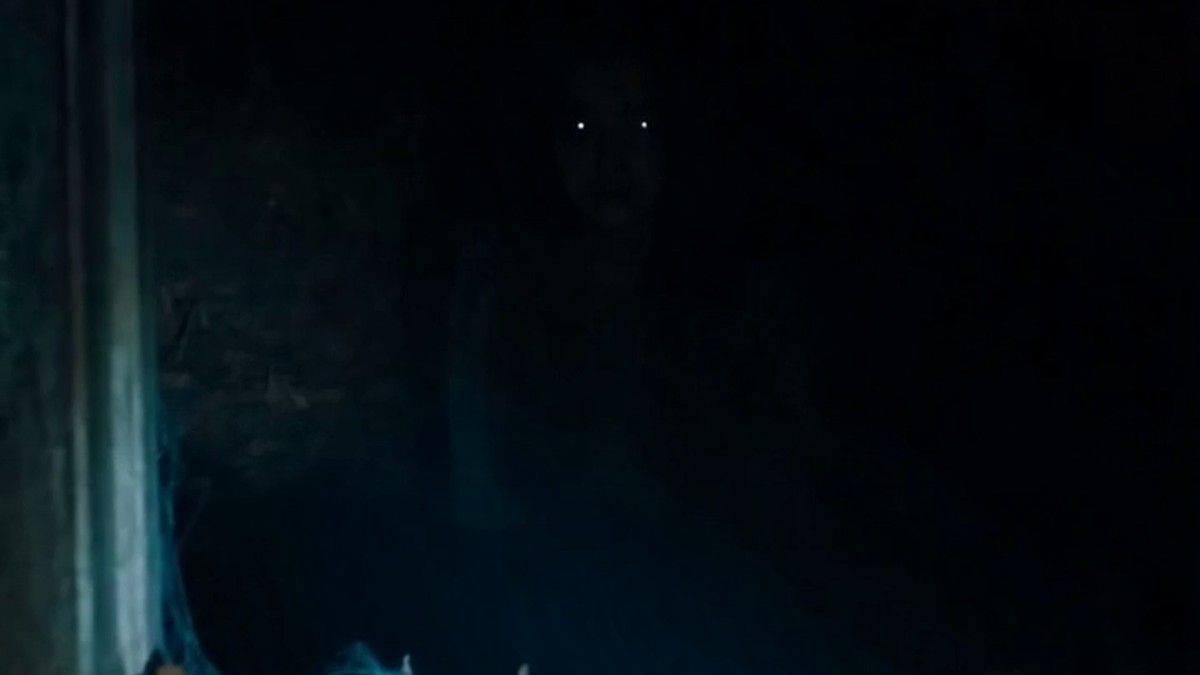
The figure moved into the light.
First the eyes. Then a dark strand of hair falling across a pale face.
Then — the scar.
Small. Faint. Sitting just above the eyebrow.
The same scar his daughter got the summer she flew off her bike and hit the pavement laughing.
His vision blurred.
“Emma…” The word barely made it out of him.
Her mouth opened.
And the single word she spoke cracked his entire world straight down the middle.
“Dad…”
He couldn’t move.
Not a single muscle. Not a single inch.
She stood there at the edge of the tree line, thin as winter, wearing a coat two sizes too big — khaki, canvas, someone else’s — and her hair was longer than he remembered, tangled where it fell across her jaw. But the eyes were the same. Exactly the same. That particular shade of amber that her mother used to call *October light*.
Thomas had not heard that word — *Dad* — in fourteen months, three weeks, and two days.
He’d counted.
God help him, he’d counted every single one.
Buddy reached her first. The old dog pressed his massive head against her thigh and just stayed there, trembling, and Emma’s hand came down and found the space behind his ear the way it always had — automatic, muscle memory, the gesture of someone who had loved that dog her whole life.
That was when Thomas’s legs finally unlocked.
He crossed the dead grass in five steps and pulled her against him, and she was real — God, she was *real*, solid and shaking and cold straight through to the bone — and something that had been locked inside his chest for over a year simply broke apart.
He didn’t say anything. He couldn’t.
Neither did she.
They stood there while the wind moved through the pines, while Buddy pressed himself against both of them, while Maya turned quietly away and let them have it.
—
It took a long time before either one of them could speak.
They went inside the cabin. Maya had a small camp stove in her pack and she heated water without being asked, found a tin of soup somewhere and set it on the flame, and that small, ordinary act of kindness — soup, heat, light — made the whole impossible thing feel almost real.
Emma sat on the floor with her back against the wall, both hands wrapped around the tin cup Maya had pressed into them. Buddy lay across her feet.
Thomas sat three feet away, close enough to reach her, far enough to let her breathe.
He’d learned, in the days after she vanished, that he’d been too close all along. That was what the investigators had said, gently. Then less gently. That sometimes teenagers run toward something. Sometimes away. That sometimes love is the pressure that breaks the glass.
He hadn’t believed them then.
He was trying, right now, to remember that.
“I didn’t know if you’d come,” Emma said. Her voice was rougher than he remembered. Something had scraped the softness out of it. “I didn’t know if you’d still be… looking.”
“I never stopped.”
She looked at him over the rim of the cup. “Mom said—”
“I know what your mom said.” He kept his voice level. Barely. “She was wrong.”
Emma nodded. Slowly. Like she’d needed to hear it confirmed out loud, by him, in person, before she could completely believe it.
Then she said: “I need to tell you something. And I need you to not react until I finish.”
Thomas nodded.
She looked down at Buddy. Her thumb moved back and forth across his ear.
“I didn’t leave on my own.”
—
The story came out in pieces.
A man named Carver. Early thirties, maybe late twenties, the kind of face that didn’t stick in your memory on purpose. He’d been at the coffee shop on Route 9 where Emma worked weekends. Then he’d been at the library. Then outside her school.
Never threatening. Never weird. Just *there*, consistently, at the edges of her days, until the edges blurred and she didn’t notice the pattern anymore.
He’d told her he was a filmmaker. That he’d seen something in her.
She was sixteen.
She knew exactly how it sounded now. She said so herself, jaw set, not apologizing for it — just naming it plainly, the way someone names a wound to stop it from controlling them.
“He said he had contacts in New York. That I had a real shot. That I just needed to disappear from my regular life for a few weeks so we could build a portfolio before—” she stopped. “Before my father, specifically, could shut it down.”
Thomas kept his face still.
“He said you’d already been contacted by the production company. That you’d called them and threatened to sue. That you were trying to control me.” She looked up. “I believed him. I actually believed him. Because we’d been fighting so much that year, and it just—” She exhaled hard. “It fit. That’s the worst part. It just fit into the story I already had about you.”
The fire from the camp stove made shadows move on the walls.
“Where is he now?” Thomas asked.
Emma’s expression shifted. Something tightened at the corners of her eyes.
“That’s the other part.”
—
Carver hadn’t taken her to New York.
He’d taken her north. Three hours north, to a property he owned or rented or had access to — she was never sure which. There were two other girls there when she arrived. One had already been there for months.
The filming was real. That part was real. But it wasn’t what he’d described, and by the time she understood what it actually was, her phone was gone and she had no car and the nearest town was twelve miles through forest she didn’t know.
She’d spent four months learning the roads. Learning his schedule. Learning which window didn’t latch all the way.
She’d gotten out sixty-three days ago.
She’d been moving south ever since, staying off main roads, sleeping in structures like this one — abandoned places, hunting cabins, seasonal camps. She’d broken into a gas station and taken food. She wasn’t sorry. She’d stolen a coat from a Laundromat. Also not sorry.
She’d carved her name into the wall of this cabin two weeks ago.
“In case something happened to me,” she said quietly. “In case someone came looking. I wanted there to be proof I’d been here.”
Maya made a sound from the far corner of the cabin. Something she swallowed before it became words.
Thomas stared at the letters carved into the wall.
*Emma.*
Still sharp. Still raw.
She’d been trying to be found. Even when she couldn’t call out loud, she’d been leaving marks. She’d been dragging her name through every dark place she passed through, trying to make herself visible.
He thought about fourteen months of searching. The private investigator who’d quit after six. The sheriff who’d said *runaway* like it was a door closing. The online forums with their theories and their cruelty. The night he’d driven back out to Route 9 at three in the morning and just parked in the coffee shop lot and sat there because it was the last place she’d definitely been and he didn’t know what else to do with himself.
“There’s more,” Emma said.
He waited.
“Carver knows this area. He has people who come up here. Hunters, he calls them, but they’re not—” She stopped. Chose the word carefully. “They watch for people moving through. Girls moving through. Moving south. That’s why I’ve been staying in places like this — off the roads, away from towns.” She looked at Thomas steadily. “He knows I’m out. He figured it out within a week. I think he’s had people working north-to-south for weeks now.”
The wind hit the side of the cabin hard enough to shudder the door in its frame.
Buddy lifted his head.
“That’s why I wasn’t sure, tonight, if you were actually you,” Emma said.
Thomas pulled out his phone.
No signal.
Of course. They were four miles up a fire access road, deep in the Catskill fringe, at eleven o’clock on a November night.
Maya was already on her feet. “My truck has a satellite radio. I can get to the road in twenty minutes.”
“Don’t go alone,” Thomas said.
“I’ll be fast—”
“Maya.” His voice came out harder than he intended. “Do not go alone.”
She stopped.
Buddy stood up.
All three of them looked at the door.
—
The sound was subtle. That was what made it wrong.
A careful footstep. Then another. Someone moving slowly enough to keep the leaves from crackling too loudly. Someone who knew how to move through woods at night.
Someone who had done it before.
Emma went absolutely still.
Thomas moved in front of her without thinking — one step, two — putting himself between her and the door. Maya pressed back against the far wall. No one spoke. The camp stove ticked quietly in the corner, indifferent.
Thomas looked around the room. One door. One window on the south wall, the glass filmed with grime. He crossed to it in three silent steps and tried to see past his own reflection into the dark outside. Nothing. Just trees and the faint silver of the trail running downhill toward the road.
The footsteps stopped.
Then something scraped against the exterior wall — slow, deliberate — like a hand trailing along the boards.
Emma made a sound low in her throat. Not a scream. Smaller than that. The sound of someone who has already learned that screaming doesn’t help.
Thomas picked up the only thing near him — a length of rusted pipe he’d noticed on the floor when they came in, left by whoever had last used this place. It was cold and heavier than it looked. He held it at his side and did not move.
Three seconds.
Five.
Ten.
Then a knock.
Two short. One long.
Emma exhaled — a sound that was half sob and half something else, something almost like relief — but Thomas kept the pipe where it was and stayed in front of her, because relief had gotten people killed before, and he was not going to be moved by sound alone.
“That’s Dee,” Emma whispered. “She got out the same night I did. We got separated about a week ago. I told her — if we ever got split up, we’d find each other at the marked places. The carved-name places.” She touched his arm. “That’s our signal.”
“Could he know it?”
A beat. Emma’s jaw tightened. “No. We made it up between us. He never heard it.”
Thomas held still for another three seconds. Then he stepped aside — one step only — and kept the pipe in his right hand as Emma moved to the door and lifted the latch.
The girl on the other side was younger. Fifteen, maybe. Red hair, gray-pale, a split lip that had healed crooked. She looked at Thomas and the pipe in his hand and at Maya pressed against the wall, and she made the fastest threat-calculation Thomas had ever seen on a teenager’s face — and then she looked at Emma, and she didn’t run.
Thomas slowly lowered the pipe.
“You found people,” the girl said.
“I found my *dad*,” Emma said. And she said it like it still surprised her. Like she was still adjusting to it being true.
Dee’s face did something complicated and young and devastating.
Then she stepped inside.
—
They moved fast after that.
Emma and Dee each carried what little they had. Maya took point on the trail back to the truck, Thomas brought up the rear with Buddy, and they moved through the dark without flashlights because Emma said lights were worse — they announced you from a quarter mile.
She knew things now that she hadn’t known before. Thomas didn’t know yet how to feel about that. Grief and pride and fury at the necessity of it all tangled together somewhere under his ribs, and he let them tangle, because the only thing that mattered right now was getting to the truck.
They were forty yards from the trailhead when Buddy stopped.
Not the slow, deliberate stop from before. A hard stop — weight dropping back onto his haunches, head swinging left toward the tree line running parallel to the trail.
Thomas put his hand on Emma’s shoulder. She froze. The signal passed back to Dee, to Maya, without a word.
Silence.
Then — movement in the brush. Close. Twenty feet, maybe less. Something big enough to push through undergrowth and not bother trying to hide it. Footsteps that had given up on being careful.
Thomas still had the pipe.
He stepped to the left, putting himself between the sound and Emma, and he raised it. His hands were steady. He was surprised by that. Some part of him that had been waiting fourteen months to be useful had simply taken over.
The shape resolved out of the dark — a man, heavyset, wearing a canvas jacket, stopping dead when he saw them grouped on the trail. He looked at Thomas. At the pipe. At Buddy, who was very still and making no sound at all, which was somehow worse than a growl.
The man took one step back.
Then he turned and walked quickly back into the trees.
No one spoke for five full seconds.
“Go,” Thomas said.
They went.
—
Maya got the satellite radio working two minutes after they reached the truck. She had a name — a state investigator she’d worked with before, someone who answered even at this hour, someone whose voice went sharp and certain the moment she started talking. Thomas gave her everything Emma had told them: Carver’s name, the property to the north, the network of people running surveillance south through the Catskills. The investigator asked three tight questions and said she was moving.
Thomas sat in the back seat with Emma on one side and Dee on the other and Buddy across all three of their laps, enormous and warm and completely certain that everything was now exactly as it should be.
The investigator arrived with two other vehicles just before one in the morning. She told Thomas, briefly and without softening it, that Carver had been on their radar for seven months — a federal task force, multiple jurisdictions, building toward charges that required more than surveillance. Emma’s account, and Dee’s, provided the witness testimony that closed the gap. Two more girls came forward within the week once the arrest was made. His people — the ones running the roads, the ones moving through the Catskills — were picked up in the same operation, a coordinated sweep that Thomas only learned the details of later, reading a paragraph in a county paper he’d saved without quite knowing why.
Thomas was in the hallway of a county building when they told him Carver was in custody. He nodded. He said thank you. He went and found Emma in the waiting room, sitting with Dee and a victim’s advocate, holding a paper cup of terrible coffee.
She looked up when he came in.
He sat down next to her.
Neither of them said anything for a long time.
Outside, the sun was coming up. That pale, clean, November light that has nothing to prove — no warmth to it, no promise, just the simple fact of the darkness ending.
“I have so much to tell you,” Emma said finally. “Not— not the bad stuff. The other stuff. Things I figured out. Things I thought about.” She glanced at him sideways, the way she used to when she was small and testing whether he was in the mood to listen. “It’s a lot.”
“I’ve got time,” Thomas said.
He meant it the way a man means something when he’s been shown, clearly and at great cost, exactly what *no time* looks like.
She leaned her head against his shoulder.
Buddy, lying across their feet, let out one long breath.
And Thomas sat there in the thin morning light, his daughter warm against his arm, alive and wrecked and extraordinary, and he thought: *start over. Start everything over. From here.*
The cup in his hand had gone cold.
He didn’t move.