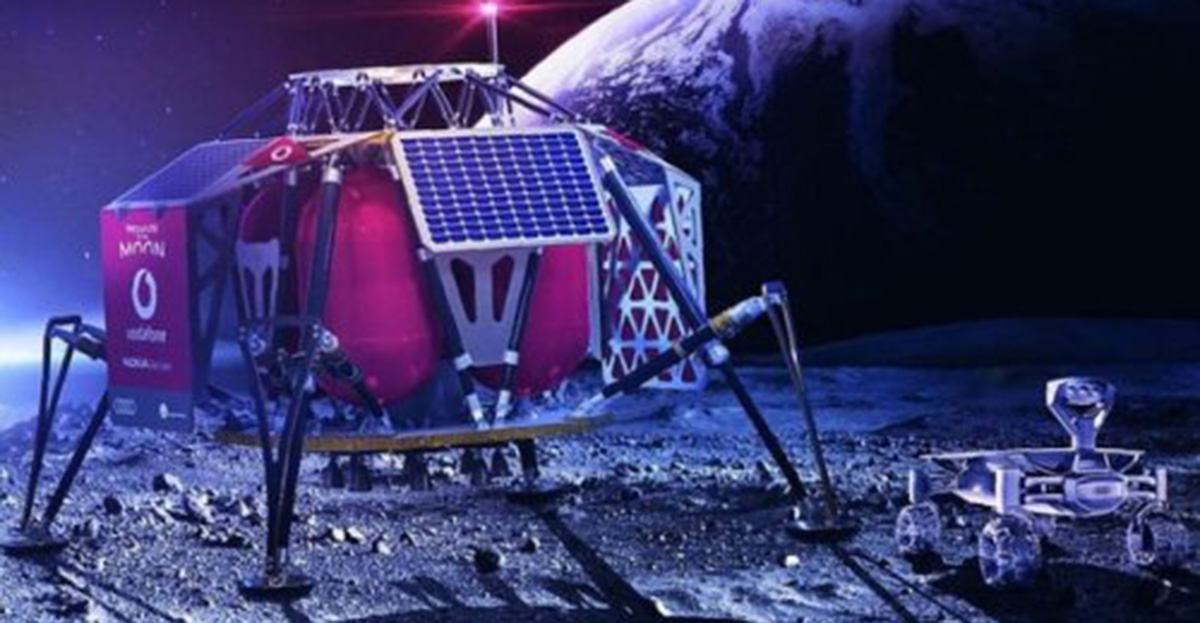
In terms of providing cellular coverage, telecommunications companies still have a lot of work to do on Earth. However, this does not prevent Vodafone and Nokia to plan the deployment of the first 4G network on the Moon. To an ordinary person, this idea may seem as pointless as opening a bar somewhere on Pluto. Nevertheless, this project has a very serious purpose, consisting in communication support for the automated mission PTScientists, which is scheduled for launch in 2019.
When the Apollo 17 lander hit the moon’s surface on Dec. 1, 1972, the astronauts communicated with Earth using an analog Unified S-Band radio link capable of only 51.2 kilobits per second. Nevertheless, this was still fast enough to transmit black and white images of the lunar surface in standard TV resolution.
Today, we live in the era of high-quality digital video, which requires much higher speeds and more bandwidth. This has become something of a problem for the PTScientists, a group of scientists and engineers based in Germany, who are about to launch their mission to the moon next year using a SpaceX Falcon 9 rocket.
The goal of this private lunar mission is to land the Autonomous Landing and Navigation Module (ALINA) on the Moon at a location near where the Apollo 11 mission landed. After landing, the ALINA module will release two Audi lunar Quattro rovers to the surface, which will explore the adjacent surface area and approach the Apollo 11 mission’s Lunar Rover.
How close to the landing site of the Apollo 11 mission the Audi lunar rovers Quattro will be able to approach is still an open question. After all, all lunar landing sites have been declared historic monuments by the U.S. government and access to these sites is restricted. The most important of these monuments is considered to be the landing site of Apollo 17 and NASA requires that any lunar mission would have landed no closer than 2 kilometers from this place.
Also note that the Audi lunar Quattro vehicles are small and lightweight, weighing no more than 30 kilograms. This means that their power sources can not give the amount of energy required to transmit the signal, which will be confidently received by the antennas of the network of distant space communications. To solve this problem, Nokia Bell Labs specialists began to develop the most compact and lightweight base station Ultra Compact Network, which will weigh only about one kilogram. This station will deploy the first 4G cellular network on the Moon, operating at a frequency of 1800 MHz, which will connect the moon rovers to the landing module, which, in turn, will transmit the data received from the moon rovers to Earth. Communication will be done using standard Internet Protocol (IP), and the data transfer rate in this network will range from 100 Mb/s to 1 Gb/s.
According to available information, the mobile lunar network will allow broadcasting HD video from the lunar surface, which will be available to the whole world through the server of the PTScientists group. “Humanity, which sooner or later will leave ‘Earth’s cradle,’ must first prepare the entire infrastructure outside our planet,” PTScientists wrote, “During this lunar mission, we will test and verify the operation of elements of the first dedicated space communications system. And the use of LTE technology will enable high data transmission speeds at relatively low energy costs.”