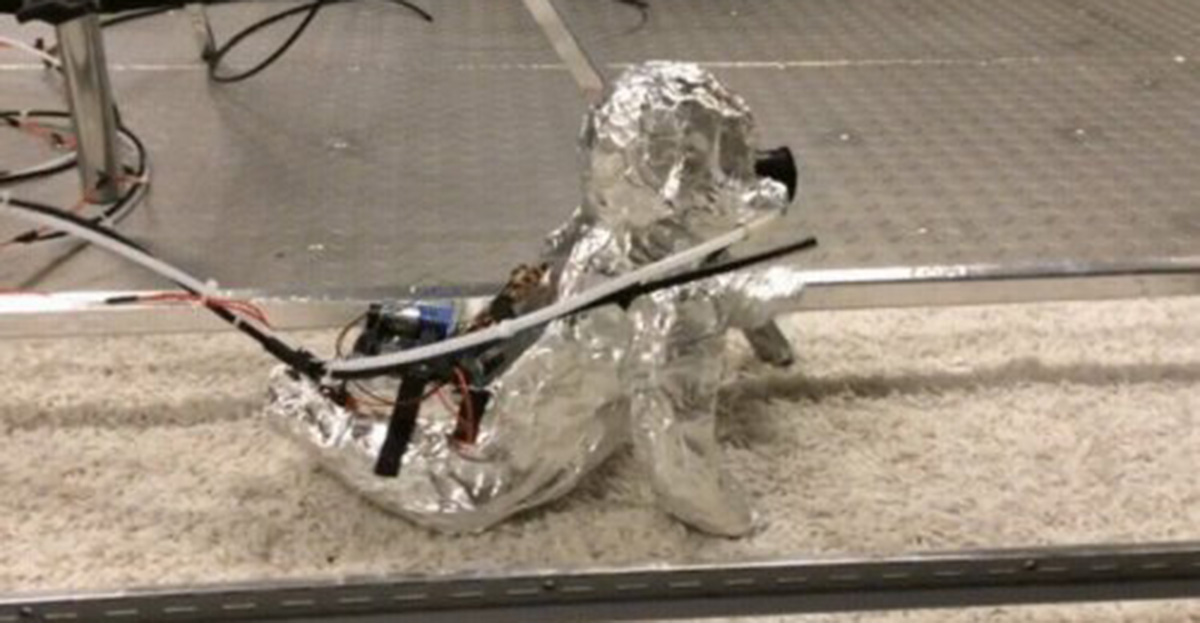
It is known that during the infancy stage, the human body forms and develops a number of systems and functions that are used by the body throughout the rest of its life. These systems include the body’s immune system, which then protects it from bacteria, viruses and other “evils”. It turns out that infants unknowingly start to train this system from an early age and do it in a very original way, crawling on their knees and thus raising impressive clouds of dust, bacteria, fungi, etc. And the scientists were able to figure this out with a creepy robot baby, which is shown “in all its glory” in the above photo.
This legless robot baby was created by researchers from Purdue University with the sole purpose of finding out the extent to which a crawling baby affects its environment. During the experiments, the scientists took an ordinary carpet from one of the houses and launched their robot on it. On a second section of the same carpet was walked by an ordinary adult, and in both cases, the scientists used a laser device to measure the concentration of dust and dirt clouds raised by the movements.
The measurements showed that a crawling child picks up twenty times the volume and concentration of the clouds, so he breathes in four times more different “aerosol particles of biological origin” per kilogram of live weight than an adult in the same room. This is further aided by the fact that a crawling child is closer to the floor and breathes mainly through the mouth, which allows particles to enter the lungs unhindered.
All of the above sounds like a threat to a child’s health, but in fact the opposite is true. Bacteria getting inside the growing and developing body activates and trains its immune system. And we get a kind of paradox – the dirtier the environment, up to certain limits, of course, the healthier it will be as an adult.
This hypothesis, which is called the “hygiene hypothesis,” has already been confirmed to some extent by the observation that children raised on farms, in homes with pets, etc., are much less likely to have autoimmune disorders than children raised in almost ideal “sterile” conditions. And this explains why children raised in highly developed countries are more likely to have asthma and allergies than children born and raised in developing countries.
Unfortunately, many of the scientists refuse to develop the “hygiene hypothesis” further because the hypothesis may be misunderstood by the general public. However, proponents of this hypothesis should not go to extremes either, their children should keep clean and visit pediatricians as usual. For normal development a child should only be allowed to crawl around and explore the world around him, as they say, in the usual way.