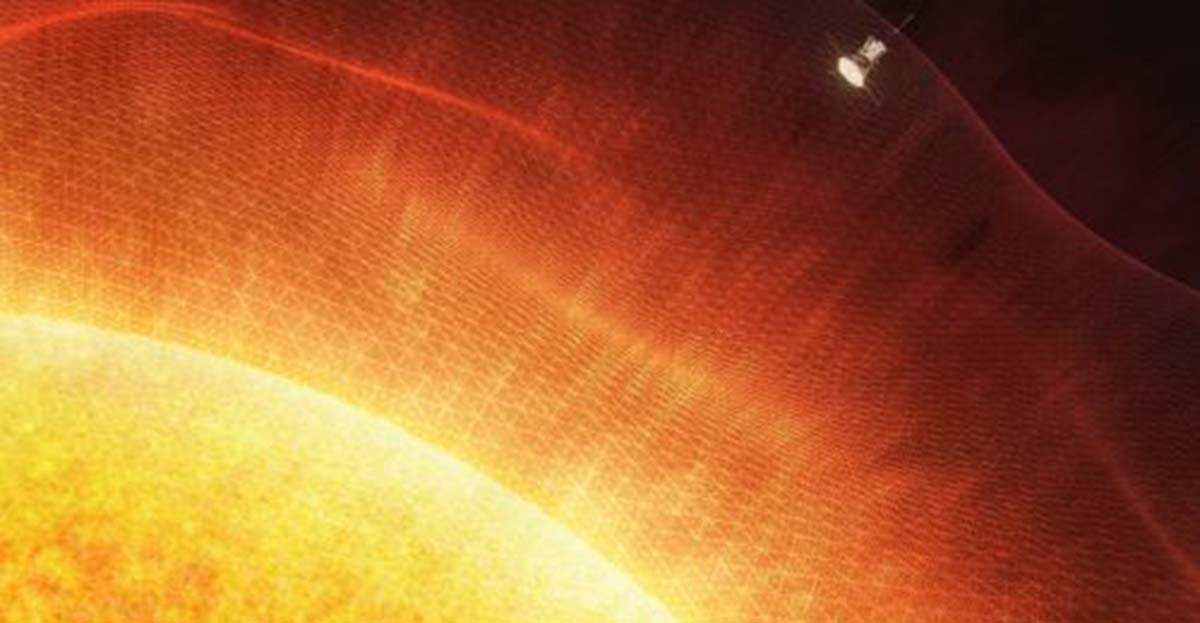
The Solar Parker Probe was launched in August 2018 to study the Sun and its processes, in particular the formation of solar winds. Only recently, the spacecraft made its first-ever “touchdown,” passing through the upper atmosphere, called the solar corona. This, in turn, allowed the spacecraft to gather a wealth of information on subatomic particles and magnetic fields in this region, opening a new chapter in the solar sciences and our understanding of how the solar system was once formed.
The study of solar winds has long been the only way to study how heat and other forms of energy pass through the upper layers and through the solar atmosphere. Within the atmosphere, these winds accelerate from subsonic to supersonic speeds, and knowing exactly what processes are involved can tell us a lot about the Sun itself and about a host of other trains in the universe.
As a reminder to our readers, the Solar Parker Probe set many new records during its journey to the Sun. By accelerating to 586,864 kilometers per hour, it became the fastest spacecraft in history. It did so last month as it completed its 10th of 24 planned rotations around the Sun. With each revolution bringing the craft closer and closer to the surface of the Sun, it will eventually pass 6.1 million kilometers from our star’s surface.
During its first contact with the solar atmosphere, the probe immediately encountered features called pseudostreamers, which are large formations clearly visible during solar eclipses. The conditions in these pseudostreamers closely resemble the so-called “eye of the hurricane,” a relatively calm region with slow fluxes of particles formed by magnetic fields.
The second significant result of the Solar Parker Probe’s first rendezvous with the Sun is the acquisition of more information about unusual zigzag structures in the solar streams, called loops. As this mission showed back in 2019, the number of loops increases as they approach the surface of the Sun, while their size decreases. However, how and by what these loops begin to form remains unknown to this day, but fortunately the probe managed to capture one of the points of loop formation, located near the visible boundary of the surface, called the photosphere.
Scientists have already discovered that the loops appear at points of so-called magnetic tubes that emerge from the depths of the photosphere. It is also suspected that exactly the points of the magnetic tubes are the points of formation of fast solar winds, which are accelerated by the magnetic field.