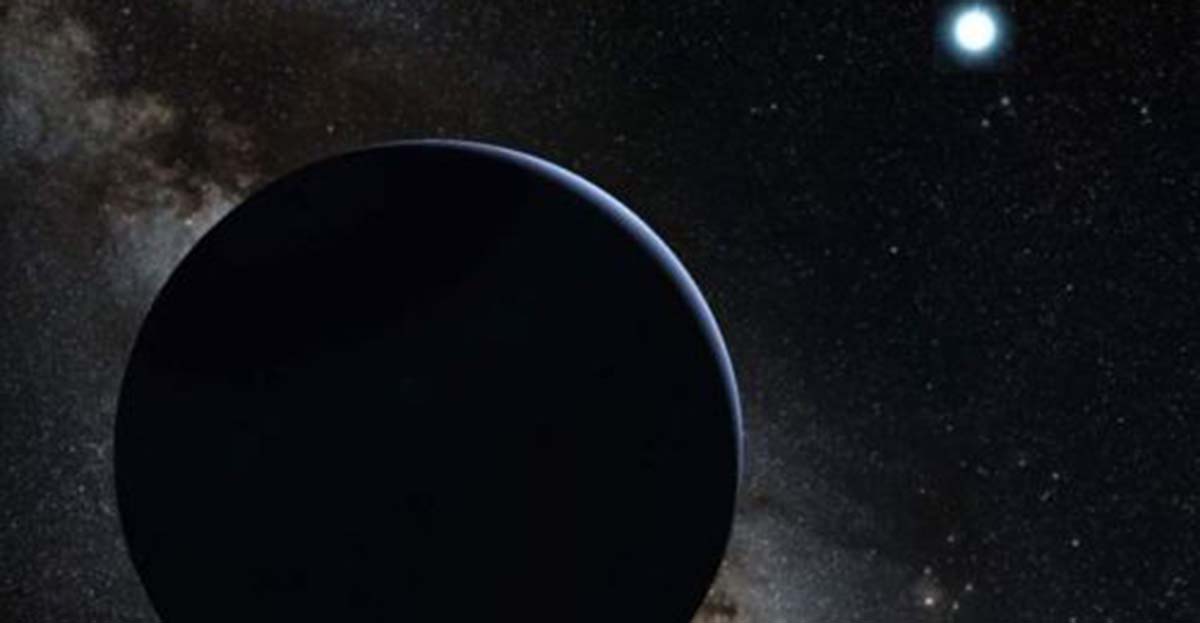
Astronomers have long suspected that our solar system may include an unknown ninth planet, orbiting the Sun at a distance much greater than the orbital distance of Pluto. However, so far no one has been able not only to observe the Ninth Planet directly, but even to determine its presumed location.
Michael Rowan-Robinson, an astronomer at Imperial College London, has recently completed a re-analysis of data collected back in 1983 by the Infrared Astronomical Satellite (IRAS). This apparatus was a space telescope operating in the long-wave infrared, and in the array of data it collected over 10 months three infrared point sources were detected, which by several parameters could be the ninth planet.
However, Michael Rowan-Robinson considers it highly unlikely that the point sources he found are the first direct detection of a ninth planet. But this data can be used now to model and determine the approximate location of Planet Nine at this time.
Collecting data with clues as to where the ninth planet might be now could allow astronomers to make a series of observations with the most sophisticated astronomical instruments available, discover this elusive planet, and close the question of its existence once and for all.
Let us remind our readers that in 2016 a paper by astronomers from the California Institute of Technology was published in which it was suggested that Planet Nine might exist. As evidence, the scientists cited cases of small objects in the Kuiper Belt whose orbits were distorted by the gravitational influence of some large space object.
The characteristics of the distortions have led scientists to speculate that if a ninth planet exists, it must be 5 to 10 times the mass of Earth and it must orbit the Sun at a distance of 400 to 800 astronomical units (AU). For comparison, Pluto’s orbit is 40 AU away from the Sun.
The reasons Planet Nine has not yet been confirmed to date is that the planet is very far away, it is relatively small, and its surface reflects very little sunlight.
Over a 10-month period in 1983, the IRAS instrument produced a survey that covered 96 percent of the entire night sky. In this data, Michael Rowan-Robinson found three sightings of an unknown moving space object, dated June, July and September 1983. Unfortunately, it is still very early to say that the spacecraft has actually seen the ninth planet. The quality of the pictures taken can by no means be called high at this time, and secondly, the pictures were taken in a region of low Galactic latitude, where there is a strong glow from fibrous clouds of cosmic gas, which glow brightly in the long-wave infrared and create interference to the picture.
But assuming the accuracy of the data collected by the IRAS spacecraft, scientists will have to reconsider some data about the ninth planet. According to the calculations of Michael Rowan-Robinson, the mass of the planet is 3-5 times the mass of the Earth, and it rotates at a distance of about 225 AE from the Sun. And this data, in turn, gives us a good direction to conduct both the real search for the planet, and the search in the data sets collected by other astronomical instruments.