If you like looking at images of galaxies of unusual shapes and sizes, the best place to go is the Arp Catalogue of Peculiar Galaxies, created by astronomer Halton Arp in 1966. This catalog features 338 exotic galaxies, galaxies that interact with each other and produce incredible effects. In laying the groundwork for his catalog, Halton Arp believed that the collected specimens were excellent “laboratories” for studying the physical processes and cosmological phenomena that distort the perfect shapes of elliptical and spiral galaxies.
Halton Arp’s view at the time was fundamentally different from that of other astronomers, who considered distorted, bizarrely shaped galaxies to be lower-order phenomena. From their point of view, the universe was the embodiment of order and harmony, but Halton Arp believed that the universe had a very different appearance, it was all literally filled with “violence, pain and birth.
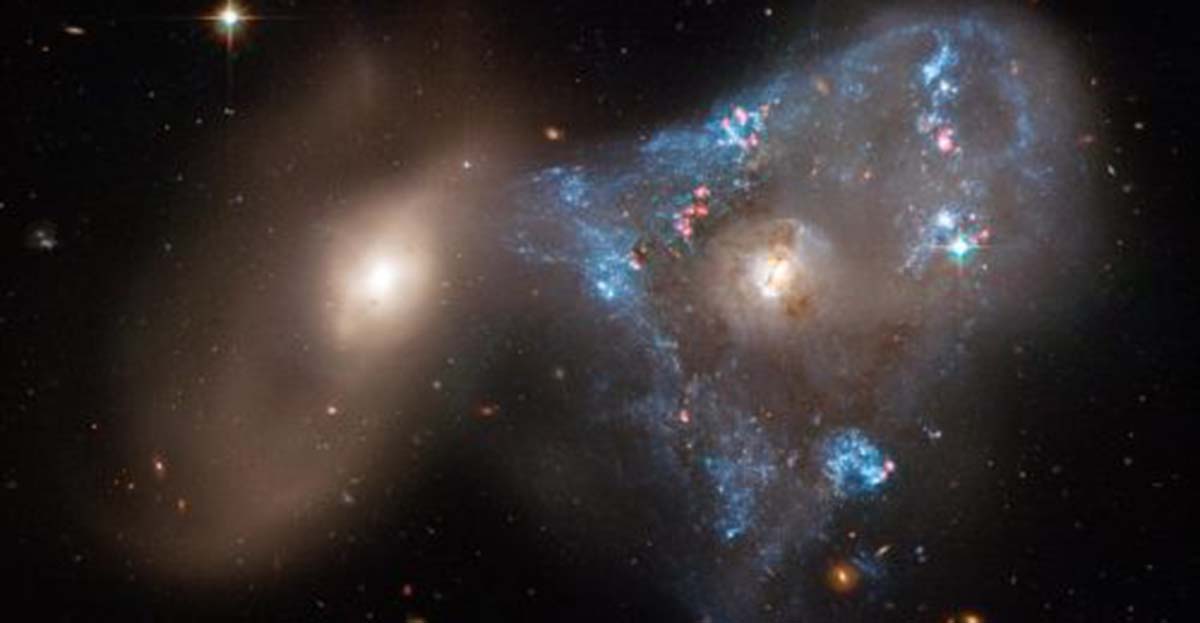
One of the items in Arp’s catalog, is object Arp 143, whose image shown here was taken with the Hubble Space Telescope. The object consists of two galaxies, NGC 2445 (right) and NGC 2444 (left), which collided anteriorly some time ago. As a result of this collision, the galaxy NGC 2445 acquired an atypical triangular shape and the rate of new star formation processes in its interior accelerated many, many times over.
Astronomers believe that after the collision the galaxies have already passed through each other, playing at this time in a kind of galactic “tug of war”. The galaxy NGC 2444 won this competition, though it lost its original shape, but it pulled all of its gas from the bowels of the galaxy NGC 2445, which is the fuel for the star-forming process.
“In our observations, we have repeatedly observed how the head-on collision of two galaxies creates ring structures of young and nascent stars,” says Julianne Dalcanton, of the University of Washington in Seattle, “What is strange about Arp 143 is that it is a triangle, not a ‘tsunami’ ring of young stars. The reason for this anomaly is that the two galaxies are still gravitationally connected and they are quite close to each other. And this gravitational relationship has distorted the ring structure of young stars between 50 and 100 million years old, turning it into a triangle”.