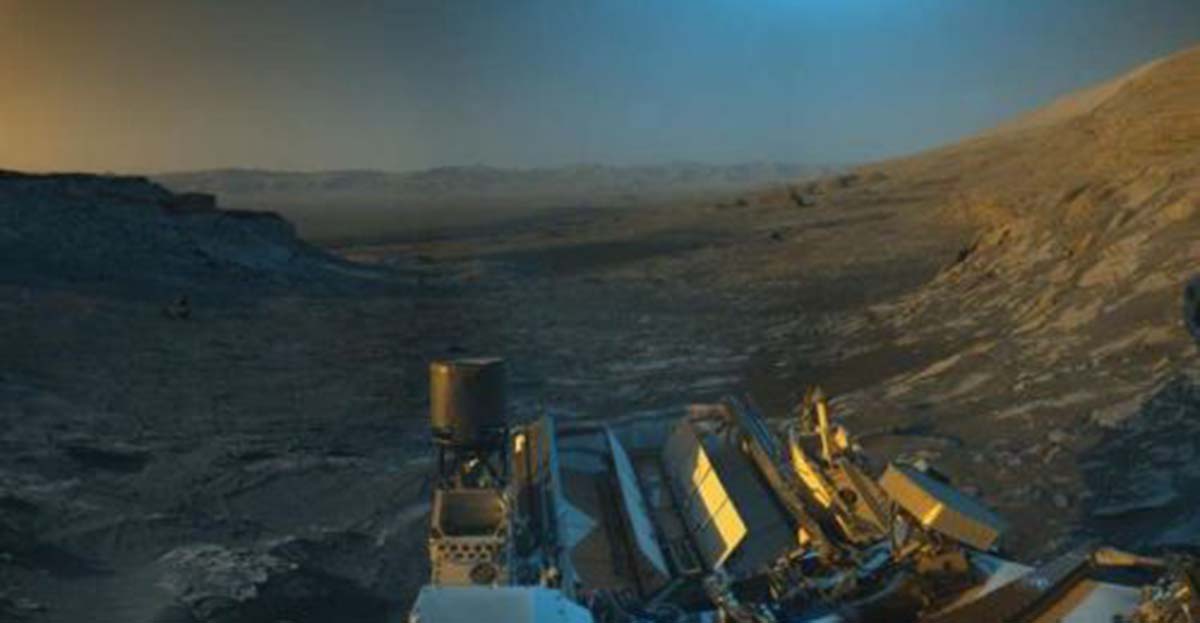
Not long ago, the notorious Curiosity rover took some remarkable images from its current location on one of the slopes of Mount Sharp. Some of the mission’s science team members were so impressed with the beauty of the Martian landscape that they combined two versions of black-and-white images taken at different times of day and recreated colors that were more or less similar to the real colors. And the result is a colorful “postcard” from the Red Planet.
The Curiosity rover takes a 360-degree panoramic picture every time it completes another leg of its journey. In order to facilitate the transfer of data to Earth, the images are taken at a fairly low resolution and stored in a format with the highest level of compression, and therefore in minimal quality. However, after seeing the grandeur of the Martian landscape that opened to the rover, the mission team decided to give the apparatus commands, according to which were made and transmitted to Earth additional images with the maximum quality available to navigation cameras.
The images were taken on November 16, 2021 (on the 3299th Martian day, or Sol, of the mission) from the same position at 8:30 and 16:10 local Martian time. The time difference provided enough difference in lighting and contrast to highlight even the smallest details. The morning scene was painted in blues and blues, while the evening scene was painted in oranges, and the combination of these colors produced shades of green that greatly enlivened the resulting image.
In the center of the image, we can see the beginning of one of the slopes of Mount Sharp, the 5-kilometer-high mountain where the rover arrived back in 2014. We remind our readers that Mount Sharp is almost in the center of Gale crater, 154 kilometers in diameter. The shaft of this crater, formed by the impact of a large cosmic body, is about 2.3 kilometers high and can be seen on the horizon from a distance of 30-40 kilometers. And the mountain ridge in the far background of the image is part of the Gale crater rampart.
At a distance of 400-800 meters from the rover can be seen area “Sands of Forvie”, covered with sand ripples. And the figure on the right side of the image is a rocky formation “Rafael Navarro Mountain”, which got its name after one of the members of the scientific team of the mission, who died earlier this year.