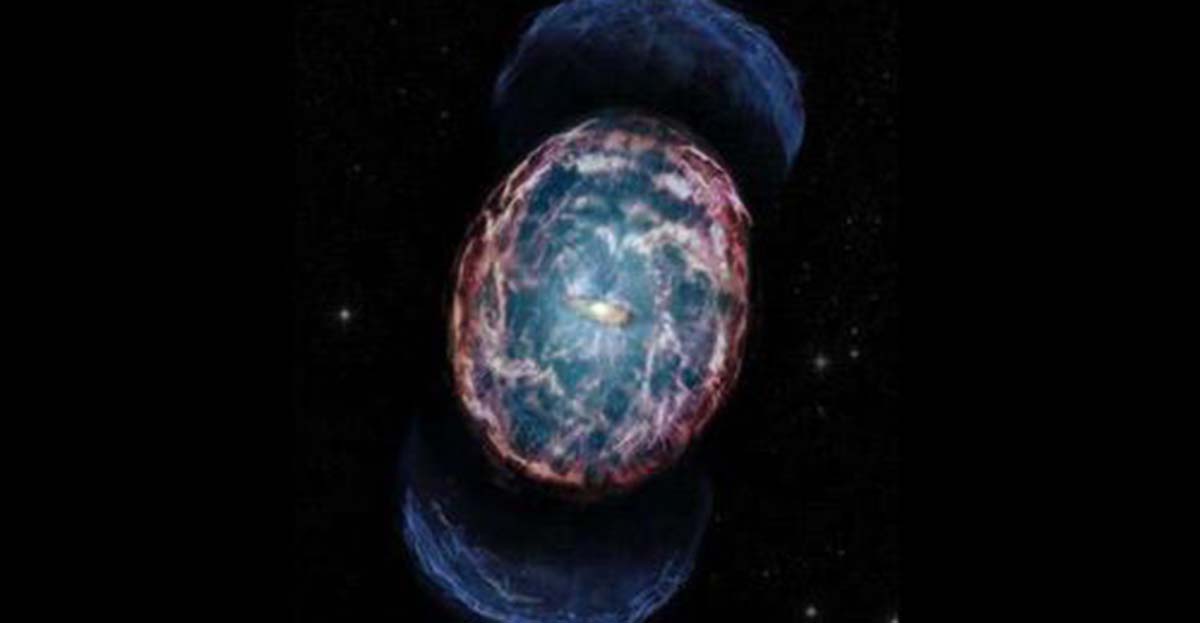
For the first time in the history of astronomy, a team of scientists led by scientists from Northwestern University managed to see firsthand the relatively fresh traces of a rare type of cosmic explosion, the kilonova explosion. This type of explosion occurs when two neutron stars, known to us as the compact but densest objects in the Universe, collide. And the actual collision generates an explosion that is a thousand times brighter than a fairly ordinary supernova explosion.
The object of interest from scientists was the notorious space object GW170817, which is a trace of the Kilonova explosion. Previously, this object had emitted a narrow stream of high-energy particles, the so-called jet. But, three and a half years after the collision, this flux disappeared, and astronomers were able to see a new and rather mysterious source of X-ray radiation at the site of the explosion.
As an explanation for what was observed, it was hypothesized that the expanding cloud of neutron star remnants produced a shock wave similar to the sonic boom from an airplane passing through a sound barrier. This shock wave heats the surrounding matter, which begins to glow in the X-ray range. There is also an alternative explanation, according to which X-rays are emitted by matter approaching the event horizon of a black hole formed by the collision of neutron stars. Note that either of the two possible scenarios would be the first observation of such a phenomenon.
We remind our readers that in August 2017 event GW170817 went down in history as the first case of neutron star collision and merger recorded and identified using gravitational waves and electromagnetic radiation (light). And in the following years, astronomers have studied this phenomenon in different ranges of the electromagnetic spectrum.
Since early 2018, using the Chandra X-ray Observatory, astronomers have observed emissions of X-ray fluxes from a stream of particles and matter moving at nearly the speed of light. Over time, the flux gradually slowed and became wider, and between March 2020 and the end of this year, the decrease in X-ray brightness almost stopped and stabilized at a certain level.
The stabilization of the X-ray brightness was what pointed astronomers to the presence of another source of this type of radiation. And the nature of this source, whether it is afterglow after the explosion or a black hole, scientists have yet to determine in the future.
In order to dot all the i’s, scientists will have a long time to follow the object GW170817 in the X-ray and radio bands. If all this is an afterglow effect, the X-ray and radio streams will become brighter over the next few months or years. But if the cause of what is happening is matter falling into the black hole, the X-ray levels would either have to remain constant or decrease dramatically over a short period of time, with little or no radio emission coming from the black hole region.
“Either answer would have far-reaching implications,” the scientists wrote, “In the first case, it would indicate that black holes may not form in all cases of neutron star collisions. And the other option would give astronomers the opportunity to study the peculiarities of matter absorption by a black hole only a few years after its formation.”