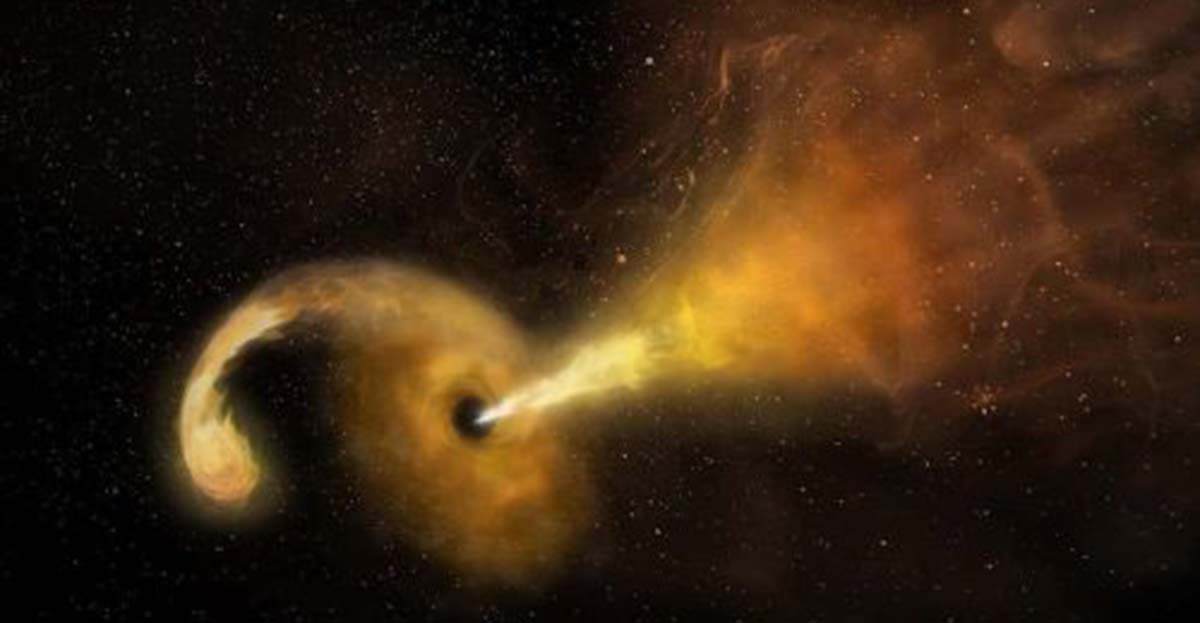
A group of astrophysicists has performed a series of calculations to calculate the number of black holes in the observable part of the Universe. According to these calculations, the number of black holes exceeds 40 quintillion (40 billion billion billion, or 40 000 000 000 000 000 000) and this is only the number of black holes in the so-called stellar mass range. What is interesting is that these black holes account for only 1 percent of the total amount of matter in the universe.
In their research, the scientists used an evolutionary astrophysical modeling code called SEVN and an extensive set of raw data that included data on the metallic properties of stars, the rate of new star formation processes and the size of stars in all known galaxies.
“What makes this work unique is the use of a detailed model of stellar evolution combined with the latest knowledge regarding star formation processes, their metallic properties, etc.” – says Alex Sicilia, an astrophysicist at Italy’s SISSA Institute, “All of this together has given us data on the function of stellar black holes in cosmic history.”
As a reminder to our readers, stellar-mass range black holes are the smallest members of their class. Their masses are usually in the range of a few to a few hundred solar masses, and they are the most common in the vastness of the universe. Astronomers also know about supermassive black holes, which are usually located in the central regions of massive galaxies and keep stars, planets and clouds of cosmic gas within the galaxy by their gravity.
And in conclusion, these studies were made to solve the mystery of the formation of supermassive black holes, because scientists have not yet been able to detect any black hole with an intermediate mass lying between stellar and supermassive black holes.
“We believe that some of the largest stellar black holes may be the “heavy seeds” from which supermassive black holes develop,” scientists write, “But this is questioned by the fact that primordial supermassive black holes existed in prehistoric times. During their existence they could not fundamentally have time to gain their mass in traditional ways, and all this will be the subject of our further research.”