A group of astronomers studying archive data collected by the Hubble Space Telescope has discovered a previously unknown ancient mysterious object. Further study of this object will explain how in the depths of “dusty” galaxies, in which active star formation processes may occur quasars, supermassive black holes, surrounded by disks of matter and spewing into space streams of particles and radiation of various types.
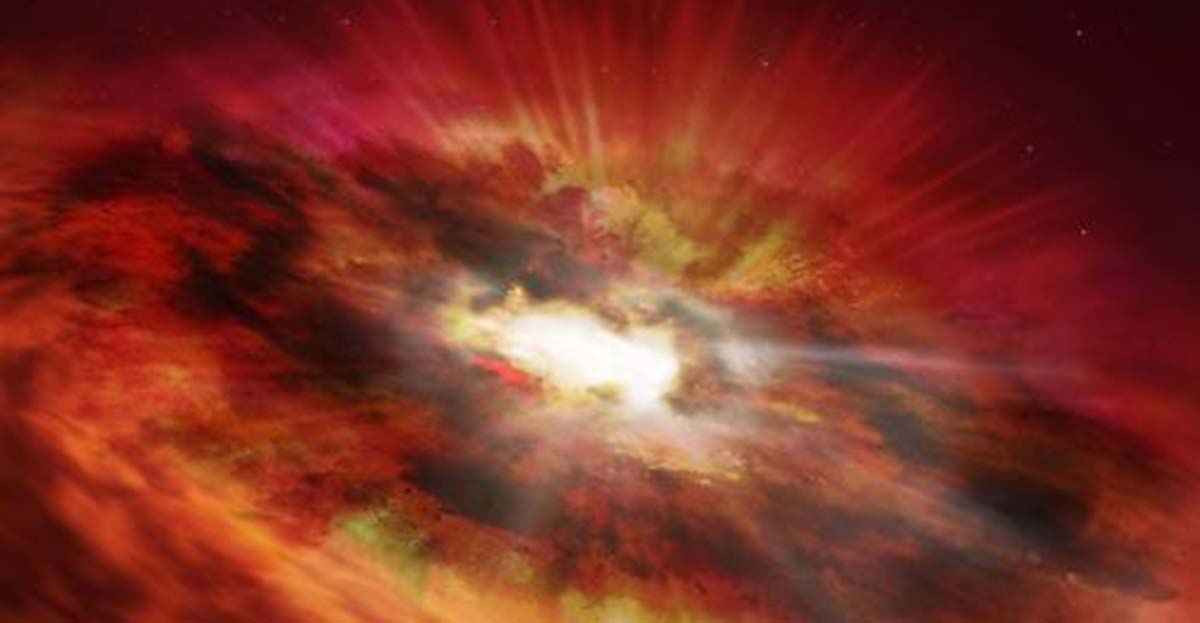
The huge object discovered is called GNz7q and as astronomers see it now, it existed about 13 billion years ago, when the Universe was only 750 million years old. The GNz7q object itself is hidden by a thick and dense cloud of cosmic dust, and scientists do not yet know exactly what it really is. However, based on current theories about black holes and data on the true size of the object, astronomers believe that GNz7q is the “embryo” of a supermassive black hole.
One of the biggest mysteries of modern astronomy and astrophysics is the answer to the question of how the very first black hole in the universe formed? According to one theory, the first black hole formed from one of the first dead stars and quickly gained mass by absorbing all matter from the surrounding space. According to another theory, a huge and dense cluster of gas could have emerged in the Universe, which, under the influence of its own gravity, compacted, compacted and eventually collapsed into a black hole, bypassing any intermediate stages.
“But even the discovery of the GNz7q object does not yet allow us to answer which of the two scenarios outlined above is proceeding,” the researchers write, “However, we are fully confident that the discovered object is the first example of a black hole, rapidly gaining mass, that existed at the earliest period of the evolution of the universe.”
As mentioned above, the object GNz7q is located in the bowels of a galaxy in which new stars are actively forming. This galaxy “produces” stars in the amount of 1600 solar masses per year. The object GNz7q itself has a mass 20 billion times that of the Sun, while the hidden black hole has a mass of 10 million solar masses. The light from the object GNz7q is colored red by the surrounding dust, and it glows particularly brightly in the infrared range.
Scientists believe that the black hole inside the object GNz7q is the missing link in the evolution from small black holes in “dusty” galaxies to the huge bright quasars observed in large numbers in the current Universe. And now scientists hope to study this object as thoroughly as possible, using all the capabilities of the new James Webb Space Telescope, which just works in the right infrared range.