Last year, a group from the Massachusetts Institute of Technology created a system capable of stopping a robot if it makes a mistake while doing something. And now this system has received a kind of addition that allows a human to point out the robot’s error and explain the correct sequence of actions with the help of “the power of his thoughts” and gestures.
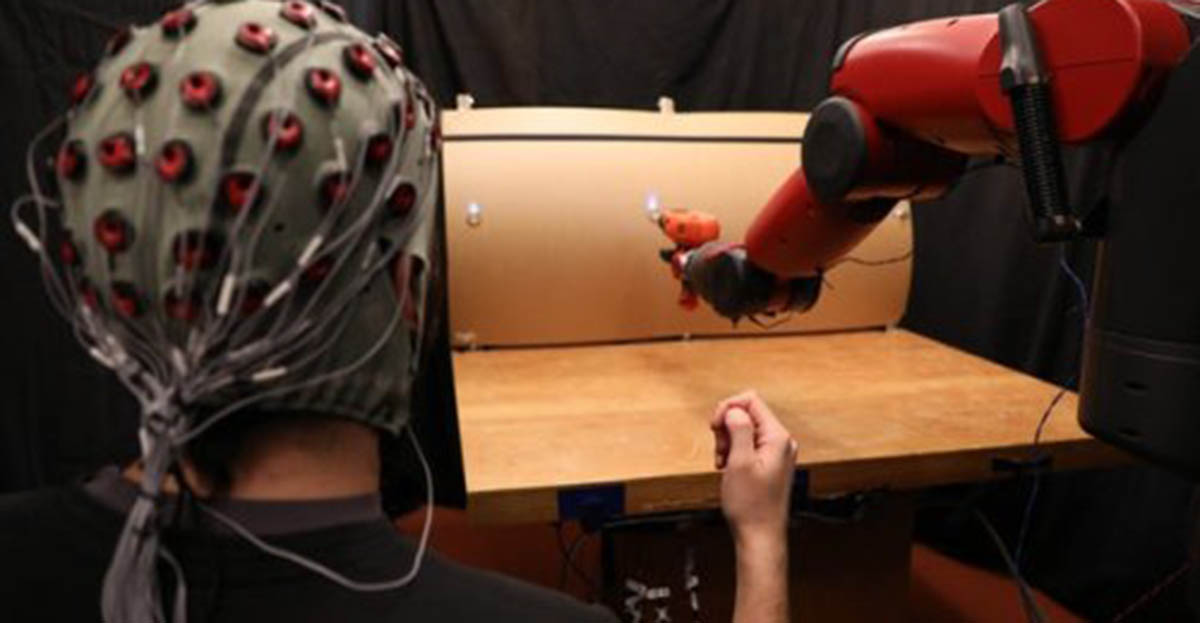
A “cap” with electroencephalographic electrodes is used to monitor human-operator brain activity. And the human operator observes the actions of the Baxter robot, which performs rather simple work. If a human notices a mistake made by the robot, his brain generates a corresponding signal, which is decoded by the computer, after which the robot’s actions are suspended.
The main difference of this approach from other attempts to implement similar systems is that a human does not need to think about something specific and “organize” his thoughts to control the robot. The system is designed in such a way that it detects the reflexive reactions of the human brain, so the system does not need to be tuned to each individual operator.
The new system also detects electrical activity in the human muscles via a special electromyographic sensor attached to the human arm. The data from this sensor allows the system to distinguish gestures and movements made by the human hand.
During the tests, which involved seven volunteer participants, the Baxter robot was required to drill several holes in places illuminated for a short time by LEDs. An artificial error was introduced into the robot’s program, and in some cases, instead of starting to drill in a set location, the robot moved the drill to a random location. At that moment, the human brain began to produce an “error signal,” which stopped the robot’s actions. Then, by pointing with his hand, the human helped the robot move its arm to the right place.
The experimental system now has a limited number of gestures it can perceive, but this database could easily be expanded, allowing humans to instruct robots to do much more complex work. “We want to get rid of the limitations imposed on humans by the capabilities of the machines they use,” the researchers write, “and, as we have demonstrated, we can already create automated systems that are a kind of ‘natural and intuitive complement’ to humans.”